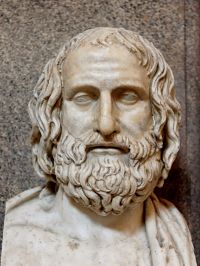
Euripides

Euripides

Electra (1913)

Summary

Portrait of Euripides Euripides Electra (1913)

In thine adversity, there is not one
Will call thee friend. Nay, that were treasure-trove,
A friend to share, not faltering from love,
Fair days and foul the same. Thy name is gone
Forth to all Argos, as a thing o'erthrown
And dead. Thou hast not left one spark to glow
With hope in one friend's heart! Hear all, and know:
Thou hast God's fortune and thine own right hand,
Naught else, to conquer back thy fatherland.
Orestes.
The deed, the deed! What must we do?
Old Man.
⁠Strike down
Aegisthus . . . and thy mother.
Orestes.
⁠'Tis the crown
My race is run for.
Source: Wikisource

Portrait of Euripides Euripides Electra (1913)

There appears in the air a vision of Castor and Polydeuces. The mortals kneel or veil their faces.
Castor.
Thou Agamemnon's Son, give ear! 'Tis we,
Castor and Polydeuces, call to thee,
God's Horsemen and thy mother's brethren twain.
An Argive ship, spent with the toiling main,
We bore but now to peace, and, here withal
Being come, have seen thy mother's bloody fall,
Our sister's. Righteous is her doom this day,
But not thy deed. And Phoebus, Phoebus . . . Nay;
He is my lord; therefore I hold my peace.
Source: Wikisource

Portrait of Euripides Euripides Electra (1913)

Our mother's mighty master leaps thereon,
Spurning the slab, or pelteth stone on stone,
Flouting the lone dead and the twain that live:
"Where is thy son Orestes? Doth he give
Thy tomb good tendance? Or is all forgot?"
So is he scorned because he cometh not. . . .
⁠O Stranger, on my knees, I charge thee, tell
This tale, not mine, but of dumb wrongs that swell
Crowding—and I the trumpet of their pain,
This tongue, these arms, this bitter burning brain;
These dead shorn locks, and he for whom they died!
His father slew Troy's thousands in their pride:
He hath but one to kill. . . .
Source: Wikisource

Get perspective with Kwize: daily news enlightened by great literature