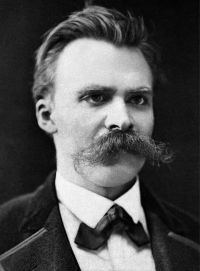
Friedrich Wilhelm Nietzsche

Friedrich Wilhelm Nietzsche

Summary

Portrait of Friedrich Wilhelm Nietzsche Friedrich Wilhelm Nietzsche The Joyful Wisdom ("La Gaya Scienza"…

Life has not deceived me! On the contrary, from year to year I find it richer, more desirable and more mysterious—from the day on which the great liberator broke my fetters, the thought that life may be an experiment of the thinker—and not a duty, not a fatality, not a deceit!—And knowledge itself may be for others something different; for example, a bed of ease, or the path to a bed of ease, or an entertainment, or a course of idling,—for me it is a world of dangers and victories, in which even the heroic sentiments have their arena and dancing-floor.
Source: Gutenberg

Portrait of Friedrich Wilhelm Nietzsche Friedrich Wilhelm Nietzsche The Joyful Wisdom ("La Gaya Scienza"…

It is to him that Shakespeare consecrated his best tragedy—it is at present still called by a wrong name,—to him and to the most terrible essence of lofty morality. Independence of soul!—that is the question at issue! No sacrifice can be too great there: one must be able to sacrifice to it even one's dearest friend, though he be also the grandest of men, the ornament of the world, the genius without peer,—if one really loves freedom as the freedom of great souls, and if this freedom be threatened by him:—it is thus that Shakespeare must have felt!
Source: Gutenberg

Portrait of Friedrich Wilhelm Nietzsche Friedrich Wilhelm Nietzsche The Joyful Wisdom ("La Gaya Scienza"…

No one equals him in the colours of the late autumn, in the indescribably touching happiness of a last, a final, and all too short enjoyment; he knows a chord for those secret and weird midnights of the soul when cause and effect seem out of joint, and when every instant something may originate "out of nothing." He draws his resources best of all out of the lower depths of human happiness, and so to speak, out of its drained goblet, where the bitterest and most nauseous drops have ultimately, for good or for ill, commingled with the sweetest.
Source: Gutenberg

Get perspective with Kwize: daily news enlightened by great literature