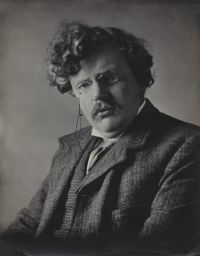
Gilbert Keith Chesterton

Gilbert Keith Chesterton

Summary

Portrait of Gilbert Keith Chesterton Gilbert Keith Chesterton George Bernard Shaw — The Philosopher (1910)

To every man and woman, bird, beast, and flower, life is a love-call to be eagerly followed. To Bernard Shaw it is merely a military bugle to be obeyed. In short, he fails to feel that the command of Nature (if one must use the anthropomorphic fable of Nature instead of the philosophic term God) can be enjoyed as well as obeyed. He paints life at its darkest and then tells the babe unborn to take the leap in the dark. That is heroic; and to my instinct at least Schopenhauer looks like a pigmy beside his pupil. But it is the heroism of a morbid and almost asphyxiated age.
Source: Wikisource

Portrait of Gilbert Keith Chesterton Gilbert Keith Chesterton George Bernard Shaw — The Philosopher (1910)

But lovers lust after constancy more than after happiness; if you are in any sense prepared to give them what they ask, then what they ask, beyond all question, is an oath of final fidelity. Lovers may be lunatics; lovers may be children; lovers may be unfit for citizenship and outside human argument; you can take up that position if you will. But lovers do not only desire love; they desire marriage. The root of legal monogamy does not lie (as Shaw and his friends are for ever drearily asserting) in the fact that the man is a mere tyrant and the woman a mere slave.
Source: Wikisource

Portrait of Gilbert Keith Chesterton Gilbert Keith Chesterton George Bernard Shaw — The Philosopher (1910)

Man should have the blind faith of a beast: he should be as mystically immutable as a cow, and as deaf to sophistries as a fish. Shaw does not wish him to be a philosopher or an artist; he does not even wish him to be a man, so much as he wishes him to be, in this holy sense, an animal. He must follow the flag of life as fiercely from conviction as all other creatures follow it from instinct.
But this Shavian worship of life is by no means lively. It has nothing in common either with the braver or the baser forms of what we commonly call optimism.
Source: Wikisource

Get perspective with Kwize: daily news enlightened by great literature