Summary

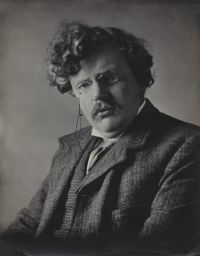
Portrait of Gilbert Keith Chesterton Gilbert Keith Chesterton Orthodoxy — Chapter III: The Suicide of Thought (1909)

The worship of will is the negation of will. To admire mere choice is to refuse to choose. If Mr. Bernard Shaw comes up to me and says, "Will something," that is tantamount to saying, "I do not mind what you will," and that is tantamount to saying, "I have no will in the matter." You cannot admire will in general, because the essence of will is that it is particular. A brilliant anarchist like Mr. John Davidson feels an irritation against ordinary morality, and therefore he invokes will—will to anything. He only wants humanity to want something. But humanity does want something.
Source: Wikisource

Portrait of Gilbert Keith Chesterton Gilbert Keith Chesterton Orthodoxy — Chapter III: The Suicide of Thought (1909)

Anarchism adjures us to be bold creative artists, and care for no laws or limits. But it is impossible to be an artist and not care for laws and limits. Art is limitation; the essence of every picture is the frame. If you draw a giraffe, you must draw him with a long neck. If, in your bold creative way, you hold yourself free to draw a giraffe with a short neck, you will really find that you are not free to draw a giraffe. The moment you step into the world of facts, you step into a world of limits.
Source: Wikisource

Portrait of Gilbert Keith Chesterton Gilbert Keith Chesterton Orthodoxy — Chapter III: The Suicide of Thought (1909)

It is vain for eloquent atheists to talk of the great truths that will be revealed if once we see free thought begin. We have seen it end. It has no more questions to ask; it has questioned itself. You cannot call up any wilder vision than a city in which men ask themselves if they have any selves. You cannot fancy a more sceptical world than that in which men doubt if there is a world.
Source: Wikisource

Get perspective with Kwize: daily news enlightened by great literature