Summary

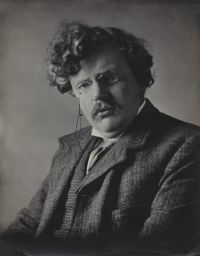
Portrait of Gilbert Keith Chesterton Gilbert Keith Chesterton The Crimes of England — Chapter VI. Hamlet and the Danes (1916)

The German begins to have an eerie abstract sympathy with the force and fear he describes, as distinct from their objective. The German is no longer sympathising with the boy against the goblin, but rather with the goblin against the boy. There goes with it, as always goes with idolatry, a dehumanised seriousness; the men of the forest are already building upon a mountain the empty throne of the Superman. Now it is just at this point that I for one, and most men who love truth as well as tales, begin to lose interest.
Source: Wikisource

Portrait of Gilbert Keith Chesterton Gilbert Keith Chesterton The Crimes of England — Chapter VI. Hamlet and the Danes (1916)

The nations of the earth were not to surrender to the Kaiser; they were to surrender to Krupp, his master and theirs; the French, the British, the Russians were to surrender to Krupp as the Germans themselves, after a few swiftly broken strikes, had already surrendered to Krupp. Through every cogwheel in that incomparable machinery, through every link in that iron and unending chain, ran the mastery and the skill of a certain kind of artist; an artist whose hands are never idle through dreaming or drawn back in disgust or lifted in wonder or in wrath
Source: Wikisource

Portrait of Gilbert Keith Chesterton Gilbert Keith Chesterton The Crimes of England — Chapter VI. Hamlet and the Danes (1916)

We see this in that very typical process, the Germanising of Shakespeare. I do not complain of the Germans forgetting that Shakespeare was an Englishman. I complain of their forgetting that Shakespeare was a man; that he had moods, that he made mistakes, and, above all, that he knew his art was an art and not an attribute of deity. That is what is the matter with the Germans; they cannot "ring fancy's knell"; their knells have no gaiety. The phrase of Hamlet about "holding the mirror up to nature" is always quoted by such earnest critics as meaning that art is nothing if not realistic.
Source: Wikisource

Get perspective with Kwize: daily news enlightened by great literature