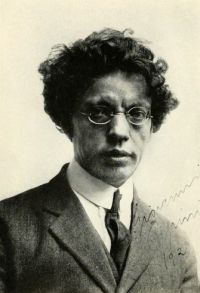
Giovanni Papini

Giovanni Papini

Summary

Portrait of Giovanni Papini Giovanni Papini Four and Twenty Minds (1922)

For I believe that it is not enough, even in the field of philosophy, to know a theory. One must live it and feel it with all one's soul, must fill one's thought with it, must make it, for the time being, the content, the coloring and the significance of one's whole life. Berkeley's principle lends itself excellently well to this integral possession of truth. When a man truly discovers the great principle—and that may be long after he has known it at second hand—he is seized by a sort of idealistic intoxication which transforms the whole world for him.
Source: Wikisource

Portrait of Giovanni Papini Giovanni Papini Four and Twenty Minds (1922)

As he looks upon the world, Walt Whitman is an optimist. An optimist, did I say? No, that is a cold and technical word, and will not serve for him. Say rather a passionate lover, a worshipper of the all—not so blind as to be unaware of the ugly and the evil, but so great as to extend his love to the ugly and the evil.
He is by instinct and by program the champion of all things:
And henceforth I will go celebrate any thing I see or am,
And sing and laugh and deny nothing. [27]
To his magnificent soul all is magnificent:
Illustrious every one!
Source: Wikisource

Portrait of Giovanni Papini Giovanni Papini Four and Twenty Minds (1922)

Spencer, like all philosophers, is fundamentally a monist, both in his goal and in his methods. Philosophy, indeed, despite its apparent variety, is conservative, constant, pertinacious. Philosophy is like a romantic old lady who to the day of her death cherishes the dream of her girlhood: the dream of reducing all things to one single thing, of denying all differences and all distinctions—that is, frankly, of annihilating things. The philosopher desires to see the world issue and unfold, like a gigantic plant, from one single seed
Source: Wikisource

Get perspective with Kwize: daily news enlightened by great literature