Summary

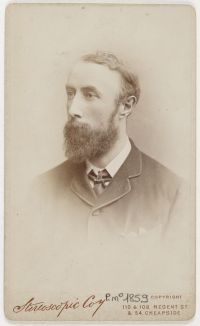
Portrait of H. B. Guppy H. B. Guppy Observations of a Naturalist in the Pacific Between 1896 and 1899…

In Fiji I trod upon the surface of submarine volcanoes that emerged ages since from the ocean and still retain their coverings of sea-deposits. Both in Hawaii and Fiji I lived much among the people; and though my chief interest lay in the comparison of these two types of volcanic islands, I could not but be drawn to the kindly natives whose hospitality I so long enjoyed.
Destiny led me to Vanua Levu in the following fashion. With the relief party to take me down from Mauna Loa there arrived a well-known German naturalist who, like myself, had been interested in coral-reef investigations.
Source: Gutenberg

Portrait of H. B. Guppy H. B. Guppy Observations of a Naturalist in the Pacific Between 1896 and 1899…

But when in such an island we regard the intermediate region between the uplands and the coast, usually the forest-zone, we find an area of change not only for the plants but also for the birds. It is here that the new genera of plants have been developed that distinguish the floras of the Pacific groups each from the others; and here also the migrant bird, having from some cause changed its ways, has given rise to new varieties and to new species.
Source: Gutenberg

Portrait of H. B. Guppy H. B. Guppy Observations of a Naturalist in the Pacific Between 1896 and 1899…

Although when we arrange the rocks in a series according to their specific weight we find no corresponding relation in the amounts of the polarity, we observe that the extent to which polarity can be developed is markedly greater in basic than in acid rocks. From this it may be inferred that the degree of intensity of the exciting cause required to give polaric powers of a certain value to an acid rock, like a dacite, would be much greater than that necessary to endow a basalt with equal powers.
Source: Gutenberg

Get perspective with Kwize: daily news enlightened by great literature