Palagonite

Definition and stakes

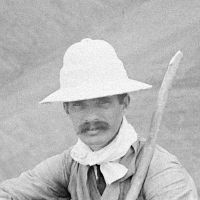
Portrait of H. B. Guppy H. B. Guppy,  Observations of a Naturalist in the Pacific Between 1896 and 1899…

“ This is a region of palagonite-tuffs which like those of the Nganga-turuturu cliffs are mainly derived from vitreous and semi-vitreous aphanitic augite-andesites. They do not effervesce with an acid, and neither foraminiferous tests nor other organic remains occur. The palagonitic material is usually vacuolar, the vacuoles being filled with palagonitic glass or with a zeolite as in the more altered rocks. Where bedding is shown, the beds are generally horizontal. ”

Source: Gutenberg

Portrait of H. B. Guppy H. B. Guppy,  Observations of a Naturalist in the Pacific Between 1896 and 1899…

“ Here and in the lower few hundred feet of the spur are exposed basic agglomerates, and occasionally in the mass a semi-vitreous vesicular olivine-basalt, almost like a pitchstone, and displaying large porphyritic crystals of plagioclase, 5 or 6 millimetres long, the agglomerates being made up of the same material. Higher up, at elevations between 1,000 and 1,500 feet, are exposed coarse palagonite-tuffs made up of fragments, usually 1 to 3 mm. in size, of extensively palagonitised basic vitreous rocks, such as occur in the cliffs above. ”
Source: Gutenberg

Portrait of H. B. Guppy H. B. Guppy,  Observations of a Naturalist in the Pacific Between 1896 and 1899…

“ The tuffs and agglomerates that once existed here have been stripped off to a great extent and the deeper rocks of the range are in part exposed. The upper part of this ridge (1,700 to 2,000 feet) is formed of a rubbly pitchstone where a basic glass has been broken up and then consolidated, the interstices being filled up with palagonite as described in other cases on page 313. Though non-vesicular, it is just such a rock as one would expect to find on the surface of a lava-flow or on the sides of a dyke. ”
Source: Gutenberg

Get perspective with Kwize: daily news enlightened by great literature