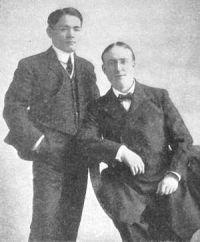
H. Irving Hancock

H. Irving Hancock

Summary

Portrait of H. Irving Hancock H. Irving Hancock Japanese Physical Training (1903)

The possession of acquired agility teaches the student another valuable trick of attack. This is for him to crouch as if intending an attack at the knees, and then, as his opponent bends to meet him, to rise suddenly and make the attack upon the upper body of his descending enemy. Just as there are no "fouls" in the Japanese method of combat, so all the highest development of the art of jiu-jitsu is based upon the employment of the utmost degree of deception.
Source: Wikisource

Portrait of H. Irving Hancock H. Irving Hancock Japanese Physical Training (1903)

One bright fellow discovered that by pressing thumb or fingers against certain muscles or nerves momentary paralysis could be produced. He also discovered that by employing the hardened edge of his hand to strike a piece of bamboo at a certain angle of impact he could break the stick. If he could paralyse his own nerves and muscles, why not another's? If he could break a stick by a sharp blow with the edge of his hand, why could he not train himself in the same way to break the arm of a dangerous antagonist? And that was the beginning of the creation of the science of jiu-jitsu.
Source: Wikisource

Portrait of H. Irving Hancock H. Irving Hancock Japanese Physical Training (1903)

When all the work described in the foregoing has been gone through with to such an extent that the student is found to be really agile, he is made to practise dodging with an opponent. The master of jiu-jitsu is as slippery as the proverbial eel. It will be found impossible for an uninitiated opponent to seize him. Just as the uninitiated one fancies he has his man within grasp he finds that he has n't, but that the Japanese has him in a grip that seems astounding, and a grip that is certainly excruciatingly painful, and bound to result in defeat.
Source: Wikisource

Get perspective with Kwize: daily news enlightened by great literature