Summary

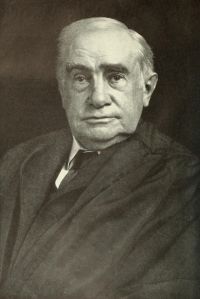
Portrait of Henry Billings Brown Henry Billings Brown Carnegie Steel Company v. Cambria Iron Company…

The mere form of expression cannot create a distinction where none exists, or destroy a law of nature. As by me it cannot be conceived that various charges of molten metal can be stored in a common reservoir without resulting mixing, it follows necessarily, by the law of diffusion of fluids, the mixing is the secondary result arising from and created by the primary act of storage. It is impossible that the secondary force can be caused to become the first and creating power by a mere collocation of words.
Source: Wikisource

Portrait of Henry Billings Brown Henry Billings Brown Carnegie Steel Company v. Cambria Iron Company…

While it is clear that a method which had for its purpose merely the prevention of abrupt variations would not necessarily include one for the obtaining of a uniform product, how a method of reservoiring molten metal as such metal is produced in the furnace and drawing it off from the reservoir for use, which produced uniformity of product as the result of the reservoiring, can be said not to have embraced the prevention of abrupt variations, is to my mind absolutely unthinkable, since the greater must necessarily include the lesser.
Source: Wikisource

Portrait of Henry Billings Brown Henry Billings Brown Carnegie Steel Company v. Cambria Iron Company…

The elementary import of the right to reservoir, as applied, not only to molten metal, but other fluids, is the storing of the fluid for use as required, and this implies the drawing off as desired, the replenishing at will, and the keeping of such residuum or reserve supply as may be deemed best. It may not be doubted that to say that one who stores fluid for use is obliged, whenever he draws any off, to draw all off before replenishing, is to say that such party has not the right to reservoir.
Source: Wikisource

Get perspective with Kwize: daily news enlightened by great literature