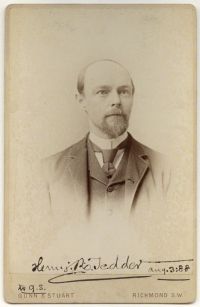
Henry Richard Tedder

Henry Richard Tedder

Summary

Portrait of Henry Richard Tedder Henry Richard Tedder 1911 Encyclopædia Britannica (1911)

Early in the 19th century the rise of the quarterly reviews threw open a new channel of publicity to those who had previously used pamphlets to spread their opinions, and later on the rapid growth of monthly magazines and weekly reviews afforded controversialists a much more certain and extensive circulation than they could ensure by an isolated publication. Although pamphlets are no longer the sole or most important factor of public opinion, the minor literature of great events is never likely to be entirely confined to periodicals.
Source: Wikisource

Portrait of Henry Richard Tedder Henry Richard Tedder 1911 Encyclopædia Britannica (1911)

Literary criticism was no more free than political discussion, and no person was allowed to trespass either upon the domain of the Journal des savants or that of the Mercure de France (see Newspapers) without the payment of heavy subsidies. This was the origin of the clandestine press of Holland, and it was that country which for the next hundred years supplied the ablest periodical criticism from the pens of French Protestant refugees.
Source: Wikisource

Portrait of Henry Richard Tedder Henry Richard Tedder 1911 Encyclopædia Britannica (1911)

It was in France that the printing-press first began to supply reading for the common people. During the last twenty years of the 15th century there arose an extensive popular literature of farces, tales in verse and prose, satires, almanacs, &c., extending to a few leaves apiece, and circulated by the itinerant booksellers still known as colporteurs. These folk-books soon spread from France to Italy and Spain, and were introduced into England at the beginning of the 16th century, doubtless from the same quarter, as most of our early chap-books are translations or adaptations from the French.
Source: Wikisource

Get perspective with Kwize: daily news enlightened by great literature