“ And whatever arts one examines, it will be found that the natural position of the arms is not the same in each, but that in every case the arms are put into the attitude which suits best with the instrument that is used, and the work to be performed. In practicing archery, no doubt this is the best attitude of the left arm, for gingly-moid extremity of the humerus being fixed in the cavity of the ulna, in this position, throws the bones of the forearm and arm into a line, as if they constituted a single bone, and all flexion at the joint is prevented in this position. ”
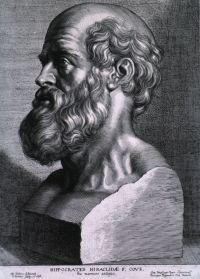
Hippocrates
Summary
Hippocrates’ On Fractures, an ancient Greek medical treatise, systematically addresses the identification and management of bone injuries, emphasizing practical methods for realigning and stabilizing broken bones. Concentrating on limbs such as the thigh, elbow, and forearm, the text outlines the application of extension, supports, and wraps to handle fractures and dislocations, underscoring anatomical distinctions between joints and the need for individualized care.
Through meticulous observations and clear guidance, Hippocrates highlights the value of mechanical tools and proper patient placement, illustrating early medical precision. This work continues to serve as a foundational text in orthopedic practice, connecting empirical evidence with organized treatment approaches.
Quotes from On Fractures (Hippocrates)
“ But the leg, both in walking and standing, is habitually extended, either completely or nearly so, and is usually in a depending position from its construction, and in order that it may bear the weight of the rest of the body. Wherefore it readily bears to be extended when necessary, and even when in bed the limb is often in this position. And when wounded, necessity subdues the understanding, since the patients become incapable of raising themselves up, so that they neither think of bending the limb nor of getting up erect, but remain lying in the same position. ”
“ For these reasons, neither the same position nor the same mode of bandaging applies to the arm and to the leg. If, then, extension by means of men be sufficient, we should not have recourse to any useless contrivances, for it any useless contrivances, for it is absurd to employ mechanical means when not required; but if extension by men be not sufficient, you may use any of the mechanical powers which is suitable. When sufficiently extended, it will be easy to adjust the bones and bring them into their natural position, by straightening and arranging them with the palms of the hand. ”
