Summary

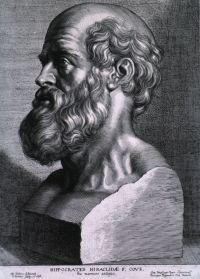
Portrait of Hippocrates Hippocrates,  Instruments of Reduction

“ Those who attempt to reduce and rectify dislocations in oxen, commit a blunder, as forgetting that the symptoms arise from the manner in which the ox uses the limb, and that the appearance is the same in a man who is in a similar condition, and forgetting also that Homer has said, that oxen are most lean at that season. In this dislocation, then, when not reduced, the patient cannot perform any of those acts which others do, by raising the arm from the side. ”
Source: Wikisource

Portrait of Hippocrates Hippocrates,  Instruments of Reduction

“ Part XXIII The symptoms of dislocation backward are:-The parts before more empty, behind they protrude, the foot straight, flexion impossible, except with pain, extension least of all: in these the limb is shortened. They can neither extend the limb at the ham, nor at the groin, unless it be much raised, nor can they bend it. The uppermost joint, in most cases, takes the lead: this is common in joints, nerves, muscles, intestines, uteri, and other parts. ”
Source: Wikisource

Portrait of Hippocrates Hippocrates,  Instruments of Reduction

“ Part XXXV Sphacelus of the fleshy parts is produced by the tight compression of bleeding wounds, and by pressure in the fractures of bones, and by blackening, arising from bandages. And in those cases in which a portion of the thigh or arm, both the bones and the flesh drop off, many recover, the case being less dangerous than many others. In cases, then, connected with fracture of the bones, the separation of the flesh quickly takes place, but the separation of the bone, at the boundary of its denuded part, is slower in taking place. ”
Source: Wikisource

Get perspective with Kwize: daily news enlightened by great literature