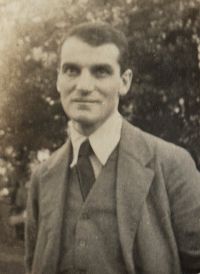
John Middleton Murry

John Middleton Murry

Summary

Portrait of John Middleton Murry John Middleton Murry Aspects of Literature

Year by year the universe grows vaster, and man, by virtue of the growing brightness of his little lamp, sees himself more and more as a child born in the midst of a dark forest, and finds himself less able to claim the obeisance of the all. Yet if he would be a poet, and not a harper of threadbare tunes, he must at each step in the downward passing from his sovereignty, recognise what is and celebrate it as what must be. Thus he regains, by another path, the supremacy which he has forsaken.
Edward Thomas's poetry has the virtue of this recognition.
Source: Gutenberg

Portrait of John Middleton Murry John Middleton Murry Aspects of Literature

Great poetry stands in this, that it expresses man's allegiance to his destiny. In every age the great poet triumphs in all that he knows of necessity; thus he is the world made vocal. Other generations of men may know more, but their increased knowledge will not diminish from the magnificence of the music which he has made for the spheres. The known truth alters from age to age; but the thrill of the recognition of the truth stands fast for all our human eternity.
Source: Gutenberg

Portrait of John Middleton Murry John Middleton Murry Aspects of Literature

It is, at all events, a folly to which poets incline. But poets are not wise; indeed, the poetry of true wisdom is a creation which can, at the best, be but dimly imagined. Perhaps, of them all, Lucretius had the largest inkling of what such poetry might be; but he disqualified himself by an aptitude for ecstasy, which made his poetry superb and his wisdom of no account. To acquiesce is wise; to be ecstatic in acquiescence is not to have acquiesced at all. It is to have identified oneself with an imagined power against whose manifestations, in those moments when no ecstasy remains, one rebels.
Source: Gutenberg

Get perspective with Kwize: daily news enlightened by great literature