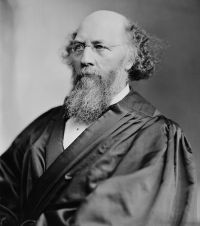
Stephen Johnson Field

Stephen Johnson Field

Summary

Portrait of Stephen Johnson Field Stephen Johnson Field Slaughter-House Cases — Dissenting Opinion (1873 | noyear)

If it be said that the civil law and not the common law is the basis of the jurisprudence of Louisiana, I answer that the decree of Louis XVI, in 1776, abolished all monopolies of trades and all special privileges of corporations, guilds, and trading companies, and authorized every person to exercise, without restraint, his art, trade, or profession, and such has been the law of France and of her colonies ever since, and that law prevailed in Louisiana at the time of her cession to the United States.
Source: Wikisource

Portrait of Stephen Johnson Field Stephen Johnson Field Slaughter-House Cases — Dissenting Opinion (1873 | noyear)

The compulsion which would force him to labor even for his own benefit only in one direction, or in one place, would be almost as oppressive and nearly as great an invasion of his liberty as the compulsion which would force him to labor for the benefit or pleasure of another, and would equally constitute an element of servitude.
Source: Wikisource

Portrait of Stephen Johnson Field Stephen Johnson Field Slaughter-House Cases — Dissenting Opinion (1873 | noyear)

The State may prescribe such regulations for every pursuit and calling of life as will promote the public health, secure the good order and advance the general prosperity of society, but when once prescribed, the pursuit or calling must be free to be followed by every citizen who is within the conditions designated, and will conform to the regulations. This is the fundamental idea upon which our institutions rest, and unless adhered to in the legislation of the country our government will be a republic only in name.
Source: Wikisource

Get perspective with Kwize: daily news enlightened by great literature