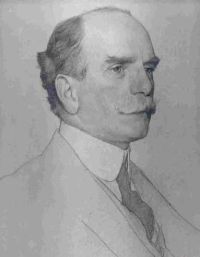
William Barclay Squire

William Barclay Squire

Summary

Portrait of William Barclay Squire William Barclay Squire A Dictionary of Music and Musicians (1900)

Again they change places, and upon each dancer returning to the spot where they began to dance, the third part goes on in the same way as the second, and on arriving at the ninth bar, the voice, the instrument, and the castanets cease all at once, and as if impromptu, the room remaining in silence, and the dancers standing immovable in various beautiful attitudes, which is what we call "well stopped" (Bien parado) .' Space will not allow us to give an example of the music which accompanies this beautiful dance.
Source: Wikisource

Portrait of William Barclay Squire William Barclay Squire A Dictionary of Music and Musicians (1900)

In England the Saraband was soon transformed into an ordinary country-dance. The first edition of Playford's 'Dancing Master' (1651) has two examples, one, to be danced 'long wayes for as many as will' (i.e. as 'Sir Roger de Coverley' is now danced) , and the other, 'Adson's Saraband,' to be danced 'longwayes for six.' It was at about this time that the Saraband, together with other dances, found its way into the Suite, of which it formed the slow movement, placed before the concluding Gigue.
Source: Wikisource

Portrait of William Barclay Squire William Barclay Squire A Dictionary of Music and Musicians (1900)

After staying some time in Leipzig, Dresden, and Berlin, Herr Bronsart and his wife settled in Hanover, where he is Intendant of the theatre. Here she devoted herself entirely to composition. An opera by her, 'Die Göttin von Sais,' had been unsuccessful in Berlin, but her next dramatic work, a setting of Goethe's 'Jery und Bätely,' was played with great success in Weimar, Cassel, and many other places. In 1870 she wrote a 'Kaiser Wilhelm March,' which was played at Berlin at a state performance to celebrate the return of the troops.
Source: Wikisource

Get perspective with Kwize: daily news enlightened by great literature