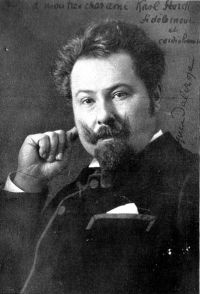
Émile Jaques-Dalcroze

Émile Jaques-Dalcroze

Summary

Portrait of Émile Jaques-Dalcroze Émile Jaques-Dalcroze The Eurhythmics of Jaques-Dalcroze

Perhaps the music will begin by being solemn and grand, becoming even tragic, and gradually the tones and melody will rise to cheerfulness, the rhythm will become more animated and the tone swell out again until a perfect ecstasy of joy is reached—and all the while the figures of the pupils are harmonising absolutely with the music, trained as they are to listen accurately to every note, every accent, every change of key and, above all, every rhythm.
Source: Gutenberg

Portrait of Émile Jaques-Dalcroze Émile Jaques-Dalcroze The Eurhythmics of Jaques-Dalcroze

But, as an artist, I wish to add, that the second result of this education ought to be to put the completely developed faculties of the individual at the service of art and to give the latter the most subtle and complete of interpreters—the human body. For the body can become a marvellous instrument of beauty and harmony when it vibrates in tune with artistic imagination and collaborates with creative thought.
Source: Gutenberg

Portrait of Émile Jaques-Dalcroze Émile Jaques-Dalcroze The Eurhythmics of Jaques-Dalcroze

The solo players of older days were without exception complete musicians, able to improvise and compose, artists driven irresistibly towards art by a noble thirst for aesthetic expression, whereas most young people who devote themselves nowadays to solo playing have the gifts neither of hearing nor of expression, are content to imitate the composer's expression without the power of feeling it, and have no other sensibility than that of the fingers, no other motor faculty than an automatism painfully acquired.
Source: Gutenberg

Get perspective with Kwize: daily news enlightened by great literature