Bantu peoples

Definition and stakes

Henry Hamilton Johnston,  1911 Encyclopædia Britannica (1910)

“ The legends and traditions of the Bantu peoples themselves invariably point to a northern origin, and a period, not wholly removed from their racial remembrance, when they were strangers in their present lands. Seemingly the Bantu, somewhat early in their migration down the east coast, took to the sea, and not merely occupied the islands of Pemba and Zanzibar, but travelled as far afield as the Comoro archipelago and even the west coast of Madagascar. ”
Source: Wikisource

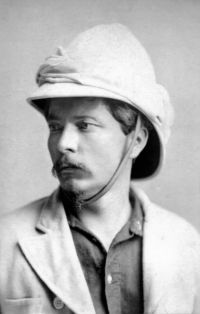
Portrait of H. Rider Haggard H. Rider Haggard,  The Ghost Kings

“ In fact, taken altogether, it is quite a question whether the higher sections of the Bantu peoples are not our equals. Of course, we have learned more things, and our best men are their betters. But, on the other hand, among them there is nothing so low as the inhabitants of our slums, nor have they any vices which can surpass our vices. Is an assegai so much more savage than a shell? Is there any great gulf fixed between a Chaka and a Napoleon? At least they are not hypocrites, and they are not vulgar; that is the privilege of civilised nations.
Well, with these folk Rachel was intimate.
”
Source: Gutenberg

Portrait of Daniel G. Brinton Daniel G. Brinton,  Races and Peoples: Lectures on the Science of Ethnography

“ Agriculture is practised on a limited scale. Their temperament is turbulent and warlike, and many of them are cannibals. Their social organization is military, but slavery is unusual. Singular to say, they do not know the bow and arrow, their weapons being the war-club and a lance called an assegai. Their religion is a fetichism, and polygamy is universal. On the whole, they are on a higher level of culture than the Negroes of the Sudan. All the Bantu tribes are mono-glottic, that is, they speak dialects traceable to one original stem. ”
Source: Gutenberg

Get perspective with Kwize: daily news enlightened by great literature