“ The Colours of Bubbles with which Children play are various, and change their Situation variously, without any respect to any Confine or Shadow. If such a Bubble be cover'd with a concave Glass, to keep it from being agitated by any Wind or Motion of the Air, the Colours will slowly and regularly change their situation, even whilst the Eye and the Bubble, and all Bodies which emit any Light, or cast any Shadow, remain unmoved. ”
Bubbles
Definition and stakes
The theme of “Bubbles” has been addressed by authors such as C. V. Boys, Various, D'Arcy Wentworth Thompson, C. Stansfeld Hicks and Worthington Hooker. It is often associated with terms like bubble, water, soap, air and surface.
Quotes about “Bubbles”
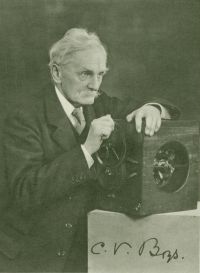 C. V. Boys,
Soap-Bubbles and the Forces Which Mould Them
C. V. Boys,
Soap-Bubbles and the Forces Which Mould Them
“ On blowing through a pipe which is immersed in the water, a great number of bubbles are formed between the plates. If the bubbles are all large enough to reach across from one plate to the other, you will at once see that there are nowhere more than three films meeting one another, and where they meet the angles are all equal. The curvature of the bubbles makes it difficult to see at first that the angles really are all alike, but if you only look at a very short piece close to where they meet, and so avoid being bewildered by the curvature, you will see that what I have said is true. ”
C. V. Boys,
Soap-Bubbles and the Forces Which Mould Them
“ In knocking bubbles together to show that they do not touch, care must be taken to avoid letting either bubble meet any projection in the other, such as the wire ring, or a heavy drop of liquid. Either will instantly destroy the two bubbles. There is also a limit to the violence which may be used, which experience will soon indicate. ”
John Cargill Brough, The fairy tales of science (1857)
“ As the temperature increases these "beaded bubbles winking at the brim" give place to much larger bubbles, which are formed at the bottom of the vessel, and which rise a little way in the liquid, and then contract and disappear in a most mysterious manner, producing a hissing or simmering sound. But as the heating goes on, these bubbles, which consist of steam, rise higher and higher in the liquid, till at last they reach the surface and escape, producing a bubbling agitation, or the phenomena of ebullition. ”
 James Stephens,
Here are Ladies
James Stephens,
Here are Ladies
“ The movement of the water in itself exercises fascinations over a boy. There are always bubbles, based strongly in froth, sailing gallantly along.—One speculates how long a bubble will swim before it hits a rock, or is washed into nothing by an eddy, or is becalmed in a sheltered corner to ride at jaunty anchor with a navy of similar delicate tonnage. ”
 Henry M. Lyman,
Insomnia; and Other Disorders of Sleep
Henry M. Lyman,
Insomnia; and Other Disorders of Sleep
“ When the bubbles are large, and when they follow each other rapidly, a continual effervescence is maintained upon the surface of the water. But if the size of the bubbles be reduced, or if the solvent capacity of the liquid be increased, the surface will become almost, if not quite, perfectly tranquil. ”
 Fleeming Jenkin,
The Atomic Theory of Lucretius
(1868)
Fleeming Jenkin,
The Atomic Theory of Lucretius
(1868)
“ The bubbles varied in "contents through density;" in "contents through size" in emptiness, or perfect fulness, and in more or less emptiness and fulness. He explains how bubbles for the animal, vegetable, and mineral reigns, of sterile or productive qualities salt, sulphurous, mercurial bubbles, etc. etc., are formed, and gives the special combination of qualities wanted for each. Thus, one of his bubbles is empty-extraordinary- alkaline-colourable-feminiue, another full-extraordinary-acid- coloured-masculine — these two kinds of seeds differ in their way of acting. ”
Popular Science Monthly (1876)
“ Why is it so easy to blow bubbles with some liquids, and so hard to form them with others? Why does a bubble when blown at the end of an open tube gradually contract and disappear? Why, when it bursts, does it not still remain a liquid film, but is shattered to an almost imperceptible dust? ”
 Charlotte M. Yonge,
The Daisy Chain, or Aspirations
Charlotte M. Yonge,
The Daisy Chain, or Aspirations
“ The consolation of the children for the departure of Hector and Tom, was a bowl of soap-suds and some tobacco pipes, and they had collected the house to admire and assist, even Margaret’s couch being drawn close to the window. Bubbles is one of the most fascinating of sports. ”
Anonymous, Cinderella; Or, The Little Glass Slipper…
“ The sun and the air absorb or suck up the water and carry it off to their homes. Now, the bubbles are made of a little water and a little air. The water is on the end of the pipe, and Tommie blows the air into the pipe, and the bubble grows big and round. When it breaks, the air sucks up the water, which was the outside of the bubble, and the air which was inside mixes with the air in the room. ”
 Robert Hooke,
Micrographia
(1665)
Robert Hooke,
Micrographia
(1665)
“ The drop it self, before it be broken, appears very transparent, and towards the middle of it, to be very full of small Bubbles, of some kind of aerial substance, which by the refraction of the outward surface appear much bigger then really they are, and this may be in good part removed, by putting the drop under the surface of clear Water, for by that means most part of the refraction of the convex Surface of the drop is destroyed, and the bubbles will appear much smaller. ”
Various, Harper's New Monthly Magazine, Vol…
“ They go up for a little way, and then they shrink, and by the time they get to the top of the water, you can hardly distinguish them. These are bubbles of steam, and they get smaller as they rise, because at first the water is colder above than below, in proportion to the distance from the flame, and the cold gradually condenses the bubbles. But when the water gets thoroughly hot, the bubbles grow larger and rise quicker, and go of the same size right up to the top of the water, and there escape—if you choose to let them. ”
C. V. Boys,
Soap-Bubbles and the Forces Which Mould Them
“ If I again fill the pipe with water, and this time draw it rapidly out of the liquid, I shall leave behind a [Pg 82] cylinder which will break up into balls, as you can easily see (Fig. 36) . I should like now to show you, as I have this apparatus in its place, that you can blow bubbles of water containing paraffin in the paraffin mixture, [Pg 83] and you will see some which have other bubbles and drops of one or other liquid inside again. One of these compound bubble drops is now resting stationary on a heavier layer of liquid, so that you can see it all the better (Fig. 37) . ”
Harold L. Goodwin, The Wailing Octopus: A Rick Brant Science-Adventure Story
“ Twin sets of bubbles rose, some distance from the boat, showing that both lungs were working well twenty fathoms down. Since the bubbles did not ascend vertically, they did not show the location of the two on the bottom. Rick studied them, working on an idea.The chicken had dropped pretty close to them. But since their floats were tied to the reef, and their bubbles were carried off a vertical path by the light currents, neither could have been used to pinpoint their whereabouts—unless whoever dropped the chicken had an excellent knowledge of the currents in this particular place! ”
“ Bubbles are white because they consist of diaphanous humor or ayre fermented, according to the axiom, perspicum primo terminatum sit album, & ayre under ice, a thicker tergant, makes a grosser & stronger white. Butt in ictericall & jandise urins the bubbles are yellow according to the tincture diffused thorough the water, wh. investeth the ayre contents of the bubbles.Even man is a bubble if wee take his consideration in his rudiments, & consider the vesicular or bulla pulsans wherin begins the rudiment of life. ”
C. V. Boys,
Soap-Bubbles and the Forces Which Mould Them
“ In pushing a bubble through a ring smaller than itself, by means of a flat film on another ring, it is important that the bubble should not be too large; but a larger bubble can be pushed through than would be expected. It is not so easy to push it up as down because of the heavy drop of liquid, which it is difficult to completely drain away. ”
Sidney Morgan, The Preparation of Plantation Rubber
“ The contributory causes are many and varied. It should be premised that, although the defect is described as “air-bubbles,” it is seldom that the appellation is strictly correct. Rarely do the bubbles contain air. In the vast majority of cases they contain gases in minute quantity. These gases may be considered to arise, broadly, from some decomposition of substances (other than rubber) , contained either in the coagulum or in the serum. In a general way, if this decomposition is evidenced by an unpleasant odour, it is described under the term of “putrefaction.” ”
Various, Chambers's Journal of Popular Literature…
“ Froth consists of bubbles, each a tiny globular portion of air, bounded on the upper surface by an exceedingly thin film of liquid; the bubbles retain this position and condition until the struggle ends as a victory for one of the belligerents. The ascensive power of the air within the bubble overcomes the cohesive power of the liquid film or covering, and 'the bubble bursts'—our beverage loses its frothy 'head.' The length of time that elapses before the air escapes by the bursting of the bubble depends chiefly on the viscidity of the liquid. ”
The Home Medical Library, Volume 1…
“ After a person has sunk to the bottom, if the water be smooth, the exact position where the body lies may be known by the air bubbles, which will occasionally rise to the surface, allowance being, of course, made for the motion of the water, if in a tide way or stream, which will have carried the bubbles out of a perpendicular course in rising to the surface. Oftentimes a body may be regained from the bottom, before [Pg 38] too late for recovery, by diving for it in the direction indicated by these bubbles. ”
 Gaston Tissandier,
Popular Scientific Recreations
Gaston Tissandier,
Popular Scientific Recreations
“ When a siphon of seltzer water has been opened some little time, and the equilibrium of tension is nearly established between the escaped gas and the dissolved gas, a vertical stream of bubbles is seen to rise from the bottom of the apparatus, which present a very clear example of the law of ascension of bubbles ”
comte de Georges Louis Leclerc Buffon, Buffon's Natural History, Volume 03…
“ The moving bodies are always a little below the surface of the liquor. On the surface some large transparent air bubbles, which have [158] no motion, generally appear, though sometimes these bubbles stir and seem to have a progressive motion, but which is nothing more than the agitation of the air. Below the moving substances we often see others much smaller, and which only appear like globules, having no tails, but the greatest number of which are oftentimes in motion. ”
C. Stansfeld Hicks, The Boy's Own Book of Indoor Games and Recreations
“ The very simplest form of balloon is a soap-bubble. Most of us have probably at some time or other amused ourselves by blowing soap-bubbles, without perhaps troubling ourselves to understand the whys and wherefores of the case.Why is it that a soap-bubble blown with air from the lungs ascends? You will tell me perhaps that it ascends because the air which comes from the lungs is of a lighter ‘nature’ than the atmosphere No, indeed, instead of having a lighter it has a heavier nature. ”
Various, Notes and Queries, Number 174, February 26…
“ In summer time, a succession of bubbles—doubtless caused by marsh gas—keep constantly appearing on the surface. Those who believe in the tradition, find in this circumstance a strong confirmation. For, as it is the entrance to the bottomless pit, the bells must be descending still; and the bubbles would necessarily be caused by bells sinking in water. ”
Worthington Hooker, The Child's Book of Nature
“ So, too, if some soap-bubbles be put under the jar, when you pump out the air they will swell; that is, the air shut up in the bubbles will expand, because the pressure of the air around them is lessened. ”
Various, Popular Science Monthly (1888)
“ Hundreds of bubbles, each full to bursting of air, press each other in every direction, and constitute a more or less conical and coherent mass of bubbles. It is here that the important point is to be noticed— Growth is possible only when the cells are in a state of tension. ”
C. V. Boys,
Soap-Bubbles and the Forces Which Mould Them
“ A rather rapid motion, or a slight jerk, is all that is required. It is advisable before passing the pipe up through the lower ring, so as to touch the inner bubble, and so drain away the heavy drop, to steady this with the other hand. The superfluous liquid can then be drained from both bubbles simultaneously. Care must be taken after this that the inner bubble is not allowed to come against either wire ring, nor must the pipe be passed through the side where the two bubbles are very close together. ”
C. V. Boys,
Soap-Bubbles and the Forces Which Mould Them
“ The air inside a bubble is generally under pressure, which is produced by its elasticity and curvature. If the bubble would let the air pass through it from one side to the other of course it would soon shut up, as it did when a ring was hung upon one, and the film within the ring was broken. ”
Various, Popular Science Monthly (1885)
“ When the larger bubbles burst, they gave rise to a local fog composed of spherical particles, which were supposed, but not known, to be hollow. Though these experiments seem to favor the vesicular theory, they do not overcome the difficulty of accounting for the previous formation of the liquid film; and the difficulty is increased when pure water is substituted for the soapy mixture. ”
Adelia B. Beard, Little Folks' Handy Book
“ Nine times out of ten you will succeed, and a [45] bubble will swell out from the spool as in Fig. 81. These wooden bubble-blowers last a long time, with no danger of breaking when accidentally dropped on the floor, and you can always find enough to provide one for each of the players who meet for a trial of skill in bubble-blowing. Fig. 81—You can blow bubbles with a spool. Now tryPretty Butterflieswhich fly from spools. Cut a butterfly (Fig. 82) from bright-colored tissue paper or thin writing paper, bend at the dotted line and paste on the large end of a very small cork. ”
Various, Chambers's Journal of Popular Literature…
“ The liquid, whatever be its body colour, is when agitated broken up into detached portions at its surface by the formation of bubbles, and each bubble reflects to the eye a portion of the light which falls upon it. Consequently, if this reflected light is nearly white in all cases, the resulting assemblage of bubbles, generally known as froth, must always appear white or nearly white. We can easily understand the greater yellowness of the froth on strong Dublin stout than that on pale Burton ale ”
 Philip Henry Gosse,
The Romance of Natural History…
Philip Henry Gosse,
The Romance of Natural History…
“ It is scarcely needful to say that the emission of bubbles is a most ordinary phenomenon, and could have not the slightest connexion with the alexipharmic power of the stone, whether real or imaginary. Any one may see exactly the same thing on dropping a bit of new flower-pot, or a very dry brick into water, or any other substance heavier than the fluid, which is at the same time dry and porous. ”
C. V. Boys,
Soap-Bubbles and the Forces Which Mould Them
“ With a part of the surface of a ball it is just the same—the larger the ball the less it is curved; and if the ball is very large indeed, say 8000 miles across, you cannot tell a small piece of it from a true plane. Level water is part of such a surface, and you know that still water in a basin appears perfectly flat, though in a very large lake or the sea you can see that it is curved. We have seen that in large bubbles the pressure is little and the curvature is little, while in small bubbles the pressure is great and the curvature is great. ”
“ Aërial Bubbles.Take a stone, or any heavy substance, and putting it in a large glass with water, place it in the receiver. The air being exhausted, the spring of that which is in the pores of the solid body, by expanding the particles, will make them rise on its surface in numberless globules, which resemble the pearly drops of dew on the tops of the grass. The effect ceases when the air is let into the receiver. ”
Various, Chambers's Journal of Popular Literature…
“ In other words, ale having a greater specific gravity than water, and also greater viscidity, the bubble formed has a thicker coating, and requires a longer time for its disrupture. Taking the round of all the 'frothy headings,' we find the same rule prevail. In the spray from the paddle of a steamboat, in the froth on the surface of beverages, in the sparkles on a cup of tea, the air is in the first place entangled among the particles of liquid, and thus forms bubbles in the struggle to escape. ”
 H. B. Guppy,
Observations of a Naturalist in the Pacific Between 1896 and 1899…
H. B. Guppy,
Observations of a Naturalist in the Pacific Between 1896 and 1899…
“ Only in rare cases does prolonged drying increase the period of flotation by more than a few days, examples being given at the end of the Table of Buoyancy results under Note 10. Adherent air-bubbles, a common cause of adventitious buoyancy, must always be removed. ”
Related terms
Authors who wrote about “Bubbles”
C. V. BoysVarious D'Arcy Wentworth ThompsonC. Stansfeld HicksWorthington Hooker
 Isaac NewtonRobert HookePhilip Henry Gosse
 Thomas BrowneJames StephensJohn Cargill BroughHarold L. GoodwinAnonymousFleeming JenkinSidney Morgancomte de Georges Louis Leclerc BuffonGaston TissandierCharlotte M. YongeHenry M. LymanE. E. Kellogg