“ On the broad and open road, within sound, nay, almost within sight, of the patrols of Casablanca. I ask, is it here that knaves are likely to hide their knavery? Your venture and its object are already the pivot on which the laughter of the market-place swings. ”
Casablanca
Definition and stakes
Casablanca Prefecture, an urban division of Morocco’s Casablanca-Settat region, includes the city of Casablanca and the enclosed Méchouar commune. Authors such as Frank Savile emphasized its strategic accessibility to patrols, while Élisée Reclus characterized its dry, European-occupied terrain.
Frederick Ferdinand Moore documented its involvement in colonial disputes, underscoring its disputed position during French expansion. These diverse viewpoints—from historical records to geopolitical analyses—highlight Casablanca as a crossroads of cultural, administrative, and strategic importance, illustrating both its modern urban character and lasting connections to Morocco’s intricate past.
Quotes about “Casablanca”
Various, Trial of the Major War Criminals Before the International Military Tribunal…
“ I read the last paragraph of this document: “The emigrants leaving Casablanca are, for the most part, Jewish families from Germany and Central Europe and also some French Jews. There is no reason to suspect that young people fit for military service have left Casablanca with the avowed intention of entering military service on the side of the enemy. ”
Budgett Meakin, Life in Morocco and Glimpses Beyond
“ Perhaps the best idea of the town for those readers acquainted with Morocco will be to call it a large edition of Casablanca. The country round is flat, the streets are on the whole fairly regular, and wider than the average in this part of the world. ”
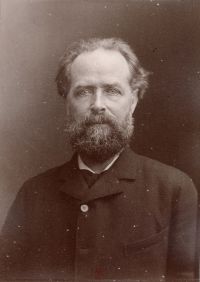 Élisée Reclus,
Africa by Élisée Reclus/Volume 2
(1892)
Élisée Reclus,
Africa by Élisée Reclus/Volume 2
(1892)
“ Notwithstanding its unhealthy climate, a small European colony, chiefly French, is settled at Casablanca, which, owing to the total absence of vegetation, presents an extremely dreary aspect. In the upper Um-er-E,bia basin, the chief centre of population is Bu-el-Jad a village of about two thousand inhabitants, ruled over by a sid, or religious sovereign, whose power is recognised by all the surrounding tribes — such as the Tadlas on the south and east, the Ait-Seri on the west, and the Shawia on the north-west. ”
James Meakin and Kate Alberta Meakin, 1911 Encyclopædia Britannica, Volume 18… (1911)
“ The passage of the detachment was opposed, whereupon the “Galilée,” aided by the “Du Chayla” bombarded the town. Casablanca was at the same time entered by the tribesmen, who began a general pillage. On the 7th the French troops arrived and Casablanca. were landed, and further fighting took place. Before order was restored nearly every inhabitant had been killed or wounded or had fled; the dead alone numbered thousands. ”
Various, Encyclopaedia Britannica, 11th Edition…
“ The population, about 20,000, includes numerous foreign merchants, Franciscan and Protestant missions, and a consular corps. Built by the Portuguese upon the site of the once prosperous town of Anfa, which they had destroyed in 1468, Casablanca was held by them for some time, till trouble with the natives compelled them to abandon it. In August 1907, in consequence of the murder of a number of French and Spanish workmen engaged on the harbour works, the town was bombarded and occupied by the French (see Morocco: History) . ”
 Frederick Ferdinand Moore,
The Passing of Morocco
(1908)
Frederick Ferdinand Moore,
The Passing of Morocco
(1908)
“ There is no danger for the French in Morocco.Nevertheless, their task is not an easy one. Conservatism at home and fear of some foreign protest has kept them from penetrating the country, as they must, in order to subdue it. So far they have made their power felt but locally, and though they have slain wantonly thousands of Moors, their position to-day is to all practical purposes the same as it was after the first engagements about Casablanca. For four months General Drude held Casablanca, with tribes defeated but unconquered all about him. ”
Frederick Ferdinand Moore,
The Passing of Morocco
(1908)
“ The older of them and those less poorly off came on mules, the youth on horses. They saw General Drude and the French consul, and went away again to discuss with the other tribesmen the terms that could be had: no arms within ten miles of Casablanca and protection of caravans bound hither. But soon it came to be known that the sorties of the French were limited to a zone apparently of fifteen kilomètres, and the spirit of the Arabs rose and they became again defiant. ”
 A. E. W. Mason,
The Winding Stair
A. E. W. Mason,
The Winding Stair
“ The Bar was full and the piano doing its worst. Above the babel of voices, every harsh note of it hurt like a tap upon a live brain. Paul and Gerard de Montignac were the only two in uniform there that night. A few small officials of the French business companies, Greeks, Italians, nondescripts from the Levant, and Jews, who three years before, paddling barefoot in the filth of their Mellah, were the only people to shout “Vive la France,” as the troops marched through Casablanca—these made up the company of the Villa Iris. ”
Frederick Ferdinand Moore,
The Passing of Morocco
(1908)
“ In 1906 a French company obtained a contract from the Moorish Government to construct a harbour at Casablanca; and beginning work they found it expedient, in order to bring up the necessary stone and gravel, to lay a narrow-gauge railway to a quarry a few miles down the coast. In those Mohammedan countries where the dead are protected from ‘Infidel’ tread the fact that the tracks bordered close on a cemetery, in fact passed over several graves, would have been cause perhaps for a conflict ”

“ On the west coast, especially, where the Mediterranean peoples, from the Phenicians to the Portuguese, have had trading-posts for over two thousand years, the harm done to such seaboard towns as Tangier, Rabat and Casablanca is hard to estimate. The modern European colonist apparently imagined that to plant his warehouses, cafés and cinema-palaces within the walls which for so long had fiercely excluded him was the most impressive way of proclaiming his domination. ”
Charles Robert Anderson, US Army Campaigns of World War II Series… (1993)
“ Garrison forces totaled 2,500 troops at Fedala and 4,325 at Casablanca, only twelve miles to the south. Fifty fighters and thirty bombers could enter the battle from airfields in the area. Casablanca was of particular concern to the U.S. Navy covering force off Fedala since it harbored French naval units including cruisers, destroyers, submarines, and the uncompleted battleship Jean Bart, whose operational 15-inch guns could easily reach both transports and landing beaches to the north. ”
“ For every battle fought a road was made; [22] for every rebel fortress shelled a factory was built, a harbor developed, or more miles of fallow land ploughed and sown.But this economic development did not satisfy the Resident. He wished Morocco to enlarge her commercial relations with France and the other allied countries, and with this object in view he organized and carried out with brilliant success a series of exhibitions at Casablanca, Fez and Rabat. ”
James Meakin and Kate Alberta Meakin, 1911 Encyclopædia Britannica, Volume 18… (1911)
“ There are only three great inland cities, each of which in turn serves as metropolis: Fez, Mequinez and Marrākesh. The towns next in importance are the seaports of Tangier, Casablanca (Dar el Baida) , Mogador, Mazagan, Saffi, Salli-Rabat, Laraish and Tetuan. All these places are separately noticed. The ports of Agadir Ighir, Azammūr and Azīla being closed to trade, are in a decayed condition. On the Mediterranean shore, along the coast of Er-Rit, the Spaniards have for centuries possessed Ceuta, Peñon de Velez, Alhucemas and Melilla ”
James Meakin and Kate Alberta Meakin, 1911 Encyclopædia Britannica, Volume 18… (1911)
“ The European colony was, however, saved. Though masters of the town, the French found the Shawia tribes still full of fight, and, first under General Drude and afterwards (Jan. 1908) under General Amadé, the French proceeded to the reduction of the Shawia country. At one time the expeditionary force numbered 15,000 men. [9] By June 1908 the district was quiet and thereafter the strength of the force was gradually reduced. [10] The action of France at Casablanca aroused the fanaticism of the tribes of Tafīlālt and those dwelling near the Algerian border. ”
J. N. Larned, History For Ready Reference, Volume 7 (1895)
“ Conflict with Tribesmen at Casablanca. Bombardment by French and Spanish Ships. Campaign against the Tribes. Dethronement of Sultan Abd el Aziz by his brother Mulai Hafid. Fresh friction between France and Germany. Its Pacific Settlement by Arbitration at The Hague. Organization of police forces for the service which France and Spain were commissioned by the Powers at the Algeciras Conference to perform in Morocco was retarded, necessarily, by the prevailing anarchy in the Empire, and fresh causes of disorder occurred before the means for prompt treatment of them were prepared. ”
James Meakin and Kate Alberta Meakin, 1911 Encyclopædia Britannica, Volume 18… (1911)
“ A railway about 24 m. long, connecting Casablanca and Ber Reshid, was opened in September 1908. This was the first line built in Morocco. There is also a railway from Melilla to some neighbouring mines. In general travelling in the interior is what it was a thousand years ago. There being practically no made roads and few bridges, vehicular traffic is out of the question, and even the transport of goods and persons on the backs of animals lacks the facilities provided in some Eastern lands—as Persia, for instance—in regular posting stations and caravanserais, here known as fandaks. ”
United States. Central Intelligence Agency, CIA World Fact Book, 2004 — Morocco (2004)
“ Casablanca Flag description: red with a green pentacle (five-pointed, linear star) known as Sulayman's (Solomon's) seal in the center of the flag; red and green are traditional colors in Arab flags, although the use of red is more commonly associated with the Arab states of the Persian gulf; design dates to 1912 Economy Morocco Economy - overview: Morocco faces the problems typical of developing countries - restraining government spending, reducing constraints on private activity and foreign trade, and achieving sustainable economic growth. ”
Karl Baedeker, The Mediterranean (1911)
“ Church service) , or Rbât, situated in the Tell (p. 93) on the left bank of the Bu Regreg, 138 M. from Tangier, is one of the sultan’s residences and vies with Tetuán (p. 102) as a most interesting coast-town. Its population together with that of Salee (p. 106) is 47,140 inhab., incl. 3000 Jews and 100 Europeans. As it is the ‘key of Morocco’, where the caravan routes from Tangier, Fez, and Casablanca (Marakesh) converge, and is also exposed to the attacks of the turbulent inland tribes of the Zemmûr and Zaïr, it has been fortified with an inner and two outer walls. ”
Robert Sidney Bowen, Dave Dawson at Casablanca
“ Farther ahead was the border line between Morocco and French Algeria, but of course there was nothing to mark it. Nothing, for as far as the eye could see there was only wasteland. These barren lands of the western rim of the Sahara Desert seemed to shimmer and tremble in the blistering heat of the sun. Even the banks of clouds were gone now. They had been left over the Atlas Mountains, and the sun blazing down made Dawson's throttles feel like red hot pokers, [Pg 205] despite the fact that he was some twelve thousand feet in the air. ”
“ No young men stroll through the bazaar in bright caftans, with roses and jasmine behind their ears, no pedlars offer lemonade and sweetmeats and golden fritters, no flower-sellers pursue one with tight bunches of orange-blossom and little pink roses. The well-to-do ride by in white, and the rest of the population goes mournfully in earth-color.But gradually one falls under the spell of another influence—the influence of the Atlas and the desert. Unknown Africa seems much nearer to Morocco than to the white towns of Tunis and the smiling oases of South Algeria. ”
“ It is one of the surprises of Morocco to find the familiar African pictures bathed in this unfamiliar haze. Even the fierce midday sun does not wholly dispel it: the air remains thick, opalescent, like water slightly clouded by milk. One is tempted to say that Morocco is Tunisia seen by moonlight.The European town of Rabat, a rapidly developing community, lies almost wholly outside the walls of the old Arab city. The latter, founded in the twelfth century by the great Almohad conqueror of Spain, Yacoub-el-Mansour, stretches its mighty walls to the river's mouth. ”
“ Before General Lyautey came to Morocco Rabat had been subjected to the indignity of European "improvements," and one must traverse boulevards scored with tram-lines, and pass between hotel-terraces and cafés and cinema-palaces, to reach the surviving nucleus of the once beautiful native town. Then, at the turn of a commonplace street, one comes upon it suddenly. The shops and cafés cease, the jingle of trams and the trumpeting of motor-horns die out, and here, all at once, are silence and solitude, and the dignified reticence of the windowless Arab house-fronts. ”
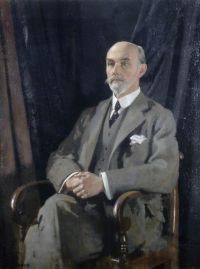 Charles Thomas-Stanford,
About Algeria: Algiers, Tlemçen…
Charles Thomas-Stanford,
About Algeria: Algiers, Tlemçen…
“ The French love broad streets, lofty houses, big windows, open spaces, and above all straight lines. The Arab town is a labyrinth of narrow lanes, twisting and curling according to no sort of plan, in fact to all appearance so inextricably confused and so full of blind alleys that one might suppose 49no living man capable of mastering their meanderings. But a stranger need be under no apprehension of being lost. He has only to keep ascending to reach the Kasbeh, the old Turkish fort at the top of the town, or descending, a course which sooner or later will bring him back to civilization. ”
“ Every detail of our trip from Tangier to Rabat had been carefully planned to keep us in unbroken contact with civilization. We were to "tub" in one European hotel, and to dine in another, with just enough picnicking between to give a touch of local colour. But let one little cog slip and the whole plan falls to bits, and we are alone in the old untamed Moghreb, as remote from Europe as any mediæval adventurer. If one lose one's way in [Pg 14] Morocco, civilization vanishes as though it were a magic carpet rolled up by a Djinn. ”
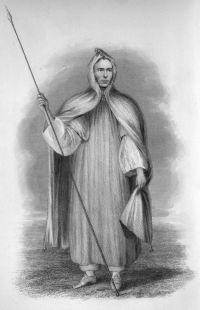 James Richardson,
Travels in the Great Desert of Sahara…
James Richardson,
Travels in the Great Desert of Sahara…
“ These Shânbah banditti (who, to my surprise, are lauded in the French works published by the Minister of War, as the most enterprising camel-drivers and merchants in The Sahara,) are, without doubt, what the people say here, the vilest and most bloodthirsty miscreants in The Desert. How strange it is they are Arabs! It is always the Arab, who is the most thorough-going, hereditary, eternal robber of The Desert! Is it because we read, "And he will be a wild man; his hand will be against every man, and every man's hand against him?" ”
“ One seems to be not in Africa itself, but in the Africa that northern crusaders may have dreamed of in snow-bound castles by colder shores of the same ocean. This is what Moghreb must have looked like to the confused imagination of the Middle Ages, to Norman knights burning to ransom the Holy Places, or Hansa merchants devising, in steep-roofed towns, of Barbary and the long caravans bringing apes and gold-powder from the south.Inside the gate of the Kasbah one comes on more waste land and on other walls—for all Moroccan towns are enclosed in circuit within circuit of battlemented masonry. ”
“ The crowd in Oriental cities is made up of many elements, and in Morocco Turks, Jews and infidels, Berbers of the mountains, fanatics of the confraternities, Soudanese blacks and haggard Blue Men of the Souss, [Pg 90] jostle the merchants and government officials with that democratic familiarity which goes side by side with abject servility in this land of perpetual contradictions. But Fez is above all the city of wealth and learning, of universities and counting-houses, and the merchant and the oulama [11] —the sedentary and luxurious types—prevail. ”
 John Ball,
Journal of a tour in Marocco and the Great Atlas
(1878)
John Ball,
Journal of a tour in Marocco and the Great Atlas
(1878)
“ We are told by Rohlfs that on the northern skirts of the Marocco Sahara the Shelluhs have adopted a predatory life, and are the most dreaded of all the [234] wandering robbers of that region. But when we learn that all the fertile oases of the Sahara have been monopolised by a small class of Arab descent, who rest their claims on religious authority, it is not apparent that there is any alternative for those who do not belong to the privileged class ”
Walcot Gibson, Frank R. Cana and Arthur Girault, 1911 Encyclopædia Britannica (1911)
“ Towns in the Sahara.—On the southern slopes of the Great Atlas, 2437 ft. above the sea, looking out on the Saharan desert, and 200 m. in a straight line S. W. of Algiers, is the ancient town of El Aghuat (erroneously written Laghouat) ; pop. 5660. It formerly belonged to Morocco, by whom it was ceded to the Turks towards the close of the 17th century. It was stormed on the 4th of December 1852 by the French, who almost entirely destroyed the Arab town. The modern town contains little of interest, but is an important military station. ”
