Duke of Bourbon

Definition and stakes

John Richard Green,  History of the English People, Volume III

“ The treason of the Duke of Bourbon stirred a new hope of conquering France. Bourbon was Constable of France, the highest of the French nobles both from his blood and the almost independent power he wielded in his own duchy and in Provence. But a legal process by which Francis sought to recall his vast possessions to the domain of the crown threatened him with ruin; and driven to secret revolt, he pledged himself to rise against the king on the appearance of the allied armies in the heart of the realm. ”
Source: Gutenberg

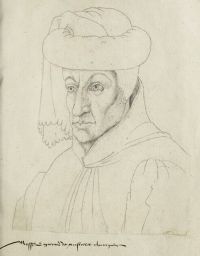
Portrait of Enguerrand de Monstrelet Enguerrand de Monstrelet,  The Chronicles of Enguerrand de Monstrelet…

“ While the duchess of Bourbon was at Paris, she obtained from the king, and from the dukes of Acquitaine and Burgundy, that the body of Binet d'Espineuse, formerly the knight of her lord the duke of Bourbon, should be taken down from the gibbet of Montfaucon, and his head from the market-house, where it had been placed some time since by the king's officers of justice. ”
Source: Gutenberg

Various,  Encyclopaedia Britannica, 11th Edition…

“ BOURBON, CHARLES, Duke of (1490-1527) , constable of France, second son of Gilbert, count of Montpensier and dauphin of Auvergne, was born on the 17th of February 1490, his mother being a Gonzaga. In 1505 he married Suzanne, heiress of Peter II., duke of Bourbon, by Anne of France, daughter of King Louis XI., and assumed the title of duke of Bourbon. The addition of this duchy to the numerous duchies, countships and other fiefs which he had inherited on the death of his elder brother Louis in 1501, made him at the age of fifteen the wealthiest noble in Europe. ”
Source: Gutenberg

Get perspective with Kwize: daily news enlightened by great literature