Goidelic

Definition and stakes

Sir John Rhys,  Celtic Folklore: Welsh and Manx…

“ Since the fairies are always represented as old-fashioned in their ways, it is quite possible that they were once regarded as talking a more ancient language of the country. Which was it? An early version of these legends might perhaps have supplied the answer, and told us that it was Gwyđelig or Goidelic, if not an earlier idiom, to wit that of the Aborigines before they learnt Goidelic from the Celts of the first wave of Aryan invasion, whether it was in the region of the Eifl or in the Demetian half of Keredigion. ”
Source: Gutenberg

William Ridgeway, Edmund C. Quiggin and William J. Gruffydd,  1911 Encyclopædia Britannica, Volume 5… (1911)

“ In Goidelic, we find two mutations, the vocalic and the nasal. Initial mutation only takes place between words which belong together syntactically, and which form one single stress-group, thus between article, numeral, possessive pronoun or preposition, and a following substantive; between a verbal prefix and the verb itself.
1. When the word causing mutation ended in a vowel we get the vocalic mutation, called by Irish grammarians aspiration. The sounds affected are the tenues k (c) , t, p; the mediae g, d, b; the liquids and nasals m, n, r, l, s, and Prim. Celt. v (Ir. f, W. gw) .
”
Source: Wikisource

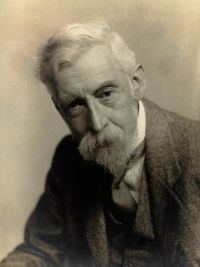
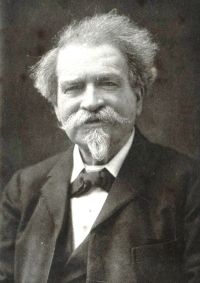
Portrait of John Rhŷs John Rhŷs,  Lectures on the Origin and Growth of Religion As Illustrated by Celtic Heathendom (1888)

“ Had the Celts, or, still better, the Goidelic Celts, been alone in making the sun feminine at a certain point in their history, one would have been tempted to see in that tendency the influence of a non-Aryan race conquered and absorbed by them; but the divergence of gender pointed out is not such as to favour that view: it only warrants the inference that each nation acted independently. ”
Source: Wikisource

Get perspective with Kwize: daily news enlightened by great literature