Graves' disease

Definition and stakes

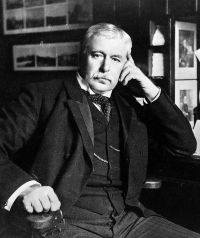
Portrait of George Washington Crile George Washington Crile,  The Origin and Nature of the Emotions…

“ In suitable cases of Graves' disease, if the thyroid secretion is sufficiently diminished by a removal of a part of the gland or by interrupting the nerve and the blood supply, the phenomena of the disease are diminished immediately, and in favorable cases the patient is restored to approximately the normal condition. The heart action slows, the respiratory rate falls, the restlessness diminishes, digestive disturbances disappear, tremors decrease, there is a rapid increase in the body weight, and the patient gradually resumes his normal state. ”
Source: Gutenberg

James J. Walsh,  Psychotherapy

“ Most cases of Graves' disease, while not particularly amenable to treatment by specific drugs, are very much improved if the patient's general health is brought up to the best standard and if all sources of worry and emotion are eliminated, as far as possible. Nothing is more serious for them, however, than the suggestion that they will not get well. Probably no one has ever seen a mild case of Graves' disease that did not improve so much as to be practically well after the lapse of some time. ”
Source: Gutenberg

Portrait of George Washington Crile George Washington Crile,  The Origin and Nature of the Emotions…

“ We have stated that in acute Graves' disease there is a tendency to the production of spontaneous fever, and that there is a magnified diurnal variation in temperature which is due to an increased output of energy in even the normal reaction producing consciousness. In Graves' disease there is, therefore, a state of intensified consciousness, which is associated with low brain thresholds to all stimuli—both to stimuli that cause muscular action and to stimuli that cause fever. The intensity of the kinetic discharge is seen in the constant fine tremor. ”
Source: Gutenberg

Get perspective with Kwize: daily news enlightened by great literature