“ Even if I should sit down now and spend a whole day trying to explain why I adored Guildford and why I am so upset over its loss, at the end of the time you would only shake your head and say, 'Poor Carolina,' without in the least understanding me. No one ever did understand about Guildford except dear Daddy, and since he died, I've been afraid to let even God know how much I wanted it, because I knew if He did, He would take it away from me! He takes everything away from me that I love! ”
Guildford
Definition and stakes
Guildford, a historic town in Surrey, is celebrated for its picturesque High Street, medieval architecture, and strategic position on the River Wey. Authors such as Eric Parker highlight its contrasting charm, describing the grace of its buildings against the urban decline near the railway station, while Julia Cartwright links its name to its ancient role as a ford and its connections to kings like Alfred the Great.
Charles G. Harper emphasizes its regional character, noting its accessibility and unique identity. These varied perspectives—from historical accounts to geographical insights—collectively underscore Guildford’s enduring appeal as a place where past and present intertwine, reflecting its significance in both literary and local heritage.
Quotes about “Guildford”
Eric Parker, Highways and Byways in Surrey
“ To arrive at Guildford by train is like walking into a garden over a rubbish heap. In the grace of its building, the charm of its colour, the fascination of the prospects of its hillside High Street, no town in Surrey, and perhaps only Oxford in England, is comparable with it. But between the railway station and the High Street it is desolation and blank walls. A few pretty old cottages jut out over a narrow pavement; beyond a huddled roof or two rises the tower of St. Nicholas' Church, umber and solid; nearly all else is tumbled down ugliness, broken brickwork, mud and shaggy grass. ”
Julia Cartwright, The Pilgrims' Way from Winchester to Canterbury
“ The ancient city of Guildford owes its name and much of its historic renown to its situation on the chief ford of the river Wey, which here makes a break in the ridge of chalk downs running across Surrey. Guildford is mentioned in his will by King Alfred, who left it to his nephew Ethelwold, and became memorable as the spot where another Alfred, the son of Knut and Emma, was treacherously seized and murdered by Earl Godwin, who, standing on the eastern slope of the Hog’s Back above the city, bade the young prince look back and see how large a kingdom would be his. ”
Related terms
Authors who wrote about “Guildford”
Eric ParkerStuart Dodgson CollingwoodGeorge Thomas Clark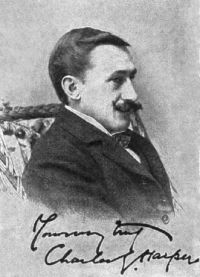 Charles G. HarperBaron Thomas Babington Macaulay MacaulayVariousJames Gairdnerno contributor recorded
 Arthur Conan Doyle
 Marie Belloc LowndesW. PriddenA. R. Hope MoncrieffJohn Cuming WaltersSir John Rennie
 Edward ThomasJulia Cartwright
 John Cassell
 Charles GarviceGeorge Norman Clark
 H. B. Marriott Watson
Charles G. HarperBaron Thomas Babington Macaulay MacaulayVariousJames Gairdnerno contributor recordedArthur Conan DoyleMarie Belloc LowndesW. PriddenA. R. Hope MoncrieffJohn Cuming WaltersSir John RennieEdward ThomasJulia CartwrightJohn CassellCharles GarviceGeorge Norman ClarkH. B. Marriott Watson