
“ Ideala had never known a man like this man. His talents, his rapid changes of mood, as sense or conscience got the upper hand, and his versatility charmed her imagination and excited her interest; and he had, besides, that magnetic power over her by which it is given to some men to compel people of certain temperaments to their will. ”
Quotes about “Ideala”
“ Ideala decided, from the corner of her couch. "He is a sort of two-reason man.""How do you mean 'a two-reason man,' Ideala?""Well, he has only two reasons for everything; one is his reason for doing anything he likes himself, which is always a good one; and the other is his reason why the rest of the world should not do likewise, which is equally clear—to himself. He thinks there should be one law for him and another for everybody else. ”
“ Ideala answered; "and there is evidence enough to prove it to people who are trying to arrive at a foregone conclusion; but it is not the resemblances we should look to, but the differences. It is in them that our hope lies, and they seem to me to be essential. Take the one grand difference that has been made by the teaching for hundreds of years of the perfect morality of the Christian religion! Do you think it possible for men, while they cling to it, to 'reel back into the beast and be no more'?" ”
“ They called Ideala unsympathetic, yet I have known her silent from excess of sympathy. She could walk with you, reading your heart and soul, sorrowing and rejoicing with you, and make you feel without a word that she did so. It was this power to sympathise, and the longing she had to find good in everything, that made her forgive the faults that were patent in a nature with which she was finally brought into contact, for the sake of the virtues which she discovered hidden away deep down under a slowly hardening crust of that kind of self- indulgence which mars a man. ”
“ Ideala's determination to be faithful to what she conceived to be her duty had kept her quiet hitherto, but now a sense of personal degradation made her desperate, and she forgot all that. Her first impulse was to consult somebody, to speak and find means to put an end to her misery; but I was not there, and to whom should she go for advice. Her impatience brooked no delay. She must see some one instantly. ”
“ This gentleman's name promised well for him, for he belonged to people whose integrity was well known; and his position vouched for his ability—and also for his age to Ideala, whose imagination had pictured a learned old gentleman, bald, spectacled, benevolent, full of knowledge of the world, "wise saws and modern instances." No one, she thought, could be better suited for her purpose; and accordingly, next day, after attending to her household duties, she went by an early train to consult him. ”
“ All the toil and trouble of the world, and all the work which began with the life of man, is directed towards one great end— the doing away with sin and suffering, and the establishment of purity and peace. And this work seems almost hopeless, not because the multitude do not approve of it, but because individuals are cowardly, and will not do their share of it. Every act of yours has a meaning; it either helps or hinders, what is being done to further this, the object of life. Lately, Ideala, you have been talking wildly, without for a moment considering the harm you may be doing. ”
“ Why are we what we are? But I warn you that it would not be fair to take any of Ideala's opinions, here given, as final. Much of what she thought was the mere effervescence of a strong mind in a state of fermentation, a mind passing successively through the three stages of the process ”
“ I must obey my own conscience, not yours; and my conscience tells me the thing is right which you hold to be wrong. I am quite willing to believe it would be wrong for you, but for me it is clearly right. You said the other day he had lowered me. What a fiction that is! In what have I changed for the worse? Do I fail in any duty of life since I knew him in which I previously succeeded? Oh, no! he has not lowered me! Love like this rounds a life and brings it to perfection; it could not wreck it.""But, Ideala, you are going to fail in a duty ”
“ They were parting then, and he looked down at her in silence for some seconds, and when Ideala saw the expression of his face, her heart sank. In that one moment she realised all that his friendship had been to her, and foresaw the terrible blank there would be for her if it should ever end. That there was any danger, that there could be anything but friendship between men and women who must not marry, had not even yet occurred to her. Her intimacy with myself had prepared the way for Lorrimer, and made this new intimacy seem also perfectly right. ”
Various, The Atlantic Monthly (1858)
“ We have named Ideality a love of life. Nay, what is it but life itself,—and that loving but true living? What word can have any value for us, unless it is a record of inevitable expansions in character. ”
William James, The Will to Believe and Other Essays in Popular Philosophy… (1897)
“ Take idealism and materialism as examples of what I mean, and suppose for a moment that both give a conception of equal theoretic clearness and consistency, and that both determine our expectations equally well. Idealism will be chosen by a man of one emotional constitution, materialism by another. At this very day all sentimental natures, fond of conciliation and intimacy, tend to an idealistic faith. Why? Because idealism gives to the nature of things such kinship with our personal selves. Our own thoughts are what we are most at home with, what we are least afraid of. ”
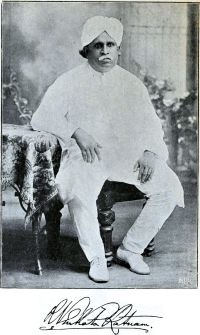 Raghupathi Venkataratnam Naidu,
The Message and Ministrations of Dewan Bahadur R. Venkata Ratnam
(1923)
Raghupathi Venkataratnam Naidu,
The Message and Ministrations of Dewan Bahadur R. Venkata Ratnam
(1923)
“ Thus it is that ideals are a living, vital agency in unfolding the latent virtues of man and so shaping his character. Hence we may perceive that in these three addresses we have, if I may use the ambitious expression, a full chart of our life — its right methods, its favourable circumstances and its ultimate realisation. Cultivate your self, sparing no pains. Seek and imbibe lofty ideals, drawing no invidious distinction between one and another. And realise that character in which alone lies the justification of human life and the gurantee of human continuity. ”
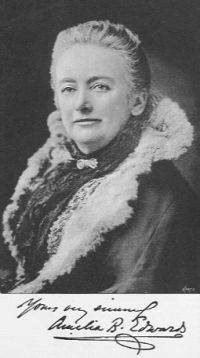 Amelia B. Edwards,
In the Days of My Youth: A Novel
Amelia B. Edwards,
In the Days of My Youth: A Novel
“ Shall I say that the Ideal is an image projected by the soul of genius upon the background of the universe? That it is that dazzling, that unimaginable, that incommunicable goal towards which the suns in their orbits, the stars in their courses, the spheres with all their harmonies, have been chaotically tending since time began! ”
 Josiah Royce,
The Religious Aspect of Philosophy
(1885)
Josiah Royce,
The Religious Aspect of Philosophy
(1885)
“ Everywhere there stands over against this ideal some critic who says: “The choice of this aim for life is an accident. I reject this boastful ideal. For where in reality is found the firm basis of fact on which the ideal is founded?” Then possibly the idealist, relaxing the rigor of his idealism, points out in the external world some real or mythical support for his ideal. ”
Edwin E. Slosson, Major Prophets of To-Day
“ But this purity of perception implies a rupture with useful convention, an innate and specially localized disinterestedness of the sense or of the consciousness, in short, a certain immateriality of life which is what has always been called idealism. So one might say without in the least playing upon the sense of the words, that realism is in the work when idealism is in the soul, and that it is by force of ideality alone that one can regain contact with reality. ”
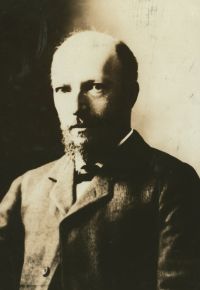 Felix Adler,
Creed and Deed: A Series of Discourses
Felix Adler,
Creed and Deed: A Series of Discourses
“ And like a tree are we, with the mighty trunk of intellect, the spreading branches of imagination, the fibrous roots of the lower instincts, that bind us to the earth. But the moral life is the fruit we bear; in it our true nature is revealed; in it we see the purpose of our being fulfilled. So when we speak of a return to nature, it is this higher nature to which we refer, whose origin we know not, but whose workings we feel, and know them by the token of the sweet satisfaction they afford us to be the crown and glory of our lives. The old Ideal emphasizes the Eternal that is without us ”
 George Edward Woodberry,
Heart of Man
George Edward Woodberry,
Heart of Man
“ But as shown to us in imagination, idealism, which is the race's dream of truth, hovers between these two worlds known to us in tendency if not in conclusion,—the world of salvation on the one hand, in proportion as the order of life is made vital in us, the world of damnation on the other hand, in proportion as the order of death prevails in our will; but the main effort of idealism is to show us the war between the two, with an emphasis on the becoming of the reality of beauty, joy, reason, and virtue in us. ”
 George William Russell,
AE in the Irish Theosophist
George William Russell,
AE in the Irish Theosophist
“ But I raise the standard of idealism, to try everything by it, every custom, every thought before we make it our own, and every sentiment before it finds a place in our hearts. Are these conditions, social and mental, which some would have us strive for really so admirable as we are assured they are? Are they worth having at all? What of the heroic best of man ”
 George Edward Moore,
Principia Ethica — Chapter VI
(1903)
George Edward Moore,
Principia Ethica — Chapter VI
(1903)
“ When we call a state of things ‘ideal’ we may mean three distinct things, which have only this in common: that we always do mean to assert, of the state of things in question, not only that it is good in itself, but that it is good in itself in a much higher degree than many other things. The first of these meanings of ‘ideal’ is (1) that to which the phrase ‘The Ideal’ is most properly confined. ”
 H. B. Marriott Watson,
The Castle by the Sea — Chapter 14
(1909)
H. B. Marriott Watson,
The Castle by the Sea — Chapter 14
(1909)
“ But, look at it how you will, the argument is in favor of ideals. On the low plane of practical happiness you have what holds you up for years, until, indeed, that blow you dread; and at the highest, 'one needs must love the highest'—there is no alternative. It comes to this, that you can't help having ideals, and that you are the happier for any ideal you have, even if it be destined to be broken. ”
Josiah Royce,
The Spirit of Modern Philosophy
(1892)
“ Can the philosopher find the true heart and essence of this our common selfhood? If he can, then idealism becomes a system. We are, then, all in one world of truth. The outer world is indeed show, but no illusion; and our life has an organic fixity, a lawful completeness about it, such as every philosophy longs for. But now, unfortunately, when idealists set about deducing this unity and consistency of the spiritual world from some deep inner principle, their reflection always leaves us in one great respect dissatisfied. ”
 Ellen Key,
The Morality of Woman, and Other Essays
Ellen Key,
The Morality of Woman, and Other Essays
“ Such a conception of the woman question is for me the ideal conception of this [ 73 ] present great movement. And ideality does not mean to adopt as the conception of life that which the majority considers ideal. Ideality means to live for the ideal, which has inflamed our consciousness and not to violate this consciousness by adapting it to such ideals as we feel with our whole soul are lower. ”
Josiah Royce,
The Religious Aspect of Philosophy
(1885)
“ You had said that an ideal must have only an ideal foundation. And now you say that the ideally right thing depends on God’s nature, on the existence of the universal Reason, or on the assertions of Conscience. ”
Oliver Wendell Holmes, Ralph Waldo Emerson
“ I expand and live in the warm day like corn and melons."—But, "seen in the light of thought, the world always is phenomenal; and virtue subordinates it to the mind. Idealism sees the world in God,"—as one vast picture, which God paints on the instant eternity, for the contemplation of the soul. ”
Theron Q. Dumont, The Power of Concentration
“ LESSON XVII. IDEALS DEVELOPED BY CONCENTRATION Through our paltry stir and strife, Glows the wished Ideal, And longing molds in clay, what life Carves in the marble real.—Lowell.We often hear people spoken of as idealists. The fact is we are all idealists to a certain extent, and upon the ideals we picture depends our ultimate success. You must have the mental image if you are to produce the material thing. Everything is first created in the mind. When you control your thoughts you become a creator. You receive divine ideas and shape them to your individual needs. ”
 Georg Wilhelm Friedrich Hegel,
The Philosophy of Fine Art, volume 2…
Georg Wilhelm Friedrich Hegel,
The Philosophy of Fine Art, volume 2…
“ The simple and unriven totality of the Ideal is dissolved, and breaks up into one of twofold aspect, namely, that of the essentially subjective life and its exterior semblance, in order to enable mind, by means of this severation, to win the profounder reconciliation in its own most proper element. ”
Georg Wilhelm Friedrich Hegel,
The Philosophy of Fine Art, volume 2…
“ Thirdly, and finally, we are made aware of the essentially necessary progress to the Ideal in the fact that the primarily superficial personifications of the activities of Nature and the most abstract spiritual conditions are contested and thrust from their prominence as something essentially subordinate and negative and, by virtue of this debasement the self-sufficient spiritual individuality and its human form and action, is suffered to attain an unchallenged masterdom. ”
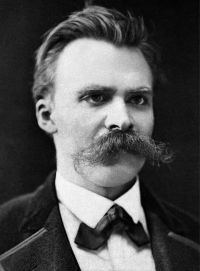 Friedrich Wilhelm Nietzsche,
The Joyful Wisdom ("La Gaya Scienza"…
Friedrich Wilhelm Nietzsche,
The Joyful Wisdom ("La Gaya Scienza"…
“ Why we are not Idealists.—Formerly philosophers were afraid of the senses: have we, perhaps, been far too forgetful of this fear? We are at present all of us sensualists, we representatives of the present and of the future in philosophy,—not according to theory, however, but in praxis, in practice.... Those former philosophers, on the contrary, thought that the senses lured them out of their world, the cold realm of "ideas," to a dangerous southern island, where they were afraid that their philosopher-virtues would melt away like snow in the sun. ”
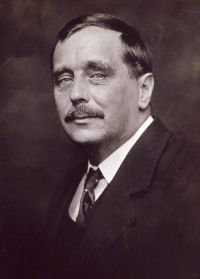 H. G. Wells,
Select Conversations with an Uncle…
H. G. Wells,
Select Conversations with an Uncle…
“ Ideals are the full dress of the soul. A business man, for instance, who let visions of reverend Venetian and Genoese seigniors interfere with his agile City movements—who, to carry out our comparison, draped his mind with these things—would be uncommonly like a bowler in a dressing-gown. "Then an ideal, we are also told, is an elevating influence in life; but unless one is very careful one may get hoist with one's own petard to a pitifully transitory soar above common humanity. ”
Cora May Williams, A Review of the Systems of Ethics Founded on the Theory of Evolution
“ A compromise between idealism and realism is everywhere necessary; and such a compromise is made, despite all fine words to the contrary, by every one,—by one only more openly or consciously than another. ”
 Harriet Beecher Stowe,
Little Foxes
(1865)
Harriet Beecher Stowe,
Little Foxes
(1865)
“ There is a faculty of the human mind to which phrenologists have given the name of Ideality, which is at the foundation of this exactingness. Ideality is the faculty by which we conceive of and long for perfection; and at a glance it will be seen, that, so far from being{251} an evil ingredient of human nature, it is the one element of progress that distinguishes man’s nature from that of the brute. ”
 Susan Glaspell,
Lifted Masks; stories
Susan Glaspell,
Lifted Masks; stories
“ He gazed at the care-worn, rugged face—face of a worker and a dreamer, reading in those lines the story of that life, seeing more clearly than he had ever seen before the beauty and futility of it. Here was the idealist, the man who would give his whole lifetime to a dream he had dreamed. ”
Josiah Royce,
The Religious Aspect of Philosophy
(1885)
“ If the ideal either does exist, or some day will exist, so much the better; but through all the changes of fate the terrible ought remains, and judges fearlessly the world, whether it be good or whether it be evil. But here the realist, to whom the moral code that is not built on natural fact is just a dream, interposes what shall just here be his final objection. ”
Friedrich Wilhelm Nietzsche,
Ecce Homo
“ Another ideal now leads us on, a wonderful, seductive ideal, full of danger, the pursuit of which we should be loath to urge upon any one, because we are not so ready to acknowledge any one's right to it: the ideal of a spirit who plays ingenuously (that is to say, involuntarily, and as the outcome of superabundant energy and power) with everything that, hitherto, has been called holy, good, inviolable, and divine ”
