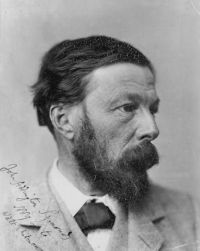
“ If the beautiful Ghirlandaios and Lippis are fading, this generation will never know it. The large Fra Angelico in the Academy is as clear and keen as if the good old monk stood there wiping his brushes; the colours seem to sing, as it were, like new-fledged birds in June. Nothing is more characteristic of early Tuscan art than the high-reliefs of Luca della Robbia; yet there isn’t one of them that, except for the unique mixture of freshness with its wisdom, of candour with its expertness, mightn’t have been modelled yesterday. ”
Luca della Robbia
Definition and stakes
Luca della Robbia (1399–1482), an Italian Renaissance sculptor from Florence, transformed art through his pioneering tin-glazed terracotta technique, combining durability with vivid expression. Celebrated for works such as The Nativity and Madonna and Child, his style emphasized grace over grandeur, setting him apart from his contemporaries.
Vasari commended his skill in marble and bronze, while Henry James praised the enduring quality of his reliefs, remarking on their "freshness with wisdom." Edward Hutton emphasized his lasting impact, contrasting the liveliness of his art with the relative obscurity of his personal fate. Della Robbia’s influence, carried on by his family, left a lasting impression on Renaissance sculpture and ceramics, uniting technical brilliance with spiritual depth.
Quotes about “Luca della Robbia”
Edward Hutton, Florence and Northern Tuscany with Genoa
“ There lay Luca della Robbia, Lorenzo di Credi, Mariotto Albertinelli, Piero di Cosimo: where is their dust to-day? As we look at their work in the galleries and churches, who cares what has happened to them, or whether such graves as theirs are rifled or no? Yet not one of them but has done more for Italy than Vittorio Emmanuele ”
Various, Encyclopaedia Britannica, 11th Edition…
“ Many fine specimens exist in private collections in England, France, Germany and the United States. The greater part of the Robbia work still remains in the churches and other buildings of Italy, especially in Florence, Fiesole, Arezzo, La Verna, Volterra, Barga, Montepulciano, Lucca, Pistoia, Prato and Siena.Literature.—H. Barbet de Jouy, Les della Robbia (Paris, 1855) ; W. Bode, Die Künstlerfamilie della Robbia (Leipzig, 1878) ; “Luca della Robbia ed i suoi precursori in Firenze,” Arch. stor. dell’ arte (1899) ”
Giorgio Vasari, Lives of the Most Excellent Painters… (1850)
“ Moved by this success, the superintendents resolved that the arch above the door of the opposite sacristy, where Donatello had executed the decorations of the other organ, should be filled by Luca della Robbia with similar figures and works in terra-cotta; whereupon, the artist executed an Ascension of Christ into Heaven, which is an extremely beautiful work. ”
Estelle M. Hurll, Tuscan Sculpture of the Fifteenth Century
“ The sculptor of the bambini, Andrea della Robbia, was the nephew of Luca della Robbia, of whom we have learned something in previous chapters. He was trained in the workshop of his uncle, and in turn passed on his art to his three sons. While Luca's work is considered superior to that of any of his pupils, the nephew Andrea had some fine artistic qualities. The decorations of the Foundling Hospital illustrate both the delicacy and the fertility of his imagination. Only a genuine artist could invent so many variations upon the simple theme of a single baby figure. ”
Giorgio Vasari, Lives of the Most Excellent Painters… (1850)
“ At a later period, Luca della Robbia produced a figure of the Virgin, surrounded by numerous angels: a work of infinite animation and beauty, [15] which was placed in the small arch over the door of the church of San Piero Buonconsiglio, situated below the Mercato Vecchio; and over the door of a small church near San Piero Maggiore, [16] he executed another Madonna, within a half circle, also attended by angels; which are considered extremely beautiful. ”
“ Luca della Robbia, born in 1388, was an eminent sculptor in marble and bronze, and worked both at Florence and at Rimini. Having abandoned his original employment for that of modelling in terra cotta, he succeeded, after many experiments, in making a white enamel, with which he coated his works, and thus rendered them durable. Vasari writes of him, "che faceva l'opere di terra quasi eterne." His chief productions are Madonnas, Scripture subjects, figures, and architectural ornaments: they are by far the finest works ever executed in pottery. ”
Giorgio Vasari, Lives of the Most Eminent Painters Sculptors and Architects…
“ How great were the despair and the bitterness of Filippo, on hearing what the Wardens had done, may be seen from this, that he was minded to fly from Florence; and if it had not been for Donato and Luca della Robbia, who comforted him, he would have lost his reason. Truly impious and cruel is the rage of those who, blinded by envy, put into peril the honours and the beautiful works of others in their jealous emulation! ”
Charles Wyllys Elliott,
Pottery and Porcelain, from early times down to the Philadelphia exhibition of 1876
“ Urbino, Gubbio, Pesaro, Castel-Durante, Faenza, Forli, Caffagiolo, Siena, Deruta, Venice, Castelli, besides many others.Fig. 65.—Mezza-Maiolica.Before giving some particulars of these manufactures, it may be well to refer to a name which seems to take precedence of others among the artists in ceramic work in Italy. This man was Luca della Robbia, born in the year 1400. M. Ritter says of him: “He was a sculptor first, and a potter afterward. An artist of the highest power, he was inspired with all the marvelous æsthetic force and subtilty and fertility of his age and of his country. ”
John Ruskin,
Mornings in Florence
“ And here he has done his best, and has put a long wall in wonderful perspective, and the whole city of Florence behind Elizabeth's house in the hill country; and a splendid bas-relief, in the style of Luca della Robbia, in St. Anne's bedroom; and he has carved all the pilasters, and embroidered all the dresses, and flourished and trumpeted into every corner; and it is all done, within just a point, as well as it can be done; and quite as well as Ghirlandajo could do it. But the point in which it just misses being as well as it can be done, is the vital point. ”
Giorgio Vasari, Lives of the Most Excellent Painters… (1850)
“ Luca moreover, be it observed, though he passed from one occupation to another—from marble to bronze, and from bronze to terra-cotta—was not induced to these changes by an idle levity, or because he was, as too many are found to be, capricious, unstable, and discontented with his vocation, but because he was by nature disposed to the search after new discoveries, and also because his necessities compelled him to seek a mode of occupation which should be in harmony with his tastes, while it was less fatiguing and more profitable. ”
Giorgio Vasari, Lives of the Most Excellent Painters… (1850)
“ Andrea had three sons besides the monks above-mentioned—Giovanni [33] (also an artist, and who had three sons, Marco, Lucantonio, and Simone, all of high promise, but who died of the plague in 1527) ; Luca and Girolamo, who devoted themselves to sculpture. Of the two last-named, Luca paid infinite attention to works in the glazed terra-cotta ”
“ “An artist worthy of the name should express all the truth of nature, not only the exterior truth, but also, and above all, the inner truth.“When a good sculptor models a torso, he not only represents the muscles, but the life which animates them—more than the life, the force that fashioned them and communicated to them, it may be, grace or strength, or amorous charm, or indomitable will.“In the works of Michael Angelo, the creative force seems to rumble; in those of Luca della Robbia it smiles divinely. ”
Algernon Charles Swinburne,
A Study of Victor Hugo
(1886)
“ And above the work in this lovely line of all poets in all time but one, there sits and smiles eternally the adorable baby who helps us for ever to forget all passing perversities of Christianized socialism or bastard Cæsarism which disfigure and diminish the pure proportions and the noble charm of 'Aurora Leigh.' Even the most memorable children born to art in Florence, begotten upon stone or canvas by Andrea del Sarto or by Luca della Robbia's very self, must yield to that one the crown of sinless empire and the palm of powerless godhead which attest the natural mystery of their omnipotence ”
Giorgio Vasari, Lives of the Most Excellent Painters… (1850)
“ For Naples, also, he constructed the marble sepulchre of the Infant, brother to the Duke of Calabria: this was decorated with ornaments in the glazed terra-cotta; it was executed in Florence, and afterwards sent to Naples: Luca being assisted in its completion by his brother Agostino. After these things, the master still sought to make further inventions, and laboured to discover a method by which figures and historical representations might be coloured on level surfaces of terra-cotta, proposing thereby to secure a more life-like effect to the pictures. ”
John Henry Middleton and William Burton, 1911 Encyclopædia Britannica, Volume 7… (1911)
“ In the tympanum of the arch is a very lovely white relief of the Madonna between two Adoring Angels (see fig. 3) . Long coloured garlands of fruit and flowers are held by nude boys reclining on the top of the arch and others standing on the cornice. All this part is of enamelled clay, but the basin of the fountain is of white marble. Neither Luca nor Andrea was in the habit of signing his work, but Giovanni often did so, usually adding the date, probably because other potters had begun to imitate the Robbia ware. ”
P. L. Jacob, The Arts in the Middle Ages and at the Period of the Renaissance
“ In the face of such contradictory coincidence, if we may say so, it would be as difficult as it would be rash to pronounce an opinion; we consider it better, while disregarding problematical indications, to boldly face a train of facts now determined by historical proof.“At the commencement of the fifteenth century”—we cannot do better than borrow from M. Jacquemart a passage which he himself took from the Italian work by Passeri, on Majolica (Pesaro, 1838, in 8vo.) —“Luca della Robbia, the son of Simone di Marro, apprenticed himself to a Florentine goldsmith, Leonardo, the son of Giovanni ”
Giorgio Vasari, Lives of the Most Excellent Painters… (1850)
“ Here he executed various works for king Francis at Madri, [34] a place not far distant from Paris, more particularly a palace decorated with numerous figures and other ornaments, cut in a kind of stone similar to that which we have ourselves at Volterra, but of a better quality, since it is soft while being worked, and becomes indurated by time and exposure to the air. Girolamo della Robbia laboured much in Orleans, and executed many works in various parts of the whole realm of France, acquiring high reputation and great riches. ”
Various, Encyclopaedia Britannica, 11th Edition…
“ In the latter part of his life Luca was mainly occupied with the production of terra-cotta reliefs covered with enamel, a process which he improved upon, but did not invent, as Vasari asserts. The rationale of this process was to cover the clay relief with an enamel formed of the ordinary ingredients of glass (marzacotto) , made white and opaque by oxide of tin. (See Ceramics: Italian Majolica.) Though Luca was not the inventor of the process, yet he extended its application to fine sculptured work in terra-cotta, so that it is not unnaturally known now as Della Robbia ware ”
Marjorie Moyca Newell, The Medici Balls: Seven little journeys in Tuscany
“ Tradition added that the formula for compounding the Della Robbia glaze was supposed to be hidden behind one of the panels, one of which was afterward found broken, the robber leaving no trace of the precious parchment. The panel, "Giving Drink to the Thirsty," was repaired, but not like the others. We can see for ourselves that it is only painted stucco and of later date. This was a story to stir youthful imagination to the highest pitch: a mystery, a secret, a theft—the very stuff that dreams are made of. Italy is full of traditions ”
Estelle M. Hurll, Tuscan Sculpture of the Fifteenth Century
“ The artistic qualities of this relief place it among the best works by Andrea della Robbia. Only a skilful artist could have rendered the draperies with such grace and simplicity. They have been compared with the draperies of the painters Raphael and Bartolommeo. ”
Robert Browning,
Dramatic Romances
“ A lady of clay is as good, I trow." But long ere Robbia's cornice, fine, With flowers and fruits which leaves enlace, Was set where now is the empty shrine— (And, leaning out of a bright blue space, 190 As a ghost might lean from a chink of sky, The passionate pale lady's face— Eyeing ever, with earnest eye And quick-turned neck at its breathless stretch, Some one who ever is passing by) The Duke had sighed like the simplest wretch In Florence, "Youth—my dream escapes! ”
Giorgio Vasari, Lives of the Most Excellent Painters… (1850)
“ Francis, Maestro Luca del Borgo, whose works treat of regular geometrical bodies, was his disciple, and when Piero became old, and finally died, after having written many books, the above-named Maestro Luca, attributing them to himself, caused the works of his master to be printed as his own, they having fallen into his hands on the death of Piero. ”
John Addington Symonds,
Renaissance in Italy, Volume 3…
“ Movement has never been suggested in stone with less exaggeration, nor have marble lips been made to utter sweeter and more varied music. Luca's true perception of the limits to be observed in sculpture, appears most eminently in the glazed terra-cotta work by which he is best known. An ordinary artist might have found the temptation to aim at showy and pictorial effects in this material overwhelming. Luca restrained himself to pure white on pale blue, and preserved an exquisite simplicity of line in all his compositions. ”
Giorgio Vasari, Lives of the Most Eminent Painters Sculptors and Architects…
“ But the Cardinal wishing to have some painting by the hand of Luca as well, he, old as he was, and hindered by palsy, painted in fresco, on the altar-wall of the chapel of that palace, the scene of S. John the Baptist baptizing the Saviour; but he was not able to finish it completely, for while still working at it he died, having reached the age of eighty-two.Luca was a man of most excellent character, true and loving with his friends, sweet and amiable in his dealings with every man, and, above all, courteous to all who had need of him, and kindly in teaching his disciples. ”
Nostradamus,
The true prophecies or prognostications of Michael Nostradamus…
(1672)
“ A great Plague, War, Hunger and Thirst shall be seen,A great way off, where their Prince Ruler shall die. ANNOT. Luca at present is a strong Town, and a little Common-wealth by it self in Italy, governed by their own Magistrate: That Town is threatned here to see those prodigies mentioned, a little before the change of their Government, besides a great Plague and dearth; as also the death of their chief Magistrate, who shall die far off that Countrey. ”
Giorgio Vasari, Lives of the Most Eminent Painters Sculptors and Architects…
“ And afterwards he was placed by his father to learn the art of the goldsmith with Leonardo di Ser Giovanni, who was then held the best master of that art in Florence. Now, having learnt under this man to make designs and to work in wax, Luca grew in courage and applied himself to making certain things in marble and in bronze, which, seeing that he succeeded in them well enough, brought it about that he completely abandoned his business of goldsmith and applied himself to sculpture, insomuch that he did nothing but ply his chisel all day and draw all night ”
Giorgio Vasari, Lives of the Most Eminent Painters Sculptors and Architects…
“ It is not by sleeping but by waking and studying continually that progress is made.Luca was barely fifteen years of age when he was summoned, together with other young sculptors, to Rimini, in order to make some [Pg 120] figures and other ornaments in marble for Sigismondo di Pandolfo Malatesti, Lord of that city, who was then having a chapel made in the Church of S. Francesco, and a tomb for his wife, who had died. ”
Anonymous, Gems Gathered in Haste
“ But Luca we love as we should a gentle, timid little girl. Sometimes, when we open the door, there she stands patiently waiting, and looks up at us with her bright eye so pleasantly, that we must stop, if ever so busy, and feed her. Occasionally we hear a gentle sound on the door-step, which we all know; then some one is sure to exclaim, "There's Luca," and run to get her something nice to eat. The little chickens, with Mater their mother, all come rushing, tapping, perching, chirping at the door, and tease and tap-tap and "yip-p yip-p" until we quite weary of them. ”
Giorgio Vasari, Lives of the Most Eminent Painters Sculptors and Architects…
“ Wherefore the said Wardens of Works—who, besides the merits of Luca, were persuaded thereunto by Messer Vieri de' Medici, then a great citizen and a friend of the people, who loved Luca dearly—commissioned him, in the year 1405, to make the marble ornament for the organ which the Office of Works was then having made on a very grand scale, to be set up over the door of the sacristy of the said church. ”
Sir Hall Caine,
The Shadow of a Crime: A Cumbrian Romance
“ Swear it? Ey, swear it!” cried Robbie at a fuller pitch of his weakened voice. “He's olas running on that, too,” whispered Mattha to Rotha. “Dusta mind 'at laal Reuben said the same?” In a soft and pleading tone Robbie mumbled on,— “Don't greet, mammy, or ye'll kill me sure enough. Killing you? Ey, it's true it's true; but I'll mend my management—I will.” There were sobs in Robbie's voice, but no tears in his bloodshot eyes. “There, there, Robbie,” whispered Mrs. Branthwaite soothingly in his ear; “rest thee still, Robbie, rest thee still.” ”