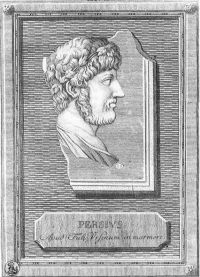
Persius

Definition and stakes

1911 Encyclopædia Britannica, Volume 21… (1911)

“ One of the points of harmony is, however, too subtle for us to believe that a forger evolved it from the works of Persius. It requires indeed a thoughtful reading of the Life before we realize how distinct is the impression it gives of a “bookish” youth, who has never strayed far, at least in spirit, from the domestic hearth and his women-folk. And of course this is notoriously the picture drawn by the Satires. So much better does Persius know his books than the world that he draws the names of his characters from Horace. ”
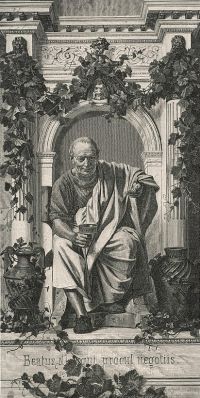
Source: Wikisource

R. W. Browne,  A History of Roman Classical Literature

“ Persius, pure in heart and passionless by education, whilst he lashes wickedness in the abstract, almost ignores its existence, and modestly shrinks from laying bare the secret pollutions of the human heart, and from probing its vileness to the bottom. The amiability, and above all the disinterestedness, which characterize his Satires, fully account for the popularity which they attained immediately on their publication by Cornutus, and the panegyrics of which he was the subject in 416later times. “Persius,” writes Quintilian, [1058] “multum et veræ gloriæ, quamvis uno libro meruit.” ”
Source: Gutenberg

Edmund Luce,  Helps to Latin Translation at Sight

“ AULUS PERSIUS FLACCUS, 34-62 A.D. 1. Life. PERSIUS.
He was born at Volaterrae in Etruria, and was the son of a Roman knight of wealth and rank. At twelve years of age Persius was removed to Rome, where he placed himself under the guidance of the Stoic Cornutus, who remained his close friend to the end of his short life. Persius (Sat. v.)
”
Source: Gutenberg

Get perspective with Kwize: daily news enlightened by great literature