“ In that event, the speed of the whole procession depends entirely on how much the destroyers can stand without being reduced to scrap-iron. Naturally, the ship under escort endeavours to make her speed conform to the best the destroyers can do under the circumstances; but since an extra knot or two an hour might well make all the difference in avoiding a submarine attack, the tendency always is to keep the escorting craft extended to just about their limit of endurance. ”
SS Endurance
Definition and stakes
Quotes about “SS Endurance”
Sir Ernest Henry Shackleton, South: The Story of Shackleton's Last Expedition…
“ The Endurance, the ship which will take the Trans-continental party to the Weddell Sea, and will afterwards explore along an unknown coast-line, is a new vessel, specially constructed for Polar work under the supervision of a committee of Polar explorers. She was built by Christensen, the famous Norwegian constructor of sealing vessels, at Sandefjord. She is barquentine rigged, and has triple-expansion engines giving her a speed under steam of nine to ten knots. To enable her to stay longer at sea, she will carry oil fuel as well as coal. ”
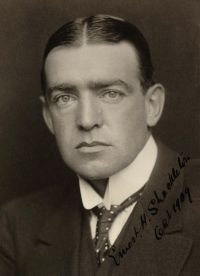
Ernest Henry Shackleton,
South: the story of Shackleton's last expedition…
(1920)
“ When the way was barred by a floe of moderate thickness we would drive the ship at half speed against it, stopping the engines just before the impact. At the first blow the Endurance would cut a V-shaped nick in the face of the floe, the slope of her cutwater often causing her bows to rise till nearly clear of the water, when she would slide backwards, rolling slightly. Watching carefully that loose lumps of ice did not damage the propeller, we would reverse the engines and back the ship off 200 to 300 yds. ”
Sir Edward J. Reed, Modern ships of war (1887)
“ A justifiable limitation is put on the coal endurance and speed, though fair speed is secured; and altogether the plans prove there can be designed vessels of comparatively small dimensions, light draught, great handiness and manœuvring power, which can carry the heaviest guns, and be capable of contending on equal terms with the heaviest European battle-ships. The cut below represents the smaller of the type of coast-defence vessels. ”
Sir Edward J. Reed, Modern ships of war (1887)
“ The torpedo-boat chaser Destructor is not only a good sea-boat, and capable of making a long passage at high speed, but has proved herself to be one of the fastest vessels afloat. She has 350 tons normal displacement, and when fully loaded and equipped 458 tons. Her engines have developed 3829 indicated horse-power. During ten days in November, 1886, a maximum speed of 233⁄4 knots was attained, and on December 13th of that year she reached a mean speed for four hours of 22.65 knots, and an estimated coal endurance of 5100 miles at 111⁄2 knots, and of 700 miles at full speed. ”
Sydney Marow Eardley-Wilmot,
The Development of Navies During the Last Half-Century
(1892)
“ Everything is, and can be without harm, sacrificed to it. But it is far different in a man-of-war. As was long ago remarked, a fighting ship must always be a compromise. There are three great requisites: offensive power, meaning guns and torpedoes; defensive power, meaning armour, whether applied to sides, turrets, barbettes, or decks; and speed, meaning the most powerful engines, combined with the greatest coal endurance, that it is possible to get a ship of given tonnage to carry. ”
Sir Ernest Henry Shackleton, South: The Story of Shackleton's Last Expedition…
“ We could break the young ice in the pool, but the pack defied us. The attempt was renewed on the 11th, a fine clear day with blue sky. The temperature was still low, –2° Fahr. at midnight. After breaking through some young ice the Endurance became jammed against soft floe. The engines running full speed astern produced no effect until all hands joined in “sallying” ship. The dog-kennels amidships made it necessary for the people to gather aft, where they rushed from side to side in a mass in the confined space around the wheel. ”
“ The German battle-cruisers were now close enough for their hulls to be distinguishable. The outline of each ship stood forth, clear-cut and black, against the sky-line. Each was rushing forward at its topmost speed, bearing down with inevitable precision upon the defenceless cargo ship, which, like an exhausted, hunted animal, strained every bolt, bar and rivet to save herself from unutterable disaster. Suddenly, it became apparent that, in addition to the Dreadnought cruisers, the sea was alive with a host of smaller craft--light cruisers and torpedo-boat-destroyers. ”
“ Unheeding our warning hail, she steams across the bows and backs at a high speed: her rounded stern jars on our hull plates, a whaler and the davits catch on a projection and give with the ring of buckling steel—she turns on the throw of the propellers and closes aboard with a resounding impact that sets her living deck-load to stagger.We lose no time. Scrambling down the life-ropes, our small company endeavors to get foothold on her decks. The destroyer widens off at the rebound, but by clutch of friendly hands the men are dragged aboard. One fails to reach safety. ”
Logan Marshall, Horrors and Atrocities of the Great War
“ The great ship, knowing the lurking danger, is traveling at her best speed limit, changing the course from time to time in a zigzag manner. Waiting beneath the surface of the calm sea a big submarine, now said to be capable of discharging a torpedo at a distance of five miles, rolls idly in the underground swell. Her crew is sleeping or talking in the semi-fetid atmosphere that the compressed air tanks relieve from time to time. An officer sits with his eye glued to a periscope, which constantly revolves that he may discern the rising smoke of an approaching vessel. ”
Sydney Marow Eardley-Wilmot,
The Development of Navies During the Last Half-Century
(1892)
“ It is, moreover, fallacious to suppose that to ram a vessel under any circumstances is an easy operation even with a superiority of speed. Accidental collisions with disastrous results have, we know, not been unfrequent. The sinking of the 'Vanguard' off the Irish coast by the 'Iron Duke,' and the loss of the 'Grosser Kurfurst' off Folkestone, from being accidentally rammed by a companion, are instances of this and examples of the power of the ram. To strike a ship at anchor as the 'Cumberland' was struck by the 'Merrimac' does not call forth any great exercise of skill. ”
Richard A. Fletcher, Warships and their story (1911)
“ Are we to see cruisers as much faster than the battleship, as the present cruiser is than the present Dreadnought? If, as is asserted to be possible, the battleship of twenty years hence will attain a speed of 30 knots under internal combustion engines, armed with weapons showing a corresponding advance in power and range and penetration, will the cruiser of that time cover its 40 or 45 knots, and the destroyer hurl itself forward at even greater speed to explode its torpedo, also correspondingly more destructive and deadly than now, at its foes? ”
Sydney Marow Eardley-Wilmot,
The Development of Navies During the Last Half-Century
(1892)
“ Under construction is a very large vessel of 10,500 tons, to be called the 'Rurik,' with a 10-in. belt, powerful armament, high speed, and large coal supply. Now, when cruisers are built of these dimensions, and carrying such an amount of offensive and defensive equipment, it is evident they are not far removed from battle ships. Our 'Admiral' class, of similar tonnage, may be equally employed as cruisers, and thus the tendency is to jumble all up together until a war demonstrates how the classes should be differentiated — a word I should like to dispense with but cannot find a substitute. ”
Sydney Marow Eardley-Wilmot,
The Development of Navies During the Last Half-Century
(1892)
“ How can we expect speed to be maintained when the vessel is thus handicapped? Such considerations have no doubt led us in the latest cruisers of similar dimensions, of which there are several now building, to limit the guns at the bow and stern to a calibre of 6-in. and a weight of 5 tons. Constructed of the length now necessary to obtain the full energy derived from improved powders, they have a long range for such a gun, and throw a shell capable of dealing terrible havoc to any unarmoured structure. No more need be demanded of vessels not primarily designed to fight ironclads. ”
J. W. Duffield, Bert Wilson, Marathon Winner
“ Sailors came running to the deck, and rushed affrightedly to the rail. The excitement spread to other vessels near at hand.A tug, one of the largest, ran alongside the Falcon, whose crew, pursued by fear, began jumping or tumbling over her side on to the tug’s deck. Whistles sounded, and vessels near at hand began drawing away from her with all possible speed.“She must be on fire,” someone said.“She is,” answered Captain Everett, coming up, his face very pale, “and part of her freight, I’m told, is several hundred cases of dynamite. Nothing can save her now. ”
Sydney Marow Eardley-Wilmot,
The Development of Navies During the Last Half-Century
(1892)
“ For it was about this time that a change came over the design of machinery for the propulsion of war vessels, so complete and radical as to mark a distinct epoch in its history. When once the fact had been grasped that all men-of-war for the future would be propelled by the screw, the immense advantage realised by the low position of the main shaft, far below the water line, became apparent, as the engines, being horizontal, would be in a great measure protected from the enemy’s fire, instead of being, as in paddle-wheel ships, dangerously and unavoidably exposed to it. ”
Percy F. Westerman, The Submarine Hunters: A Story of the Naval Patrol Work in the Great War
“ It was late in the afternoon when the Oxford arrived, under her own steam, at Rosyth. Although the dry docks were in use, accommodation was quickly found for the damaged cruiser by the simple expedient of floating out a battleship that was being cleaned and recoated with anti-fouling composition. Since speed is an absolute necessity for efficiency in war-time, it was the practice to dock all the ships of the battle-cruiser and armoured cruiser class in rotation, the margin of safety being sufficient to allow this to be done without impairing the strength of the squadrons. ”
Percy F. Westerman, The Dispatch-Riders: The Adventures of Two British Motor-cyclists in the Great War
“ Owing to the already crippled condition of the German craft, Kenneth could easily out-manoeuvre her. In spite of the risk of a shell from the exasperated Teuton, he kept his vessel about half a mile from the torpedo-boat and awaited the inevitable ending. It was not long in coming. Torn by the well-aimed shells, her mast, funnels, and deck fittings swept clean away, the torpedo-boat settled down. From amidships a cloud of black smoke, tinged with lurid flames, soared skywards. Men were pouring up from the engine-room and throwing themselves into the sea. ”
Sydney Marow Eardley-Wilmot,
The Development of Navies During the Last Half-Century
(1892)
“ She attained a mean speed of 18.779 knots on the measured mile under unfavourable circumstances as regards weather, and has since then frequently achieved 19 knots on actual service. She has taken an active part in all naval manoeuvres of late years, and has been the terror of her imaginary foes, mainly because her engines have never broken down. This is no doubt owing to the fact that the stipulated weight of the machinery was exceeded. The great difficulty in obtaining and maintaining high speeds in the navy has been the incapacity of boilers to withstand the strain put upon them. ”
Augustus Charles Hobart-Hampden,
Sketches From My Life
“ We commenced the chase at 4.30 p.m. Unfortunately our decks were loaded with coal; however, we made a clean thirteen knots. At first it seemed as if we were coming up with the chase, so much so that I felt inclined to fire the long bow gun at her. But I always think and I say from blockade-running experience that firing more or less injures a vessel's speed; so I refrained from doing so. As night closed in a beautiful moon rose and made everything as clear as day. The equality of our speed was most remarkable, inasmuch as the distance between us did not vary a hundred yards in an hour. ”
Lawrence Perry, Our Navy in the War
“ The amount of time which a submersible may [Pg 297] run beneath the waves depends upon her speed. The best of the German undersea boats, it has been estimated, could not remain under more than three hours at high speed. They then had to come up, as the navy saying has it, for "more juice." To be more explicit, a submersible has a mechanical process, a combination motor and dynamo between the engine, which drives the boat when it is on the surface, and the thrust block through which the shaft runs to the propeller. ”
Percy F. Westerman, The Thick of the Fray at Zeebrugge…
“ Speed was promptly reduced in the hope that the inrush of water might be checked. At the same time sound-signals were made in order to get in touch with the off-shore destroyers. For nearly half an hour M.-L. 254 crawled along at slow speed without aid being forthcoming. It seemed as if her deck cargo of human beings—nearly all of them wounded—would soon be struggling for dear life in the numbing water, for the metal dinghy was hopelessly damaged and practically all the life-saving devices had been either swept overboard or destroyed by shell-fire. ”
Willis J. Abbot,
American Merchant Ships and Sailors
(1902)
“ Even if the great steamship were stopped at once, her momentum would carry her a mile beyond the spot before a boat could be lowered, and then it would be almost impossible to find the floating wreckage in the fog. So, usually, the steamships press on with unchecked speed, their officers perhaps breathing a sigh of pity for the victims, but reflecting that it is a sailor's peril to which those on the biggest and staunchest of ships are exposed almost equally with the fishermen. ”
Morgan Robertson,
The Wreck of the Titan
“ In the engine-room, oilers passed to and fro, in and out of the plunging, twisting, glistening steel, with oil-cans and waste, overseen by the watchful staff on duty, who listened with strained hearing for a false note in the confused jumble of sound—a clicking of steel out of tune, which would indicate a loosened key or nut. On deck, sailors set the triangular sails on the two masts, to add their propulsion to the momentum of the record-breaker, and the passengers dispersed themselves as suited their several tastes. ”
Sydney Marow Eardley-Wilmot,
The Development of Navies During the Last Half-Century
(1892)
“ She was afterwards deprived of half her boiler power, to increase her coal carrying capacity, and sent to the Mediterranean to do duty as a despatch vessel, for which service she could always be relied upon as a 12-knot steamer. Paddle-wheel men-of-war were at one lime the most important factor in our navy — the manufacture of their engines called forth the utmost skill in design, ingenuity of detail, and accuracy of workmanship that were in those days available — but their end was near, and they were soon to become as obsolete and forgotten as though they had never been. ”
Baron John Arbuthnot Fisher Fisher, Records, by Admiral of the Fleet… (1919)
“ Coal-burning Battleships then under construction were re-designed to burn oil, with great increase of their efficiency and speed, and the last two of these eight Battleships were scrapped (the “Renown” and “Repulse”) , and, together with three new vessels—the “Courageous,” “Glorious,” and “Furious”—were arranged to have immense speed, heavy guns and unprecedented light draught of water, thus enabling them to fulfil the very work described in this letter below of absolutely disposing of hostile light cruisers and following them into shallow waters. ”
Sydney Marow Eardley-Wilmot,
The Development of Navies During the Last Half-Century
(1892)
“ The 75-ton gun is the largest she has afloat. While we had been hampered in the production of fast steam cruisers by the endeavour to give them good sailing qualities as well, the French clearly recognised, twenty years ago, that sail power must be sacrificed and longer vessels built to give speed under steam. This was carried out in two vessels, the 'Sané' and 'Seignelay,' launched respectively in 1870 and 1874, where with a displacement of 1900 tons a speed of 15 knots was obtained. The steam speed of our cruisers of that size rarely exceeded 13 knots. ”
Percy F. Westerman, The Submarine Hunters: A Story of the Naval Patrol Work in the Great War
“ Experience had told them that speed was one of the essentials to safety, even when in land-locked waters such as the Firth of Clyde. "You don't look like leaving us in a hurry," remarked Midshipman Sefton, when he communicated the latest change of plans to Trefusis and his chum. "We don't mind in the slightest," Ross hastened to assure him. "It's jolly comfortable on board the Oxford." "Wait until we're ordered straight away for patrol work," said Sefton. "It's more than likely that we may be pushed off to the Norwegian coast without having so much as a sniff at Rosyth. ”