“ In the same way, the letters prefixed to other Suras may be monograms, or abbreviations, or initial letters of the names of the persons to whom the copies of the respective Suras belonged. ↑ This Sura has been supposed by ancient Muslim authorities to be, not the oldest, the second revelation, and to have followed Sura xcvi.But this opinion probably originated from the expression in v. i compare with Sura xcvi. 4. Verses 17–33 read like a later addition, and this passage, as well as verse 48–50, has been classed with the Medina revelations. ”
Sura
Definition and stakes
Quotes about “Sura”
Jonathan Rigg, A Dictionary of the Sunda language (1862)
“ Sur bai di gusur, he trailed him along the ground. Sur, Arabic, the zodiacal sign Taurus. Sura, the word occurs often in the composition of proper names. sura, C. 752, from Sura, to shine, to be radiant. A god, a deity, the sun; a sage, a learned man; power, majesty, dignity, auspiciousness. In Java Sura generally is taken for a hero, a brave man. Surabaya, the capital of the east-end of Java, in the straits of Madura, and name of an extensive residency. Sura, vide voce, or Suru, C. 754, a warrior, a hero. ”
Various contributing authors, Dictionary of Greek and Roman Biography and Mythology (1870)
“ Catil. 5) , regard Sulla as a diminutive of Sura, which was a cognomen in several Roman gentes [Sura] , and we are disposed to accept this as the most probable explanation of the word. It would be formed from Sura on the same analogy as puella from puera, and tenellus from tener (comp. Schneider, Elementarlehre der lateinischen Sprache, vol. i. p. 47, &c.) . There is no authority for writing the word Sylla, as is done by many modern writers. On coins and inscriptions we always find Sula or Sulla, never Sylla. ”
G. Maspero, History of Egypt, Chaldæa, Syria…
“ Drawn by Faucher-Gudin, from Layard’s sketch Without losing a moment, Assur-nazir-pal marched down the course of the Khabur, hastily collecting the tribute of the cities through which he passed. The defenders of Sura were disconcerted by his sudden appearance before their town, and their rulers came out and prostrated themselves at the king’s feet: “Dost thou desire it? it is life for us;—dost thou desire it? it is death;—dost thou desire it? what thy heart chooseth, that do to us!” ”
Georg August Schweinfurth,
The heart of Africa, Vol. 2 (of 2…
(1873)
“ The second Sura of the Koran begins with the prescription: “To open the way of God, slay all those who would slay you; but be not yourselves the first to commence hostilities, for God loves not sinners; slay them wherever you meet them; drive them away from the spot from which they would drive you, for temptation is worse than a death-blow.” ”
G. Margoliouth, The Koran (Al-Qur'an)
“ Others understand, the seven long Suras; or, the fifteen Suras which make a seventh of the whole; or, this Sura (Hedjr) as originally the seventh. Mathani is an allusion, according to some, to the frequency with which the fatthah is to be repeated; or, to the frequent repetitions of great truths, etc., in order to impress them on the memory of the hearer and reader ”
Moulavi Gerágh Ali, A Critical Exposition of the Popular 'Jihád'…
“ The people of Mecca submitted without bloodshed, and hence it is obvious that the injunctions contained in the commencement of the ninth chapter of the Koran were never carried out. They remained as dead letter, and will, I think, so remain perpetually. Almost all European writers, as far as I know, labour under the delusion that at the end of the ninth year Mohammad published the opening verses of the ninth Sura, commonly designated Súra Barát. ”
Short stories from the Balkans (1919)
“ In all the windows and doors are crowds of greedy observers.“Ah, ha,” thinks Leiba. “Now they have caught a robber!”The crowd comes nearer. Sura slips out of the crowd and comes up to where Leiba is standing on the rest-house steps.“What’s up, Sura?{59}”“A madman from Golia [2] —escaped.”“Let’s close up so he can’t attack us.”“Oh, they’ve bound him. But before they did it, he beat the soldiers. The bad tempered Christians shoved a Jew out of the crowd, and the madman bit him on the cheek.” ”
Arthur Anthony Macdonell,
A History of Sanskrit Literature
“ One poet mentions anger, dice, and surā as the causes of various sins; while another speaks of men made arrogant with surā reviling the gods. Its use must have been common, for by the time of the Vājasaneyi Saṃhitā, the occupation of a “maker of surā” (surākāra) or distiller had become a profession.One of the chief occupations of the Vedic Indians was of course warfare. They fought either on foot or on chariots. The latter had two occupants, the fighter and the driver. This was still the case in the Mahābhārata, where we find Kṛishṇa acting as charioteer to Arjuna. ”
Maneckji Nusservanji Dhalla,
History of Zoroastrianism
(1938)
“ Weal and immortality are the other boons that are asked from the fire. [20] Good reward and good renown and fulfilment of one's wishes now and forever and the shining, all-happy abode of the righteous are asked from the fire of Ahura Mazda. [21] Ardvi Sura is invoked to grant heroic sons of innate wisdom that may further one's house, village, town, country, and the religion of the country. [22] The waters of Ardvi Sura are asked to give riches and virtuous offspring that may not wish ill of any one ”
Cherágh Ali, A Critical Exposition of the Popular 'Jihád'
“ The fifth verse of the ninth Sura is by no means an injunction to attack first or wage an aggressive war. This verse is one of the several published at Medina after the Meccans had violated the treaty of Hodeibia and attacked the Bani Khozaa, who were in alliance with Mohammad. The Meccans were given four months' time to submit, in default of which they were to be attacked for their violation of the treaty and for their attacking the Bani Khozaa. They submitted beforehand, and Mecca was conquered by compromise. The verses referred to above (Sura IX, 1-15, &c.) ”
Edward Sell, The Faith of Islam
“ The Arabs call each of these divisions a Juz. Owing to this division, a pious man can recite the whole Qurán in a month, taking one Sípára each day. Musalmáns never quote the Qurán as we do by Súra and Áyat, but by the Sípára and Rukú', a term I now proceed to explain. ”
G. Margoliouth, The Koran (Al-Qur'an)
“ In no other Sura beside this is one subject treated of throughout. It was recited to the first eight of the Ansars who were converted, and clearly proves that Muhammad must have been in confidential intercourse with learned Jews.2 The word Koran is here used in the same sense as Sura.3 Muhammad was either unaware of the previous dream mentioned, Gen. xxxvii. 7, or passes it by in silence.4 The captious and unbelieving Koreisch.5 Wir mussten denn zuerst das Leben einbüssen. Wahl. Ullm. Maracci.6 Lit. your minds have made a thing seem pleasant to you. ”
G. Margoliouth, The Koran (Al-Qur'an)
“ Lo! ye are they, who are called to expend for the cause of God: and some of you are niggards: but whoso is niggardly shall be niggard only to his own loss; for God is the Rich, and ye are the poor: and if ye turn back, He will change you for another people,8 and they shall not be your like!_______________________1 This Sura was revealed at a period after the victory at Bedr, when there was still some hesitation on the part of Muhammad's followers to take decided steps for securing their position. ”
“ This change of the Kebla from Jerusalem to Mecca shows that this part of the Sura was revealed at a time when the breach between Muhammad and the Jews was past healing; i.c. in the first half of the second year of the Hejira. See Thilo's. Cod. Apoc. p. 21, n.60 That is, the Jews are really convinced of the truth of Muhammad's mission.61 That is, warring with the infidels. The precise date of verses 148-152 depends upon whether this passage refers to the battle of Bedr or Ohod.62 These words are constantly used by the pious Muslims when in any trouble. ”
Moulavi Gerágh Ali, A Critical Exposition of the Popular 'Jihád'…
“ If it be admitted that the preliminary verses of Sura IX of the Koran were revealed or published for the first time in the last month of the ninth year of the Hegira, then they—the verses—become aimless, without being pregnant of any object in view. They contain injunctions for carrying hostile operations against those who had broken certain treaties, had helped others against the Moslems, and themselves had also attacked them. They proclaimed war against certain tribes, whose people did not regard ties of blood and good faith, and had been the first aggressors against the Moslems. ”
G. Margoliouth, The Koran (Al-Qur'an)
“ See Sura [lxxxvii.] vii. 168, and v. 73 below.19 See Sura [lxv.] xxi. 49.20 Lit. slay one another.21 The Talmudists relate how the Israelites who had died, on hearing the divine voice, etc., were restored by the intercession of the Law itself. Sanh. 5.22 By storing them up in violation of God's command.23 Jericho according to some commentators, Jerusalem according to others, but see verse 58.24 See Sura [lxxxvii.] vii. 162.25 Lit. all men. This incident is perhaps inadvertently borrowed from Ex. xv. 27. ”
Roy Floyd Dibble, Mohammed (1926)
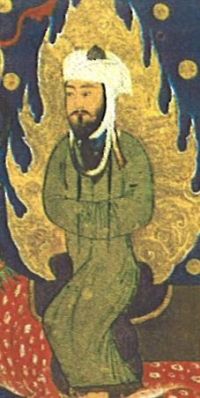
“ In the earlier Koran, he is characterized as the “man in the blanket,” or the “man who is wrapped up.” For he fully appreciated the necessity of keeping his followers in a state of protracted mystification, and to that end he made use of many theatrical tricks. He would drum up a crowd with his ludicrous snortings and puffings until the resounding cry, “Inspiration hath descended on the Prophet!” assured him that he had a sufficiently large audience to warrant the ebullition of a new Sura. ”
Hadith — Volume 004, Book 058: Merits of the Helpers in Madinah…
“ The Prophet said, "Stay where you are and do not allow anybody to reach us." So, in the first part of the day Suraqa was an enemy of Allah's Prophet and in the last part of it, he was a protector. Then Allah's Apostle alighted by the side of the Al-Harra and sent a message to the Ansar, and they came to Allah's Prophet and Abu Bakr, and having greeted them, they said, "Ride (your she-camels) safe and obeyed." Allah's Apostle and Abu Bakr rode and the Ansar, carrying their arms, surrounded them. The news that Allah's Prophet had come circulated in Medina. ”
Theodore R. W. Lunt, The story of Islam (1909)
“ Busy and occupied with fighting as those last years of Mohammed's life were, his work as religious prophet was not neglected. He poured forth fresh suras as each new occasion demanded. True, they seem to have lost their old rugged earnestness now, and much of their sense of God, but he declares them still to be the revelation of the Almighty, and to have existed in heaven from the beginning of eternity. Many suras are concerned with the most trivial and unimportant matters treated in the most commonplace way. ”
T. W. Allies, Peter's Rock in Mohammed's Flood…
“ They seek to extinguish the light of God with their mouths: but God willeth no other than to perfect His light, although the infidels be averse thereto. It is He who hath sent His Apostle with the direction and true religion, that He may cause it to appear superior to every other religion, although the idolaters be averse thereto.” This Sura was the last in time of those issued. “It96 bears the stamp of much reflection and careful execution.” In March, 631, Mohammed had sent the greater pilgrimage to Mecca, under guidance of Abu Bekr. ”
G. Margoliouth, The Koran (Al-Qur'an)
“ Hist. Ar. p. 62. And thus the comm. generally. But Geiger (p. 192) and Nöldeke (p. 77 n.) understand the passage of Dan. iii. But it should be borne in mind that the Suras of this early period contain very little allusion to Jewish or Christian legends. ”
S. Khuda Bukhsh, The Islam of Mohamed
“ They walk in the guidance of their Lord, and they are the blessed. As to them who believe not—it is indifferent to them whether thou exhortest them or not exhortest them. They will not believe. Sealed hath Allah their hearts and their ears and over their eye is darkness and theirs will be a great punishment.—” “And in this wise,” Goethe continues, “we have surah after surah. ”
Collier's New Encyclopedia — Surabaya (1921)
“ The houses are very good, and some are elegant, particularly the country seats of private individuals. Surabaya is situated within that narrow strait which is formed by the islands of Java and Madura, and is defended by batteries. ”
Moulavi Gerágh Ali, A Critical Exposition of the Popular 'Jihád'…
“ Chapter XXXI is one of the oldest of the Meccan Suras, having been revealed between the sixth and tenth year of the Prophet's mission. The admonition relates to a man's behaviour to his parents. He is enjoined to treat them with kindness, but not to obey them if they lead him to polytheism. ”
Edwin Balmer,
The Surakarta
(1913)
“ Owing to the fact that you have not yet discovered anything missing—though everything has been disturbed—I feel that I am confirmed in my first opinion that this search is a direct result of the complications over the loss of the Surakarta. ”
Jonathan Rigg, A Dictionary of the Sunda language (1862)
“ To this moment sometimes the Sunda mountaineers scratch a bit of fresh green bambu with a sharp pointed knife and in Arabic characters when better writing materials fail them. The word Surat, altered to Suratra, also exist in the Malagasi of Madagascar, and means not only writing, but also painting. This Crawfurd, in his Dissertation, page 157, considers as of Arabic origin. The word Surat, when it assumes the verbal form becomes in Sunda Nyurat, Nyuratan, when the intitial Sa is dropped. ”
“ We gradually lose the Poet in the missionary aiming to convert, the warm asserter of dogmatic truths; the descriptions of natural objects, of the judgment, of Heaven and Hell, make way for gradually increasing historical statements, first from Jewish, and subsequently from Christian histories; while, in the 29 Suras revealed at Medina, we no longer listen to vague words; often as it would seem without positive aim, but to the earnest disputant with the enemies of his faith, the Apostle pleading the cause of what he believes to be the fruit of God. ”
Hosakote Krishna Sastri, South-Indian Images of Gods and Goddesses (1916)
“ VajraprastārinīVajraprastārinī [20] is stated to be seated on a lotus, in a boat of blood floating in an ocean of blood. The limbs of her body as well as her head are also bathed in blood. SurāSurā, wine personified, is represented as a terrible unmarried goddess of eighteen arms and of three eyes. She is tall of form and is as dangerous as destructive fire. She is a terror to the demons and a blessing to angels. In plain language Umā herself is described to be the goddess of wine and Siva (her consort) to be the power of intoxication thereof. ”
Frances Delavan Page Jermain,
In the path of the alphabet
“ The word Deva, from the Sanskrit Div, signified “brilliant,” “shining.” In its spiritual sense, the “Shining Ones” applied originally to the ministering spirits, the bright messengers of Asura. From the word Deva, we have the word Deus, God; Divus, divine; dæmons, and other similar forms in various branches of Aryan speech.At first, Asura is the most sacred name used [152] for Deity. Later on, with the increase of gods in the Hindu pantheon, the term Asura is conferred as a highest dignity upon the greater gods, as Asura-Varuna, Asura-Indra. ”
William Crooke, The Popular Religion and Folk-Lore of Northern India…
“ Sûraj Nârâyan, the Sun Godling. The first and greatest of the “pure” godlings is Sûrya or Sûraj Nârâyan, the Sun godling. He is thus regarded as Nârâyana or Vishnu occupying the sun. A curiously primitive legend represents his father-in-law, Viswakarma, as placing the deity on his lathe and trimming away one-eighth of his effulgence, leaving only his feet. Out of the blazing fragments he welded the weapons of the gods. Sûrya was one of the great deities of the Vedic pantheon: he is called Prajapati or “lord of creatures:” he was the son of Dyaus, or the bright sky. ”
1911 Encyclopædia Britannica (1911)
“ SURABAYA (Dutch Soerabaja) , a seaport of Java, in the eastern division of the island, on the narrow Surabaya strait, which separates the island of Madura from Java, and at the mouth of the Kali Mas River. Pop. (1000) , 146,944 (Europeans 8906; Chinese 13,035) . Surabaya is the principal mercantile town in Java. Its roadstead is sheltered by Madura, and it has important dockyards. It is also the headquarters of the military authorities for East Java, and has artillery workshops. Railways running north-west, south-west and south give it connexions throughout the island. ”