“ Shanter was the real name of a farm near Kirkoswald, then occupied by a Douglas Grahame, who was much of Tam’s character, and was well content to be called by his country neighbours Tam o’ Shanter for the rest of his life, after Burns had made the name of the farm immortal. ”
Tam o' Shanter
Definition and stakes
The theme of “Tam o' Shanter” has been addressed by authors such as Clayton Mackenzie Legge, Robert Burns, F. W. H. Myers, W. L. Manson and Bret Harte. It is often associated with terms like Tristram, shanty, Toby, uncle and family.
Quotes about “Tam o' Shanter”
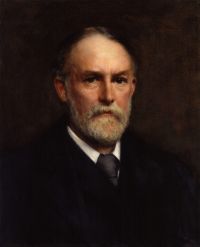
“ Who, but some impenetrable dunce or narrow-minded puritan in works of art, ever read without delight the picture which he has drawn of the convivial exaltation of the rustic adventurer Tam o' Shanter? The poet fears not to tell the reader in the outset that his hero was a desperate and sottish drunkard, whose excesses were as frequent as his opportunities. ”

“ To his surprise it was the young girl he had met a few months before on the Skyscraper. But the Tam o’ Shanter was replaced by a little straw hat; and a light dress, summery in color and texture, but more in keeping with her rustic surroundings, seemed as grateful and rare as the sunshine. Without knowing why, he had an impression that it was of her own making—a gentle plagiarism of the style of her more fortunate sisters, but with a demure restraint all her own. As she recognized him a faint color came to her cheek, partly from surprise, partly from some association. ”
Clayton Mackenzie Legge, Highland Mary: The Romance of a Poet
“ Here her voice dropped to a whisper, “or some day ye’ll be catched wi’ warlocks in the mire, Tam O’Shanter.” He stopped his noise and straightened up in his chair.“Aye, and ghosties and witches will come yelpin’ after ye as ye pass the auld haunted kirk at Alloway,” added Souter sepulchrally, leaning over Tam with fixed eyes and hand outstretched, clutching spasmodically at imaginary objects floating before Tam’s suspicious, angry eyes. ”
W. L. Manson, The Highland bagpipe (1901)
“ In the course of time, however, he became more amiable, and, drawing up his tail over his shoulder, he fingered it as if it were the chanter of the pipes, and there poured out a most inspiriting jig, the force of which neither demon nor man could resist, and the performance rivalled that in Alloway’s “auld haunted kirk.” But, and this is where Tam o’ Shanter failed and the innkeeper succeeded, “mine host” remembered the tune after his recovery, and played it, and the last teller of the story says he “heard it played by another party who had learned it from him.” ”
James Grant, The King's Own Borderers: A Military Romance… (1865)
“ Every shot rung with a hundred reverberations between the mountain peaks; Quentin, however, never looked back, but rode recklessly and breathlessly on, thinking as the old lady scoured after him on her mule, and as he lashed his horse without mercy, that he somewhat resembled Tam o' Shanter pursued by Cuttie Sark. There was no contingency of war of which he had a greater horror than that of becoming a prisoner. If taken by the enemy, years might pass on and still find him in their hands, and when released or exchanged, he would be little better than a private soldier—not so good, in fact. ”
 Ruth Edna Kelley,
The Book of Hallowe'en
Ruth Edna Kelley,
The Book of Hallowe'en
“ Burns: Tam o' Shanter. [1] Ring.The light for the revelry came from a torch [Pg 68] flaring between the horns of the Devil's steed the goat, and at the close the ashes were divided for the witches to use in incantations. People imagined that cats who had been up all night on Hallowe'en were tired out the next morning.Tam o' Shanter who was watching such a dance "By Alloway's auld haunted kirk"in Ayrshire, could not resist calling out at the antics of a neighbor whom he recognized, and was pursued by the witches. ”
Charles Mackay, Memoirs of Extraordinary Popular Delusions and the Madness of Crowds
“ Thus did they nurse their folly, as the good wife of Tam O’Shanter did her wrath, “to keep it warm.” ”
Clayton Mackenzie Legge, Highland Mary: The Romance of a Poet
“ Not waiting for [6] their answer, he continued proudly, “Nae witches can catch Tam O’Shanter when he’s astride his auld mare’s back, whether he is drunk or sober,” and he glared defiantly at his listeners. At that moment the door from the “ben” opened, and Gilbert Burns entered the room. An angry frown wrinkled his forehead as his gaze fell upon the two old cronies. A hard worker himself, he could not abide laziness or shiftlessness in another. ”
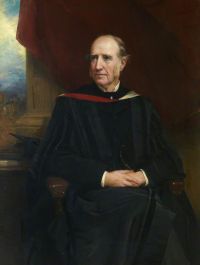 John Campbell Shairp,
Robert Burns
John Campbell Shairp,
Robert Burns
“ In no other instance, except perhaps in The Jolly Beggars, had he done this; and in that cantata, if the genius is equal, the materials are so coarse, and the sentiment so gross, as to make it, for all its dramatic power, decidedly offensive. It is strange what very opposite judgments have been formed of the intrinsic merit of Tam o' Shanter. Mr. Carlyle thinks that it might (p. 202) have been written "all but quite as well by a man, who, in place of genius, had only possessed talent; that it is act so much a poem, as a piece of sparkling rhetoric ”
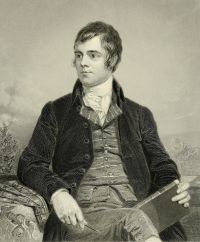 Robert Burns,
Tam O'Shanter
(1825)
Robert Burns,
Tam O'Shanter
(1825)
“ Remember Tam Shanter's mare. ↑ It is a well known fact, that witches or any evil spirts have no power to follow a poor wight any farther than the middle of the next running stream.—It may be proper like wise to mention to the benighted traveller, that when he fall in with bogles, whatever danger may be this going, forward there is much more danger in turning back. ”
Robert Burns,
Aloway Kirk, or, Tam o' Shanter
(1817)
“ The obliging landlord has on the walls of the house painted in bright letters, "Burns's Cottage. Robert Burns the Ayrshire Poet, was born under this roof, on the 25th January, 1759. In one of the largest Rooms, there stands a drawing of the poet on canvas. Many of the Travellers who visit Ayr, walks out to the cottage and the ruins of Alloway Kirk the scene of action with Tam o' Shanter and the Witches. The Kirk stands without a roof in the midst of the Burying ground. ”
 Laurence Sterne,
The Life and Opinions of Tristram Shandy…
(1759)
Laurence Sterne,
The Life and Opinions of Tristram Shandy…
(1759)
“ Let no man, who has read my father's first and second beds of justice, ever rise up and say again, from collision of what kinds of bodies light may or may not be struck out, to carry the arts and sciences up to perfection.—Heaven! thou knowest how I love them;—thou knowest the secrets of my heart, and that I would this moment give my shirt—Thou art a fool, Shandy, says Eugenius, for thou hast but a dozen in the world,—and 'twill break thy set.— No matter for that, Eugenius ”
 Mary Martha Sherwood,
Shanty the Blacksmith; a Tale of Other Times
Mary Martha Sherwood,
Shanty the Blacksmith; a Tale of Other Times
“ Whilst Tamar was under her seventh year, she never rambled beyond the moat alone; but being seven years old, and without fear, she extended her excursions, and not unseldom ran as far as Shanty's shed.The old man had always taken credit to him self for the part he had had in the prosperity of the little girl, and Mrs. Margaret did not fail to tell her how she had first come to the Tower in Shanty's arms; on these occasions the child used to say,--"then I must love him, must not I ma'am?" ”
 Bankim Chandra Chattopadhyay,
Anandamath — Part IChapter XVI
(1941)
Bankim Chandra Chattopadhyay,
Anandamath — Part IChapter XVI
(1941)
“ That's very simple, Shanti, very simple!''I happen to know the nature of the atonement for such sins!' she retorted, smiling. 'But I wonder if the punishment for a single offence is the same as for a hundred such offences?''Why do you ask such a question?' Jiban inquired in sorrow and in surprise.'I have only one request to make. Please do not make atonement for this breach of vow before you meet me again.''You may rest assured of that, Shanti. I am not going to die before seeing you again; that is certain. There is no hurry for death anyway. I must not stay here any longer. ”
“ She pointed to the newspaper. "With garbage like that? Head cold!" Her face flushed, and she turned her back angrily. "I know your writing, Mr. Shandor. I've been exposed to it for years. You've never written an honest, true story in your life, but you always want the truth to start with, don't you? I'm to give you the truth, and let you do what you want with it, is that the idea? No dice, Mr. Shandor. And you even have the gall to brag about it!"Shandor flushed angrily. "You're not being fair. ”
Mary Martha Sherwood,
Shanty the Blacksmith; a Tale of Other Times
“ What may that be which you are now shaping; why may it not serve my turn as well as another? so let me have it, and you shall have its worth down on the nail.""Did not I tell you," said Shanty, sullenly, "that it must be a cast shoe that must keep off a witch; every fool allows that.""Well," said the young man, looking about him, "have you never a cast shoe?""No," replied Shanty, "I have none here fit for your turn.""I am not particular," returned the young man, "about the shoe being an old one; there is as much virtue, to my thinking, in a new one; so let me have that you are about." ”
Mary Martha Sherwood,
Shanty the Blacksmith; a Tale of Other Times
“ Then followed speculations on the parentage of Tamar, and old Shanty asserted that he believed her to be nothing more or less than the daughter of the gipsy hag who had laid her at his door. Some said she was much to good to be the child of a gipsy; and then Shanty asserted, that the grace of God could counteract not only the nature of a child of a vagrant of the worst description, but even that of such vagrant himself; the Spirit of God being quick and powerful, and sharper than a two-edged sword. ”
Laurence Sterne,
The Life and Opinions of Tristram Shandy…
(1759)
“ Now, my father, as I told you last year, detested all this—He pick'd up an opinion, Sir, as a man in a state of nature picks up an apple.—It becomes his own—and if he is a man of spirit, he would lose his life rather than give it up. I am aware that Didius, the great civilian, will contest this point; and cry out against me, Whence comes this man's right to this apple? ex confesso, he will say—things were in a state of nature—The apple, is as much Frank's apple as John's. Pray, Mr. Shandy, what patent has he to shew for it? ”
Laurence Sterne,
The Life and Opinions of Tristram Shandy…
(1765)
“ This was my father Mr. Shandy's hypothesis; concerning which I have only to add, that my brother Bobby did as great honour to it (whatever he did to the family) as any one of the great heroes we spoke of:—For happening not only to be christen'd, as I told you, but to be born too, when my father was at Epsom,—being moreover my mother's first child,—coming into the world with his head foremost,—and turning out afterwards a lad of wonderful slow parts,—my father spelt all these together into his opinion; and as he had failed at one end,—he was determined to try the other. ”
Laurence Sterne,
The Life and Opinions of Tristram Shandy…
(1761)
“ It is in vain longer, said my father, addressing himself as much to Ernulphus's curse, which was laid upon the corner of the chimney-piece,—as to my uncle Toby who sat under it—it is in vain longer, said my father, in the most querulous monotone imaginable, to struggle as I have done against this most uncomfortable of human persuasions—I see it plainly, that either for my own sins, brother Toby, or the sins and follies of the Shandy-family, heaven has thought fit to draw forth the heaviest of its artillery against me ”
Laurence Sterne,
The Life and Opinions of Tristram Shandy…
“ What a jovial and a merry world would this be, may it please your worships, but for that inextricable labyrinth of debts, cares, woes, want, grief, discontent, melancholy, large jointures, impositions, and lies!Doctor Slop, like a son of a w——, as my father called him for it,—to exalt himself,—debased me to death,—and made ten thousand times more of Susannah’s accident, than there was any grounds for; so that in a week’s time, or less, it was in everybody’s mouth, That poor Master Shandy asterisks ("mastershandy",1,1) ”
“ Shandy takes bodily shape and consistency before our eyes. It is a mistake, I think, of Sir Walter Scott's to regard the portrait of this eccentric philosopher as intended for a satire upon perverted and deranged erudition—as the study of a man "whom too much and too miscellaneous learning had brought within a step or two of madness." Sterne's conception seems to me a little more subtle and less commonplace than that. Mr. Shandy, I imagine, is designed to personify not "crack-brained learning" so much as "theory run mad." ”
Laurence Sterne,
The Life and Opinions of Tristram Shandy…
“ CHAPTER XXXII MY UNCLE TOBY’S APOLOGETICAL ORATION I am not insensible, brother Shandy, that when a man whose profession is arms, wishes, as I have done, for war,—it has an ill aspect to the world;——and that, how just and right soever his motives and intentions may be,—he stands in an uneasy posture in vindicating himself from private views in doing it.For this cause, if a soldier is a prudent man, which he may be without being a jot the less brave, he will be sure not to utter his wish in the hearing of an enemy ”
Laurence Sterne,
The Life and Opinions of Tristram Shandy…
(1759)
“ Slop, (parodying my uncle Toby's hobby-horsical reflection; though full as hobby-horsical himself) —do I know, Captain Shandy, what might have become of the garrison above stairs, in the mutiny and confusion I find all things are in at present, but for the subordination of fingers and thumbs to...—the application of which, Sir, under this accident of mine, comes in so a propos, that without it, the cut upon my thumb might have been felt by the Shandy family, as long as the Shandy family had a name. ”
Laurence Sterne,
The Life and Opinions of Tristram Shandy…
“ Great wits jump: for the moment Dr. Slop cast his eyes upon his bag (which he had not done till the dispute with my uncle Toby about midwifery put him in mind of it) —the very same thought occurred.—’Tis God’s mercy, quoth he (to himself) that Mrs. Shandy has had so bad a time of it,——else she might have been brought to bed seven times told, before one half of these knots could have got untied.——But here you must distinguish—the thought floated only in Dr. Slop’s mind, without sail or ballast to it, as a simple proposition ”
“ That is too serious a matter with both of them; their mutual desire to share each other's ideas and tastes is too strong; and each time that the philosopher shows his impatience with the soldier's fortification-hobby, or the soldier breaks his honest shins over one of the philosopher's crotchets, the regret and remorse on either side is equally acute and sincere. It must be admitted, however, that Captain Shandy is the one who the more frequently subjects himself to pangs of this sort, and who is the more innocent sufferer of the two. ”
 Hippolyte Taine,
History of English Literature Volume 2…
Hippolyte Taine,
History of English Literature Volume 2…
“ Thus, to read Sterne we should wait for days when we are in a peculiar kind of humor, days of spleen, rain, or when through nervous irritation we are disgusted with rationality. In fact his characters are as unreasonable as himself. He sees in man nothing but fancy, and what he calls the hobby-horse—Uncle Toby's taste for fortifications, Mr. Shandy's fancy for oratorical tirades and philosophical systems. ”
Frederic Stanhope Hill, Twenty years at sea: Leaves from my old log-books (1893)
“ A really good shantier received larger pay than the other men in the gang, although his work was much less laborious. Their songs, which always had a lively refrain or chorus, were largely what are now called topical, and often not particularly chaste. Little incidents occurring on board ship that attracted the shantier’s attention were very apt to be woven into his song, and sometimes these were of a character to cause much annoyance to the officers, whose little idiosyncrasies were thus made public. ”
Bankim Chandra Chattopadhyay,
Anandamath — Part IIChapter II
(1941)
“ Nimi understood Shanti's mood.'Isn't it nice, Shanti, that you met my brother?' Nimi asked. Shanti said nothing. Nimi felt that her sister was not in a mood to give expression to her thoughts. She knew too that Shanti was never fond of speaking out her inner thoughts. So she changed the topic of conversation by asking: 'Look here, sister, how do you like my child?''Where did you get the child, sister?' Shanti asked. 'When did you give birth to a baby?''Good gracious! You should be ashamed of your ignorance. The child is not mine. ”
Laurence Sterne,
The Life and Opinions of Tristram Shandy…
(1761)
“ Whilst I am worth one, to pay a weeder,—thy path from thy door to thy bowling green shall never be grown up.—Whilst there is a rood and a half of land in the Shandy family, thy fortifications, my dear uncle Toby, shall never be demolish'd. ”
 Leslie Stephen,
Hours in a Library, Volume 3
Leslie Stephen,
Hours in a Library, Volume 3
“ The elder Shandy could not have found in the universe a listener more admirably calculated to act as whetstone for his strangely-constructed wit, to dissent in precisely the right tone, not with a brutal intrusion of common-sense, but with the gentle horror of innocent astonishment at the paradoxes, mixed with veneration for the portentous learning of his senior. By looking at each brother alternately through the eyes of his relative, we are insensibly infected with the intense relish which each feels for the cognate excellence of the other. ”
