“ The value of the Twelve Tables consists not in any approach to symmetrical classification or even to terse clarity of expression, but in the publication of the method of procedure to be adopted, especially in civil cases, in the knowledge furnished to every Roman of high or low degree as to what were both his legal rights and his legal duties, in the political victory won by the plebeians, who compelled the codification and the promulgation of what had been largely customary law interpreted and administered by the patricians primarily in their own interests. ”
Twelve Tables
Definition and stakes
The Twelve Tables, Rome’s foundational legal code promulgated in 449 BC, formalized the rights and obligations of Roman citizens, converting unwritten customary law into a public, written system. Initially a response to plebeian demands for legal equality, the Tables ensured procedural fairness, outlined private rights, and helped balance power between patricians and plebeians.
Cicero praised them as surpassing philosophical libraries in authority and utility, while their provisions—ranging from debt enforcement to familial structures—reflect a practical fusion of tradition and progress. Their legacy lies in establishing legal transparency, though their shortcomings in addressing agrarian issues or fully erasing class divisions highlight their role as a significant, yet incomplete, step toward Roman legal fairness.
Quotes about “Twelve Tables”
“ While there is no evidence whatever that any enactment of the Twelve Tables reproduced in any form the terms of the Athenian statute here quoted, still the Twelve Tables may have contained some such provisions. [33] What were these conditions we know not; all that we have from this item are the unbracketed words, which are quoted as examples of how words change their meanings and which are assigned to the Twelve Tables. [34] Some scholars suppose that only branches over fifteen feet above ground are meant. In any case the idea is that shade from the tree may not damage a neighboring estate. ”
“ UNPLACED FRAGMENTS There are extant about a dozen fragments of whose place in the Twelve Tables we are ignorant. In nearly every instance these fragments consist of only one word or phrase, which later Latin antiquarians have preserved to illustrate an ancient spelling or to explain an archaic usage or to point a definition.The longest fragment only is worth reproduction for the present purpose: To appeal from any judgement (inuicium) and sentence (poena) is allowed. ”
1911 Encyclopædia Britannica, Volume 16… (1911)
“ This explains the reason of the division of furtum into manifestum and nec manifestum. The manifest thief was one taken red-handed—“taken with the manner,” in the language of old English law. The Twelve Tables denounced the punishment of death against the manifest thief, for that would be the penalty demanded by the indignant owner in whose place the judge stood. The severity of this penalty was afterwards mitigated by the praetor, who substituted for it the payment of quadruple the value of the thing stolen. ”
“ This statute is quoted by Cicero (De Legibus, III. 4. 11) , who inserts censores (censors) as the subject of the last verb locassint (have placed) . But the last clause must have been "modernized" either by Cicero or in his source, because the promulgation of the Twelve Tables in 449 B.C. antedated the creation of the censorship, which can not be traced higher than 443 B.C., if we can believe Livy's account of its institution (op. cit., IV. 8. 2-7) . Before that time the consuls superintended the lists of citizens. [59] The first provision doubtlessly descends from a primitive tribal tabu. ”
1911 Encyclopædia Britannica, Volume 28… (1911)
“ The action of equity is illustrated by the recognition by the praetor of cognatic or natural as distinguished from agnatic or artificial relationship, and of a widow's claim to succeed on the death of her husband intestate and without relations. Legislation, beginning as early as the Twelve Tables, which forbade excessive mourning for the dead by female mourners, did not progress uniformly towards enfranchisement of women. ”
Mary Ronald,
The Century Cook Book
“ A round or square table five feet across is a convenient size for ordinary use, giving ample room for six people, and leaving space for decoration. Large round tops are made to fit over extension-tables, which will seat from twelve to twenty or more people ”
“ It is strictly the first and the only Roman code, [1] collecting the earliest known laws of the Roman people and forming the foundation of the whole fabric of Roman Law. Its importance lies in the fact that by its promulgation was substituted for an unwritten usage, of which the knowledge had been confined to some citizens of the community, a public and written body of laws, which were easily accessible to and strictly binding on all citizens of Rome.Till the close of the republican period (509 B.C.-27 B.C.) the Twelve Tables were regarded as a great legal charter. ”
George Herbert Palmer, The Nature of Goodness
“ In doing its work and fitting into the large relationships for which tables exist, its inner organization becomes disjointed. In time it will go to pieces. We can, however, imagine a magic table, which might be consolidated by all it does. ”
“ That open space in front of the table, into which the skirt and the lean legs of the man come so well—how well the point of view was selected! The beautiful, dissonant rhythm of that composition is like a page of Wagner—the figures crushed into the right of the canvas, the left filled up with a fragment of marble table running in sharp perspective into the foreground. The newspaper lies as it would lie across the space between the tables. ”
Leo Tolstoy,
The Complete Works of Lyof N. Tolstoï
(1899)
“ Almost all teachers, guiding themselves along such a path of thought, give out for their first subjects of composition the definition of a table or a bench, and cannot persuade themselves that for the description of a table or a bench one needs to stand on the very highest plane of philosophical and dialectical development, and that the same lad who is shedding tears over his composition about tables or benches will describe admirably the sentiment of love or hate, the meeting of Joseph and his brethren, or a squabble among his companions. ”
Sophie Lee Foster, Revolutionary Reader: Reminiscences and Indian Legends
“ Today in a little home of one of your members are to be found two very plain, solid, old mahogany tables that span these years reaching back to the Revolution, that belonged to this young couple—a fitting table on which to pen a love letter and the best exponent of the character of Revolutionary times, serving not one, but five generations, and even now in daily use. ”
Earl of Beaconsfield Benjamin Disraeli, Lothair
“ The walls of the chamber were covered with bright drawings and sketches of our modern masters, and frames of interesting miniatures, and the meal was served on half a dozen or more round tables, which vied with each other in grace and merriment; brilliant as a cluster of Greek or Italian republics, instead of a great metropolitan table, like a central government absorbing all the genius and resources of the society. ”
Bertrand Russell,
Our Knowledge of the External World as a Field for Scientific Method in Philosophy
“ Such arguments, however, seem to involve the assumption that there can be something more real than objects of sense. If we see two tables, then there are two visual tables. It is perfectly true that, at the same moment, we may discover by touch that there is only one tactile table. ”
Marguerite Steinheil,
My Memoirs
“ She took my hands in hers and replied: "No creature on earth is despicable; we don't know what a being is, has been, or might have been."There were four small tables in our cell—three feet by one and a half—and Sister Léonide on a day when I was more profoundly dejected than usual gave them names to try to make me laugh: the drawing-room table (also called dressing-table) on which stood the mimosa in its ink-bottle and the photographs of my daughter and my mother; the dining-room table used for our meals; the library table on which we wrote our letters and the work-table for our sewing. ”
Frederick Douglass,
The North Star
“ On either side, and all around this table, were tables connected from one end of the hall to the other, and only divided from each other by multitudinous forms of living green rising between them. Some of the more youthful of the ladies wore wreathes of evergreen about their heads, as if determined to be in unity with the natural and artificial beauty surrounding them. ”
J. P. Blake, Little Books About Old Furniture…
“ Coming to Elizabethan and early Jacobean times, we find desks of small dimensions mounted on table-stands, but it is fairly certain that the ordinary tables of the house were more often used for writing purposes. The composite article—secretaire, escritoire, or bureau (interchangeable terms) —for writing and storage of writing materials is the product of the end of the seventeenth century. ”
Mary Ronald,
The Century Cook Book
“ Those appropriate to a small table often appear scanty and insufficient on a large one. Masses of one color are more effective than mixtures, and a display of abundance may be made on large tables while on small ones daintiness is more pleasing. ”
Cuthbert Bede,
The Adventures of Mr. Verdant Green
“ Foote, although uninstructed, could play skilfully. There were round tables and square tables, and writing tables; and there were side tables with statuettes, and Swiss carvings, and old china, and gold apostle-spoons, and lava ware, and Etruscan vases, and a swarm of Spiers's elegant knick-knackeries. ”
Frank Podmore,
1911 Encyclopædia Britannica, Volume 26…
(1911)
“ By believers the table was made to serve as a means of communicating with the spirits; the alphabet would be slowly called over and the table would tilt at the appropriate letter, thus spelling out words and sentences. Some Evangelical clergymen discovered by this means that the spirits who caused the movements were of a diabolic nature, and some amazing accounts were published in 1853 and 1854 of the revelations obtained from the talking tables. ”
Clement of Alexandria,
Ante-Nicene Christian Library/Volume XII
(1869)
“ And the table which was in the temple was six cubits; [140] and its four feet were about a cubit and a half. They add, then, the twelve cubits, agreeably to the revolution of the twelve months, in the annual circle, during which the earth produces and matures all things; adapting itself to the four seasons. And the table, in my opinion, exhibits the image of the earth, supported as it is on four feet, summer, autumn, spring, winter, by which the year travels. ”
A. Frederick Collins,
Jack Heaton wireless operator
(1919)
“ David Devant, the celebrated conjurer, exhibited the table and he said—and nobody in the audience disputed him—that the table possessed the ghostly property of connecting this world with the next, the quick with the dead, that which is now with that which is to be, and that it would rap out answers to any questions which might be asked to prove it. ”
“ Now as to the placing of the tables (Fig. 2) . It is customary for the large table to occupy the centre of the room, beneath or just back of the chandeliers, flanked by two small tripod tables or gueridons. ”
Percy Hetherington Fitzgerald,
All the Year Round
(1869)
“ Men are busy at the tables gathering up large handfuls of the pure silver pieces, and with amazing dexterity are covering the whole table with squadrons and squares of them—little heaps of five, and the heaps in rows of five, and the rows of five in squares of five. ”
U. G. Krishnamurti,
Mind is a Myth — We Have Created This Jungle Society…
“ The table is not an object at all. The very fact that you recognize the table as a table is the issue. It does not matter, as the philosophers seem to think, that you and I have slightly different views of the chair and so interpret it differently. ”
James Whitbread Lee Glaisher,
1911 Encyclopædia Britannica
(1911)
“ Some seven-figure tables extend to 100,000, and others to 108,000, the last 8000 logarithms, to 8 places, being given to ensure greater accuracy, as near the beginning of the numbers the differences are large and the interpolations more laborious and less exact than in the rest of the table. The eight-figure logarithms, however, at the end of a seven-figure table are liable to occasion error ”
Various, Popular Science Monthly (1890)
“ The tables are arranged in parallel columns, the headings of which vary according to the charcteristics of the succeeding ages, but which usually include a column for each of the leading nations of the time, one for the world elsewhere, often one devoted to ecclesiastical affairs, and always one headed Progress of Society. ”
J. Maxwell, Metapsychical Phenomena: Methods and Observations
“ The legs of the table should be separated. One-legged tables should be discarded, and especially tripods, their supervision being so very difficult. When the legs are thin and apart, observation is untrammelled.The colour of the table did not seem to me to exercise any influence over the phenomena. I have been equally successful with black, white, red, and brown tables. They may be polished or unpolished. I do not think it matters what kind of wood they are made of, though I have obtained my finest raps with an unpolished mahogany table. ”
Hastings Rashdall,
Philosophy and Religion
“ But very often, when the Realist insists that there must be something to cause in my mind this appearance, which I call my consciousness of a table, he assumes all the while that this something—the real table, the table in itself—is there, inside or behind the phenomenal table that I actually see and feel; out there, in space. ”
“ To take an example, the impressions of roundness, angularity, smoothness, roughness, colour, etc., of a table contain, all told, nothing that could assure us of the existence of the object 'table' as the real content of an external world. ”
Florence Marryat,
There is No Death
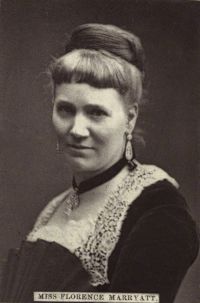
“ The very fact of so common an article of furniture as a table, as an agent of communication with the unseen world, has excited so much ridicule and opens so wide a field for chicanery, that I thought it would be wiser to drop the subject, and confine myself to those phases of the science or art, or religion, or whatever the reader may like to call it, that can be explained or described on paper. The philosophers of the nineteenth century have invented so many names for the cause that makes a table turn round—tilt—or rap—that I feel quite unable (not being a philosopher) to cope with them. ”
graf Leo Tolstoy, The Journal of Leo Tolstoi (First Volume…
“ It is certainly so, every time I take up a little ball in that way there are two and for every one who takes up a ball in that way there are two, and nevertheless there are no two little balls. In the same way, the table is a table only for the twisted fingers of my senses, but it is perhaps half a table, a thousandth of a table—in fact, no part of a table at all, but something altogether different. So that what is real is only my ever recurring impression, confirmed by the impressions of other people. ”
Swami Vivekananda,
The Complete Works of Swami Vivekananda…
“ There is no real difference between the table and me; the table is one point in the mass of matter, and I another point. Each form represents, as it were, one whirlpool in the infinite ocean of matter, of which not one is constant. ”
Warren Hilton, Applied Psychology: Making Your Own World
“ Clearly, then, the table of which you are directly and immediately conscious when your eyes are open is always this mental duplicate, this aggregate of color, form, size and touch impressions; while the real table, the physical table, may be something other than the one of which you are directly aware. ”
Charles Babbage,
The calculating engine
(1834)
“ There is a much greater variety of tables, whose importance is no way inferior, which are, however, of a more special nature: Such are, for example, tables of interest, discount, and exchange, tables of annuities, and other tables necessary in life insurances; tables of rates of various kinds necessary in general commerce. But the science in which, above all others, the most extensive and accurate tables are indispensable, is Astronomy; with the improvement and perfection of which is inseparably connected that of the kindred art of Navigation. ”
Bertrand Russell,
The Problems of Philosophy
(1912)
“ All these things are not commonly noticed in looking at a table, because experience has taught us to construct the "real" shape from the apparent shape, and the "real" shape is what interests us as practical men. But the "real" shape is not what we see; it is something inferred from what we see. And what we see is constantly changing in shape as we move about the room; so that here again the senses seem not to give us the truth about the table itself, but only about the appearance of the table. ”
Herbert Spencer,
Essays: Scientific, Political, & Speculative…
“ But as used for delineating societies having known histories, the tabular form is so employed as to exhibit not only the connexions of phenomena existing at the same time, but also the connexions of phenomena that succeed one another. By reading horizontally across a Table at any period, there may be gained a knowledge of the traits of all orders displayed by the society at that period ”