“ The vibrating segments and nodes of a bell are similar to those of a disk. When a bell sounds its deepest note, the coalescence of its pulses causes it to divide into four vibrating segments, separated from each other by four nodal lines, which run up from the sound-bow to the Fig. 77. crown of the bell. The place where the hammer strikes is always the middle of a vibrating segment ”
Bell (sound)
Definition and stakes
The theme of “bell (sound)” has been addressed by authors such as John Tyndall, Hugh Reginald Haweis, Samuel B. Goslin, Thomas L. Papillon and Hugh M. Ross and Alexander Graham Bell. It is often associated with terms like vibration, musical, wave, instrument and piano.
Quotes about “bell (sound)”
 James Clerk Maxwell,
Encyclopædia Britannica, Ninth Edition
(1878)
“ If we suppose that there are a great many bells precisely similar to each other, and that they are struck, first one and then another, in a perfectly irregular manner, yet so that, on an average, as many bells are struck in one second of time as in another, and also in such a way that, on an average, any one bell is not again struck till it has ceased to vibrate, then the audible result will appear a continuous sound, composed of the sound emitted by bells in all states of vibration, from the clang of the actual stroke to the final hum of the dying fundamental tone. ”
“ There are no points of absolute rest in a vibrating bell, for the nodes of the higher tones are not those of the fundamental one. But it is easy to show that the various parts of the sound-bow, when the fundamental tone is predominant, vibrate with very different degrees of intensity. Suspending a little ball of sealing-wax a, Fig. 78 (next page) , by a string, and allowing it to rest gently against the interior surface of an inverted bell, it is tossed to and fro when the bell is thrown into vibration. ”
George Laing Miller, The Recent Revolution in Organ Building
“ So long as the dome is filled with air the sound of the bell can be heard, but directly the air is pumped out silence results, even though it can be seen that the bell is continuously ringing. As there is no air surrounding the bell there is nothing to convey its vibrations to the ear. ”
“ The intermittent sound of certain bells, heard more especially when their tones are subsiding, is an effect of interference. The bell, through lack of symmetry, as explained in the fourth chapter, vibrates in one direction a little more rapidly than in the other, and beats are the consequence of the coalescence of the two different rates of vibration. ”
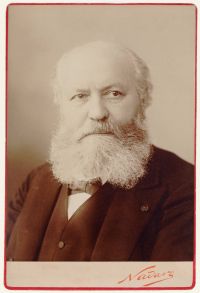 Charles Gounod,
Charles Gounod
“ Some people say that when you hear a bell strike, you hear only one sound. That depends entirely on the metal and the founding of the bell. If those be perfect, the sound produced is a delightful series of harmonic vibrations. ”
J. Arthur Thomson, The Outline of Science, Vol. 1…
“ We know that sound travels in waves; sound consists of waves in the air, or water or wood or whatever medium we hear it through. If an electric bell be put in a glass jar and the air be pumped out of the jar, the sound of the bell becomes feebler and feebler until, when enough air has been taken out, we do not hear the bell at all. Sound cannot travel in a vacuum. We continue to see the bell, however, so that evidently light can travel in a vacuum. The invisible medium through which the waves of light travel is the ether, and this ether permeates all space and all matter. ”
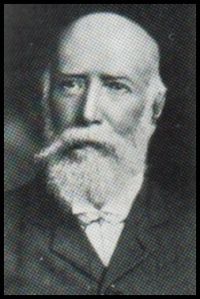 Alfred Percy Sinnett,
The Occult World
“ Indeed, the theory of imposture is one which in the matter of the bells has only one narrow conjecture to rest on. Unlike the sound of a rap, which in the ordinary way could be produced by many different methods — so that, to be sure any given example of such a sound is not produced by ordinary means, one has to procure its repetition under a great variety of conditions — the sound of a bell can only be made, physically, in a few ways. You must have a bell, or some sonorous object in the nature of a bell, to make it with. ”
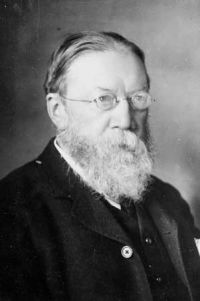 William Henry Preece,
Popular Science Monthly
(1882)
“ Here is the dome of a bell, which I strike with a mallet or hammer, and thereby impart energy to it, and it sets the whole air of this room in motion, and every tympanum of every ear present is struck by the little bullets of air that are thrown into vibration, and the result is the effect called sound. ”
Thomas Garnett, Popular Lectures on Zoonomia
“ The same stroke, which makes the bell vibrate, occasions the sound, and as the vibrations decay, the sound grows weaker. We may be convinced by our senses that the parts of the bell are in a vibratory motion while it sounds. If we lay the hand gently on it, we shall easily feel this tremulous motion, and even be able to stop it, or if small pieces of paper be put upon the bell, its vibrations will put them in motion. ”
Francis M. Walters, Physiology and Hygiene for Secondary Schools
“ Nature of Sound Waves.—If some sonorous body, as a bell, be struck, it is given a quivering, or vibratory, motion. This is not confined to the bell, but is imparted to the air and other substances with which the bell comes in contact. These take up the movements and pass them to objects more remote, and they in turn give them to others, until a very considerable distance is reached. Such progressive vibrations are known as waves, and, since they act as stimuli to the organs of hearing, they are called sound waves. ”
 John Tyndall,
Popular Science Monthly
(1878)
“ Most, if not all, of our ordinary sound-producers send forth waves which are not of uniform intensity throughout. A trumpet is loudest in the direction of its axis. The same is true of a gun. A bell, with its mouth pointed upward or downward, sends forth waves far denser in the horizontal plane passing through the bell than at an angular distance of 90° from that plane. ”
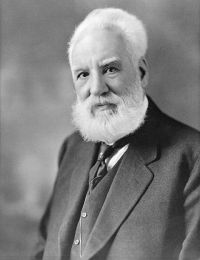 Alexander Graham Bell,
The Telephone: A lecture entitled Researches in Electric Telephony
“ Not only so, but the amplitude of vibration in the one will determine the amplitude of vibration in the other, for the intensity of the induced current is determined by the amplitude of the inducing vibration, and the amplitude of the vibration at the receiving end depends upon the intensity of the attractive impulses. When we sing into a piano, certain of the strings of the instrument are set in vibration sympathetically by the action of the voice with different degrees of amplitude, and a sound, which is an approximation to the vowel uttered, is produced from the piano. ”
Archibald Williams, How it Works
“ Nature of sound—The ear—Musical instruments—The vibration of strings—The sounding-board and the frame of a piano—The strings—The striking mechanism—The quality of a note. Sound differs from light, heat, and electricity in that it can be propagated through matter only. Sound-waves are matter-waves, not ether-waves. This can be proved by placing an electric bell under the bell-glass of an air-pump and exhausting all the air. Ether still remains inside the glass, but if the bell be set in motion no sound is audible. ”
Edward Fenton Elwin, India and the Indians
“ But if you listen critically to each bell, when a row of carts is passing, you will every now and then hear one of a peculiarly rich and mellow sound. I once tried to persuade a man to sell a melodious bell which I heard by chance as he drove by, but he would not entertain the idea for a moment. ”
George M. Shaw, Popular Science Monthly (1878)
“ A simple noise being a sound-wave, has its wave-form or make-mark. The blending of many such would produce a tone in that likeness; hence, a musical note is a blending of like noises, and every noise is really the first wave, the key-note of a musical tone. Take the ringing of a door-bell. Here the ear hears not only a musical tone, a sound-blend, in the ring of the bell, but also the noise of the clapper's clang, clang, clang. The vibrations of the bell throw the air into musical waves, shown in Fig. 5, while a huge clang-wave will sweep Fig. ”
Thomas Garnett, Popular Lectures on Zoonomia
“ The tone of a musical string, or a bell, appears continuous. This depends upon a law of sensation, formerly mentioned, namely, that impressions made upon any of the organs of sense do not immediately vanish, but remain some time; and we hear sound continuous from these vibrations, for the same reason that we hear it continuous when we draw a stick quickly along a rail, or a quill along the teeth of a comb; the vibrations succeed each other so quickly that we hear the succeeding before the effect of the preceding is worn off ”
Various, Harper's Young People, July 18…
“ The true test of a bell is its strength of sound. How far can you hear it? is the question, not how heavy it may be. High up in the steeple and on an elevation a bell ought to be heard for miles. In old times the bells summoned the people to gatherings called folk-motes. ”
“ The ringing of bells, although a recreation chiefly of the lower sort, is, in itself, not incurious. The tolling of a bell is nothing more than the producing of a sound by a stroke of the clapper against the side of the bell, the bell itself being in a pendant position, and at rest. In ringing, the bell, by means of a wheel and a rope, is elevated to a perpendicular; in its motion, the clapper strikes forcibly on one side, and in its return downwards, on the other side of the bell, producing at each stroke a sound." There are still in London several societies of ringers. ”
Samuel B. Goslin, First Steps to Bell Ringing
“ To ring, and to ring changes, on either church or musical hand bells, are three very different subjects. In order to ring changes, however, it is absolutely necessary to have a good knowledge of ringing, or the means adopted to make the bells sound in their proper time and place, whether it be in the church tower, on the large swinging bells with ropes, or in the parlour or drawing-room, upon the musical bells, held in the hand or hands. ”
Thomas L. Papillon and Hugh M. Ross, 1911 Encyclopædia Britannica (1910)
“ In the old system, which has been largely superseded by pneumatic and still more by electric bells, the bells themselves are of the ordinary conical shape and are provided with clappers hung loosely inside them. Being supported on springs they continue to swing, and therefore to give out sound as the clapper knocks against the sides, for some time after they have been set in motion by means of the strings or wires by which each is connected to a bell-pull in the rooms. ”
A Dictionary of Music and Musicians (1900)
“ All the contrivances for performing music on bells with mechanical precision involve a greater or less departure from the true principle of the bell, and an impairing of its characteristic sound by fixing it instead of letting it swing freely. ”
Anonymous, The Philosophical Review (1892)
“ A bell is rung mechanically at adjustable positions of a pointer moving over a dial, and the subject fixes the location of the hand when the sound is heard. The results are called correct, positive displacements, or negative displacements according as the pointer is seen at, beyond, or before the correct position when the sound is heard. Wundt recorded least errors when the revolutions occurred once a second; faster rate giving a predominance of positive, slower rate, of negative errors. ”
“ The rate at which the beats succeed each other is equal to the difference between the two rates of vibration.When a bell or disk sounds, the vibrations on opposite sides of the same nodal line partially neutralize each other; when a tuning-fork sounds, the vibrations of its two prongs in part neutralize each other. By cutting off a portion of the vibrations in these cases the sound may be intensified. ”
Rupert Sargent Holland, Historic Inventions
“ He studied the effect of vibrations upon the bones of the ear, and this led him to experiment with vibrating a thin piece of iron before an electro-magnet.His study of the effect of vibrations on the human eardrum showed Bell what path he should follow. Sound waves striking the delicate ear-drum could send thrills through the heavier bones inside the ear. ”
Ernest R. Suffling, Jethou; or, Crusoe Life in the Channel Isles
“ It is scarcely true to say that the rocks never hear the sound of the church-going bell, for with a westerly breeze the bells can be heard quite plainly, and I have even heard a dog bark at that distance, which shows how distinctly, and to what a great distance sound will travel over water. ”
Alexander Graham Bell,
Popular Science Monthly
(1881)
“ A convenient mode of arranging a lampblack cell for experimentalFig. 9. purposes is shown in Fig. 9. When an intermittent current is passed through the lampblack (A) , or when an intermittent beam of sunlight falls upon it through the glass plate (B) , a loud musical tone can be heard by applying the ear to the hearing-tube (C) . When the light and the electrical current act simultaneously, two musical tones are perceived, which produce beats when nearly of the same pitch. By proper arrangements a complete interference of sound can undoubtedly be produced. ”
“ Every stroke of the bell is accompanied by a momentary darkening of the room.The foregoing experiments illustrate the lengthening280 and shortening of flames by sonorous vibrations. They may also produce rotation. From some of our homemade burners issue flat flames, about ten inches high, and three inches across at their widest part. When the whistle sounds, the plane of each flame turns ninety degrees round, and continues in its new position as long as the sound continues. ”
“ The noise is really due to the reinforcement of the feeble sounds with which even the stillest air is pervaded, and also in part to the noise produced by the pressure of the shell against the ear itself. By using tubes of different lengths, the variation of the resonance with the length of the tube may be studied. The channel of the ear itself is also a resonant cavity. When a poker is held by two strings, and when the fingers of the hands holding the poker are thrust into the ears on striking the poker against a piece of wood, a sound is heard as deep and sonorous as that of a cathedral bell. ”
 Henry David Thoreau,
The First and Last Journeys of Thoreau…
(1905)
“ When we hear any musical sound in Nature, it is as if it were a bell ringing; we feel that we are not belated, but in season wholly, and enjoy a pensive and leisure hour. What a fine and beautiful communication from age to age of the fairest and noblest thoughts,—the aspirations of ancient men preserved,—even such as were never communicated by speech,—is music! ”
W. H. McCormick, Electricity (1915)
“ In private offices and elsewhere the rather aggressive sound of an118 ordinary trembler bell is apt to become a nuisance, and in such cases a modified form which gives a quiet buzzing sound is often employed. ”
Dorothy Wordsworth, Journals of Dorothy Wordsworth…
“ it seemed in the wood, but it must have been above it, for presently we saw a raven very high above us. It called out, and the dome of the sky seemed to echo the sound. It called again and again as it flew onwards, and the mountains gave back the sound, seeming as if from their centre; a musical bell-like answering to the bird's hoarse voice. ”
“ In this way we obtain a vacuum more perfect than that of Hawksbee, and this is important, for it is the last traces of air that are chiefly effective in this experiment. You now see the hammer pounding the bell, but you 38hear no sound. Even when the ear is placed against the exhausted receiver not the faintest tinkle is heard. Observe also that the bell is suspended by strings, for if it were allowed to rest upon the plate of the air-pump the vibrations would be communicated to the plate, and thence transmitted to the air outside. ”
 William Cowper,
The Works of William Cowper
“ But the sound of the church-going bell These valleys and rocks never heard, Never sigh'd at the sound of a knell, Or smiled when a sabbath appear'd. ”
 Lilian Bell,
At Home with the Jardines
“ Washington Heights is a crowning wilderness looking down upon the city from Fort George, while the Sound and a glimpse of the village beyond seen through the faint blue haze of distance lend a touch of fairylike enchantment. The Jersey shore and the Palisades are one long drawn out joy, so that, turn where you will, you find New York beautiful. ”
John Weeks Moore, Complete Encyclopaedia of Music… (1880)
“ A peal, in technical language, is a performance on the bells of more than 5000 changes ; and it occupies the ringers a considerable period of time, generally more than three hours. But a touch or flourish on the bells, which is the ordinary method of notifying any joyful occurrence, is round ringing varied by changes at the option of the ringers, or according to the custom of the belfry. It is usual in the first instance to set the bells ; that is, to throw every bell, with its mouth upward, in a stationary position in the frame. ”
Related terms
Authors who wrote about “bell (sound)”
John Tyndall Hugh Reginald HaweisSamuel B. GoslinThomas L. Papillon and Hugh M. RossAlexander Graham BellJohn Weeks MooreA. E. DolbearGuillaume Durand
 Alice MeynellAlfred Percy SinnettFrank BellVariousHenry David ThoreauLilian BellThomas GarnettRobert Routledge
 Marcel ProustFrancis M. Walters
 Wassily KandinskyGeorge Laing Miller
