Ralph Waldo Emerson,
Miscellanies
(1855)
“ Better that the book should not be quite so good, and the bookmaker abler and better, and not himself often a ludicrous contrast to all that he has written. ”
A bookmaker is an individual or organization that accepts and settles bets on sporting and other events, adjusting odds to ensure profit through balanced wagers. Historically rooted in 18th-century England, the practice evolved with legal frameworks like the UK’s Gambling Act 2005, which regulated betting shops and online operations. While operational strategies focus on risk management and financial balancing, literary references to "bookmakers" often explore the interplay between authors, publishers, and the cultural significance of books.
Writers like Ralph Waldo Emerson and Washington Irving highlighted the tensions between creative vision and commercial interests, while others, such as Harry Lyman Koopman, emphasized the artistry in book production. These perspectives, though varied, collectively underscore the dual role of bookmakers as both financial intermediaries and custodians of intellectual exchange.
Ralph Waldo Emerson,
Miscellanies
(1855)
“ Better that the book should not be quite so good, and the bookmaker abler and better, and not himself often a ludicrous contrast to all that he has written. ”
Catherine A. Warfield, Sea and Shore
“ We want every Bookseller, and every News Agent, everywhere, to sell our books, and to keep an assortment of them on hand, and to send to us at once for a copy of our New Illustrated Descriptive Catalogue, which look over carefully, marking what books you may want, as it contains a list of all books published by us, all or any of which will be sold by us to everybody in the Book Trade, to Booksellers, or to News Agents, at very low rates. There are no books published you can sell as many of, or make as much money on, as Petersons'. ”
Harry Lyman Koopman, The Booklover and His Books
“ Never before was so much money spent in making books attractive—for the publisher always has half an eye on the booklover—and while much of this money is wasted, not all is laid out in vain. Our age is producing its quota of good books, and these the booklover makes it his business to discover. ”
Harry Lyman Koopman, The Booklover and His Books
“ To the printer the librarian would say: since wishing is easy, let us imagine that what ought always to happen is happening regularly instead of rarely, namely, that the author produces a book worth printing and that the publisher leaves you free to put it into a worthy form. This is the opportunity that you have always been looking for. How are you going to meet it? Do you know all the elements that you deal with and can you handle them with a sure touch practically and esthetically? If so, you will not need any hints from the librarian, and he will order your book "sight unseen." ”
Ainsworth Rand Spofford,
A Book for All Readers
“ Side by side with printing, it strives after that perfection which shall ensure the perpetuity of human thought. Thus a book, clothed in morocco, is not a mere piece of mechanism, but a vehicle in which the intellectual life of writers no longer on earth is transmitted from age to age. And it is the art of book-binding which renders libraries possible. What the author, the printer, and the binder create, the library takes charge of and preserves. ”
Washington Irving,
Tales of a Traveller
“ How soon should the Pleasures of Melancholy throw this world of booksellers and printers into a bustle of business and delight! How soon should I hear my name repeated by printers’ devils throughout Pater Noster Row, and Angel Court, and Ave Maria Lane, until Amen corner should echo back the sound! Arrived in town, I repaired at once to the most fashionable publisher. Every new author patronizes him of course. In fact, it had been determined in the village circle that he should be the fortunate man. ”
Douglas Brooke Wheelton Sladen,
Twenty Years of My Life
“ You thank whatever gods there be for having made you a writer. The book or the play finished, the artist takes his departure, to dream of fresh triumphs. The shopkeeper—possibly a married shopkeeper with a family—comes into the study, finds the manuscript upon the desk. Then follows the selling, bargaining, advertising. It is a pretty hateful business, even with the help of agents. The book or the play you thought so fine, you thought that every one was bound to like it. Your publisher, your manager, is doubtful. ”
Henry Howard Harper, Book-Lovers, Bibliomaniacs and Book Clubs
“ In referring to this class of book-buyers, Roswell Field says, "The book-lover, so-called, who lacks any of the thrills that go with the establishment as well as the enjoyment of a library in all of its appointments has deprived himself of many of the most pleasurable literary and semi-literary emotions. That bibliophile never pats his horse or his dog. To him his books are merely tools of trade, accessories to knowledge, to be pawed over, thrown away and replaced by new copies when worn out. ”
Frank Allaben, Concerning Genealogies
“ Finally, choose a printer and publisher who is a book-making genius. The author is dependent upon the printer for the best suggestions for style of book within the limits of cost decided upon. There are masters of the art of making books who, having learned the author's mind as to price, have an ability almost amounting to genius for suggesting the perfect thing within the limit named. They have the character of the work in mind, and they suggest an ideal combination of type, size of page, illustrations, paper, margins and style of cover. ”
Henry Curwen, A History of Booksellers, the Old and the New
“ Books are now so dear that they are becoming articles of fashionable furniture more than anything else; they who do buy them do not read, and they who read them do not buy them. I have seen a Wiltshire clothier who gives his bookseller no other instructions than the dimensions of his shelves; and have just heard of a Liverpool merchant who is fitting up a library, and has told his bibliopole to send him Shakespeare, Milton, and Pope, and if any of those fellows should publish anything new to let him have it immediately. ”
John Cotton Dana,
A Library Primer — Chapter XVI, Buying books
(1899)
“ The more clear and definite your orders are made out, the more promptly and completely can your bookseller supply them.An ideal bookseller, qualified to act as your agent, is one who has familiarized himself with the various editions of books, and will always make selections with greater stress on quality than quantity; who will not send you the second edition of a scientific work when a third is out ”
Henry Curwen, A History of Booksellers, the Old and the New (1873)
“ And, by this plan, it is believed that, while some firms at present growing into eminence may have been omitted, or have received but scant acknowledgment, no one Publisher or Bookseller, whose spirit and labours have as yet had time to justify a claim to a niche in the "History of Booksellers," has been altogether passed over. ”
P. B. M. Allan, The Book-Hunter at Home
“ To the real collector there is no more delightful reading than the literature which deals with the subject he has made his own; and the more ample and specialised it be, the greater will be his delight.What bibliophile has not read, and read again, such delightful works as Burton's 'Book Hunter,' Blades' 'Enemies of Books' and 'Life and Typography of William Caxton,' 'The Library' and 'Books and Bookmen' by Andrew Lang, Harrison's 'Choice of Books' and 'Among my Books,' Clark's 'Care of Books,' Edwards' 'Libraries and Founders of Libraries,' and many others of equal charm? ”
Alfred W. Pollard,
Old Picture Books, With Other Essays on Bookish Subjects
“ THE FIRST ENGLISH BOOK SALE [18] THERE are many points in the history of books and of book-collecting which are still tantalisingly obscure. How little we know about the prices of early books, the cost of printing, the relations of printer and publisher or of publisher and author! With the exception of a few royal personages and a few men and women of great wealth and rank, the book-collectors of the two centuries which succeeded the invention of printing are hardly known to us, even by name. A few have gained immortality among book-lovers by clothing their books in priceless bindings ”
Theodore Wesley Koch,
The Library Assistant's Manual
“ The early separation of publishing from bookselling is touched upon, and the emergence of publishers as a separate class is outlined. The transitory phenomenon of the man of letters assisting the publisher in an advisory capacity as to the suitability of manuscripts submitted for publication is an interesting chapter in the expansion of the publishing business. Publishing being today largely a commercial affair, the literary reader has in the main been supplanted by the man of business with an aptitude for estimating how many copies of a given book can be sold. ”
Arthur Low Bailey, Library Bookbinding
“ To decide properly what books should be rebound and how they should be rebound is not a simple matter nor one which should be left to an inexperienced or uneducated assistant. In addition to a good working knowledge of materials and processes the assistant in charge of this work should have a general knowledge of books—paper, editions, prices, literary value, timeliness, etc.—and good judgment in deciding whether a book should be bound or whether it should be mended, recased, wrapped in paper, recovered, or thrown away. ”
Theodore Wesley Koch,
The Library Assistant's Manual
“ Bookselling.—Even those librarians who think that they know something about buying books, can with decided advantage read the article on Bookselling. The modern system goes back almost to the invention of printing. The earliest printers were also editors and booksellers but as they were not able themselves to dispose of the entire output of their presses they had agents at most of the universities. The religious dissensions following the Reformation created a great demand for books and there were troublous times for both printers and booksellers. ”
Charles Nodier,
The Book Collector
(1951)
“ In that age of ignorance from which we have now had the good fortune to emerge, the publisher was, in general, a man capable of appreciating the books he published; he printed them on good solid paper, supple and resonant, and, when they were sufficiently important, had them bound in sound moisture-proof leather, well-glued and stoutly sewn. If by chance the volume found its way to the second-hand book-stall, that did not spell its ruin. Whether of sheep-skin, calf, or parchment, the binding—blanched and hardened in the sun ”
William Dana Orcutt,
The Author's Desk Book
“ THE MECHANICS OF THE BOOK SOME authors have a general idea of how a book is manufactured, but more have none. Even in the case of experienced writers, every printing-office could tell surprising stories to illustrate the unreasonableness born of a lack of knowledge of the ordinary mechanics of manufacture, or of a confidence born of too little knowledge. And unreasonableness on the part of the author means extra and unnecessary expense either to the printer or to the publisher. ”
Isaac Disraeli,
Literary Character of Men of Genius
“ Were it practicable, as I believe it to be, that authors and men of letters could themselves be booksellers, the public would derive this immediate benefit from the scheme; a deluge of worthless or indifferent books would be turned away, and the name of the literary publisher would be a pledge for the value of every new book. Every literary man would choose his own favourite department, and we should learn from him as well as from his books. ”
James Duff Brown, Manual of Library Economy
“ A preponderating part of the lending stock will be of fiction—perhaps twenty per cent. of it—and here the librarian has the accumulated experience of other librarians to assist his selection, and, with regard to contemporary writings, they are not so numerous that the characteristics of any given author cannot easily be tested. Books of classic rank should be available in such numbers that there are always enough copies to meet the current demand and at the same time to leave a copy on the shelves. ”
George Haven Putnam,
Books and their makers during the Middle Ages…
(1896)
“ The business carried on by these early publishers differed very materially from that of their successors. All the machinery of book-making had to be originated or created, while it was necessary also to establish channels of distribution, and through these to discover and to educate a reading public which should absorb the productions of the new presses. ”
Frank Frankfort Moore, Discovering "Evelina": An Old-fashioned Romance
“ But if I could prevail on someone—a bookseller—to print what I write, I hope you will consent to my doing so—not putting my name to the thing, of course?”“And does my Fanny believe that ’tis all so easy to persuade a bookseller to pay her printer’s bill?” he said, pinching her ear. “Booksellers are shrewd men of business.”“But even men of business have their weak moments,” said she. “And so if—if—you would not think it too bold of me to let James take my parcel to a bookseller? ”
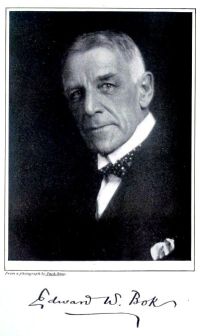
Edward W. Bok,
The Americanization of Edward Bok
(1921)
“ All publishing houses employ “readers” outside of those in their own offices for the reading of manuscripts on special subjects. One of these “outside readers” was given a manuscript for criticism. He took it home and began its reading. He had finished only a hundred pages or so when, by a curious coincidence, the card of the author of the manuscript was brought to the “reader.” The men were close friends.Hastily gathering up the manuscript, the critic shoved the work into a drawer of his desk, and asked that his friend be shown in. ”
Frank Allaben, Concerning Genealogies
“ The truth, however, is that the author cannot expect to do for himself, even in a modest way, much which the experienced publisher does for him. The avenues to the book trade, the book reviewer, and therefore to the general public, are not really open to any of us who are not publishers—as we can soon learn by making the attempt to travel, unpiloted, in these directions. ”
P. B. M. Allan, The Book-Hunter at Home
“ It is a very serious business, this book-collecting. Whether we are contented now to let our library be slow of growth, or whether we are still imbued with the ardour of our early youth, we are none the less under the spell of books. Our paths may lie outside the pale of book-land for years, but the chance handling of a valuable or scarce volume will instantly awaken all our bibliophilic desires. ”
Henry K. Rowe, Society: Its Origin and Development
“ The cheapened process of book publication on a large scale, and the investment of large sums of money in the publishing business, with its mechanics of sale management as well as printing, has made possible an enormous output of literature on all subjects and has widened the range of general information in possession of the public. The whole system of modern life would be impossible without the press. ”
Joyce Kilmer,
The Circus, and Other Essays and Fugitive Pieces
“ Nevertheless, somewhere about the opening of our own day an iron-bound tradition became erected in the publishing business, at least in the United States, that books of essays would not sell; could not be made to sell even sufficiently to avoid a considerable loss on the investment of manufacture; in fact, were quite impossible as a publishing venture. No matter how much a publisher himself, or his manuscript reader, might enjoy a collection [Pg 17] of essays that chanced to turn up in his shop, his conviction as to its unmarketability as a book was not altered—not even stirred. ”
“ If a publisher wished to make a book beautiful he put in plates. If he wanted to make it more beautiful he put in more or larger plates. If he wanted to make it a real triumph of beauty he engraved the whole book, letterpress and all, as in the case of Sturt’s Prayer Books and Pine’s Horace. That a printer by the selection and arrangement of type, by good presswork and the use of pretty capitals and tailpieces, could make a book charming to eye and hand, without any help from an illustrator—such an idea as this had nearly perished. ”
Stuart Brent, The seven stairs (1962)
“ But what of the young man or woman who has determined to devote himself to the difficult craft of writing, who has beaten out a book to his best ability, and is looking for a publisher? What do you do?Well, of course, there is nothing to prevent you from bundling up your manuscript and mailing it to various publishers. Experience shows, however, that very few manuscripts submitted “cold” or, in the trade phrase, “over the transom” (obviously the mailman can’t stick a manuscript through the letter slot) , ever see the light of day. ”
Frederick Marryat,
Diary in America, Series Two
“ What publisher would give its worth for a novel, in manuscript, supposing it to be equal to Bulwer’s best, when he would get a novel of Bulwer himself, for a few shillings—with an English reputation at the back of it? This is the great reason that we have so few works illustrative of our own history—whether of fact or fiction. Our booksellers are supplied for nothing. ”
Leon H. Vincent, The Bibliotaph, and Other People
“ It was amusing to discover, by means of these autograph letters, how seldom a good author was an equally good bibliographer. And this is as it should be. The author’s business is, not to take account of first editions, but to make books of such virtue that bibliomaniacs shall be eager to possess the first editions thereof. It is proverbial that a poet is able to show a farmer things new to him about his own farm. Turn a bibliographer loose upon a poet’s works, and he will amaze the poet with an account of his own doings. ”