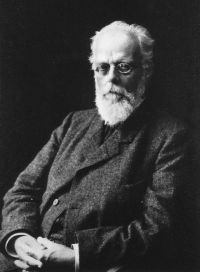
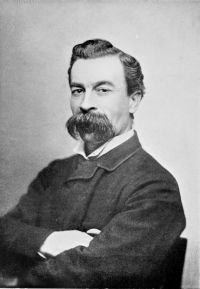
Portrait of Thomas Henry Huxley Thomas Henry Huxley,  Science and Culture, and Other Essays

“ In all animals and plants, above the lowest, the germ is a nucleated cell, using that term in its broadest sense; and the first step in the process of the evolution of the individual is the division of this cell into two or more portions. The process of division is repeated, until the organism, from being unicellular, becomes multicellular. The single cell becomes a cell-aggregate; and it is to the growth and metamorphosis of the cells of the cell-aggregate thus produced, that all the organs and tissues of the adult owe their origin. ”
Source: Gutenberg

Alfred B. Rendle, Arthur G. Tansley, Joseph R. Green, Charles E. Moss, Harold W. T. Wager, Sydney H. Vines, and William T. Thiselton-Dyer,  1911 Encyclopædia Britannica (1911)

“ If we consider the behaviour of a growing organ such as a root, we find that, like a cell, it shows a grand period of growth. Just behind its apex the cells are found to be all in process of active division. Growth is small, and consists mainly in an increase of the quantity of protoplasm, for the cells divide again as soon as they have reached a certain size. ”
Source: Wikisource

Various,  Popular Science Monthly (1913)

“ On the other hand, processes which lead to the increase of the general protoplasm in a cell, either by the growth of the protoplasm already present or by the conversion of metaplasm into protoplasm, lead also to the growth of the nucleus, to increased interchange between nucleus and protoplasm, and hence to increased powers of assimilation, cell division and regulation. Anything which decreases the interchange between nucleus and protoplasm leads to senility ”
Source: Wikisource

Get perspective with Kwize: daily news enlightened by great literature