Metazoa

Definition and stakes

E. S. Russell,  Form and Function: A Contribution to the History of Animal Morphology

“ From the fact that all Metazoa develop from an ovum which is a simple cell, the evolutionists inferred that all must have arisen from one primordial cell. From the fact that the next step in development is the segmentation of the ovum, they argued that the ancestral Metazoa came into being through the division of the primal Protozoon with aggregation of the division-products. From the fact that a gastrula stage is very commonly formed when segmentation has been completed, they assumed that all germ-layered animals were descended from an ancestral Gastræa. ”

Source: Gutenberg

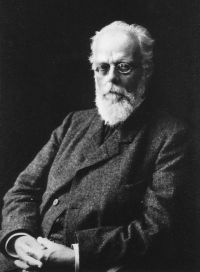
Portrait of Edward Alfred Minchin Edward Alfred Minchin,  1911 Encyclopædia Britannica (1911)

“ In the Metazoa the sexual process is always related to the production of a new individual, that is to say, of a multicellular organism for which there is no analogy amongst the Protozoa, although an approach to the Metazoan condition is seen in colony-forming Flagellata, such as Volvox and its allies. The reproduction of Protozoa is analogous to the ordinary process of cell-division and multiplication which is going on at all times in the bodies of the Metazoa, and which can be observed in the production of the gametes ”
Source: Wikisource

Edwin Ray Lankester and Joseph Thomas Cunningham,  1911 Encyclopædia Britannica (1911)

“ The Metazoa all commence their individual existence as a single cell or plastid, which multiplies itself by transverse division. Unlike the cells of Protozoa, these embryonic cells of the Metazoa do not remain each like its neighbour and capable of independent life, but proceed to arrange themselves into two layers, taking the form of a sac. The cavity of the two-cell-layered sac or diblastula thus formed is the primitive gut or arch-enteron. ”
Source: Wikisource

Get perspective with Kwize: daily news enlightened by great literature