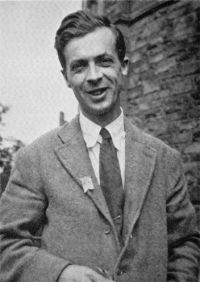
Julian Huxley

Julian Huxley

Summary

Portrait of Julian Huxley Julian Huxley Essays of a Biologist

If I may be Irish, its absoluteness is relative to our organization and to reality as we perceive it. We cannot perceive anything fuller, more absolute—until perhaps one day, with the growth of our minds, we come to have some still richer and more complete experience. As William James was so fond of reminding the world, we have no right to assume that our minds are, much less that they must be, the highest type of mind realized in the universe—no more right than our domestic animals have, although our minds to them could only be measured by their own standards.
Source: Gutenberg

Portrait of Julian Huxley Julian Huxley Essays of a Biologist

They are realized in many forms—in love, in intellectual discovery, in art, in religion; but the salient fact about all is that they are felt as of intensest value, and that they seem to leave no more to be desired. Doubtless when we say that at such moment we touch the Infinite or the Absolute we mean only that we touch what is infinite and absolute in comparison with our ordinary selves. None the less, the sense of finality and utter reality attendant on them is difficult to bring into line with our idea of progress.
Source: Gutenberg

Portrait of Julian Huxley Julian Huxley Essays of a Biologist

In any case the man of science must obviously, if he face the problem at all, take up a scientific attitude of mind towards it. He cannot say that there is no such thing as religion; or try to whittle it away by explaining that it is something else—a complicated fear, or a sublimated sex-instinct, or a combination of credulity and duplicity. A thing, if it is a thing at all, is never merely something else. Nor can he submit to the pretensions of those who assert that it is too sacred to be touched, or that its certainties are greater than those of science.
Source: Gutenberg

Get perspective with Kwize: daily news enlightened by great literature