Karyokinesis

Definition and stakes

A system of practical medicine…

“ It is a tissue similar in many respects to the spleen, and, though confined to the short and flat bones, the total amount in the body is very considerable. In the young it also fills the long bones. The evidence of the development of red corpuscles in the marrow rests upon the constant presence of nucleated cells infiltrated with hæmoglobin, and of their fission. Forms undergoing the process of karyokinesis can be seen without difficulty. In excessive hemorrhage, natural or induced, it appears to undergo an active proliferation, and in the long bones a red marrow may replace the fatty tissue. ”
Source: Gutenberg

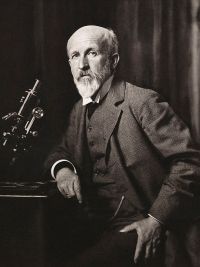
Portrait of Oscar Hertwig Oscar Hertwig,  The Biological Problem of To-day…

“ Form, size, and number are different in different animals, but there is reason to believe that they are normally the same in all the individuals of a species. The fertilised nucleus, thus consisting of chromosomes from male and female, then divides by a complicated process known as karyokinesis, in which each chromosome splits longitudinally, one half passing to each daughter-nucleus. Throughout the whole process of embryonic and post-embryonic growth, the chromatin is gradually increasing in bulk, and being distributed by karyokinesis. ”
Source: Gutenberg

Various,  Popular Science Monthly (1901)

“ When a nerve cell has attained its normal size it does not seem to be capable of reproducing new cells in its substance by a process of karyokinesis, such as takes place when young cells arise in the egg and in the tissues generally. It would appear that nerve cells are so highly specialized in their association with the evolution of nerve energy, that they have ceased to have the power of reproducing their kind, and the metabolic changes, both in cell plasm and nucleus, are needed to enable them to discharge their very peculiar function. ”
Source: Wikisource

Get perspective with Kwize: daily news enlightened by great literature