Circle (geometry)

Definition and stakes

Jaime Luciano Balmes,  Fundamental Philosophy, Vol. 1…

“ The centre of a circle is a point in itself indivisible, it fills no space; but in order that it be of any use as centre, we must be able to refer all the radii to it, and this is impossible unless it occupy a determinate position equidistant from all points of the circumference. As a general rule, geometry acts upon dimensions, and these dimensions require points in which they commence, points through which they pass, and points in which they end, and by which distances, inclinations, and all that relates to the position of lines and planes, are measured. ”
Source: Gutenberg

Various,  Encyclopaedia Britannica, 11th Edition…

“ CIRCLE (from the Lat. circulus, the diminutive of circus, a ring; the cognate Gr. word is κιρκος, generally used in the form κρίκος) , a plane curve definable as the locus of a point which moves so that its distance from a fixed point is constant.
The form of a circle is familiar to all; and we proceed to define certain lines, points, &c., which constantly occur in studying its geometry. The fixed point in the preceding definition is termed the “centre” (C in fig. 1) ; the constant distance, e.g. CG, the “radius.” The curve itself is sometimes termed the “circumference.”
”
Source: Gutenberg

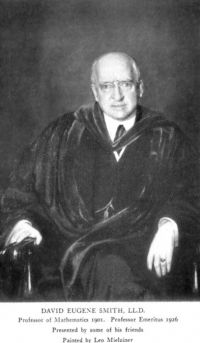
Portrait of David Eugene Smith David Eugene Smith,  The Teaching of Geometry

“ The sphere is less frequently looked upon in geometry as a surface, and in popular usage it is always taken as a solid.
Analogous to the postulate that a circle may be described with any given point as a center and any given line as a radius, is the postulate for constructing a sphere with any given center and any given radius. This postulate is not so essential, however, as the one about the circle, because we are not so concerned with constructions here as we are in plane geometry.
”
Source: Gutenberg

Get perspective with Kwize: daily news enlightened by great literature