Cone (geometry)

Definition and stakes

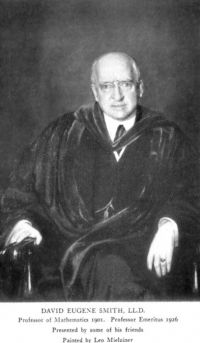
Portrait of David Eugene Smith David Eugene Smith,  The Teaching of Geometry

“ The generation of a conic surface may be shown by taking a blackboard pointer and swinging it around by its tip so that the other end moves in a curve. If we consider a straight line as the limit of a curve, then the pointer may swing in a plane, and so a plane is the limit of a conic surface. If we swing the pointer about a point in the middle, we shall generate the two nappes of the cone, the conic space now being double. ”
Source: Gutenberg

Various,  Encyclopaedia Britannica, 11th Edition…

“ The Conic Sections.—The conics, as they are now called, were at first defined as curves of intersection of planes and a cone; but Apollonius substituted a definition free from reference to space of three dimensions. This, in effect, is that a conic is the locus of a point the distance of which from a given point, called the focus, has a given ratio to its distance from a given line, called the directrix (see Conic Section) . If e : 1 is the ratio, e is called the eccentricity. The distances are considered signless. ”
Source: Gutenberg

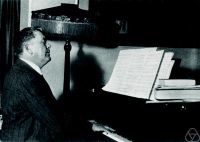
Portrait of Petrus Ramus Petrus Ramus,  The Way To Geometry

“ But the cause of this threefold difference in the angles from of the difference of the shankes, is out of the consectaries of the threefold triangle of a right line cutting the base into two equall parts, as appeareth at the end of the viij Booke.
And
7 A Cone is the first of all variable.
For a Cone is so the first in variable solids, as a triangle is in rectilineall plaines: As a Pyramis is in solid plaines: For neither may it indeed be divided into any other variable solids more simple.
And
8 Cones of equall heighth are as their bases are 11.
”
Source: Gutenberg

Get perspective with Kwize: daily news enlightened by great literature