Good sense
Definition and stakes
Quotes about “good sense”
 Jean-Jacques Rousseau,
Emile, or On Education
(1762)
Jean-Jacques Rousseau,
Emile, or On Education
(1762)
“ My barren heart yielded nothing but a feeble zeal and a lukewarm love of truth. I said to myself: Why should I strive to find what does not exist? Moral good is a dream, the pleasures of sense are the only real good. ”
Theodore P. Wilson, True to his Colours
“ Practical good sense, the fruit of a plain scriptural creed thought out, prayed out, and lived out, in the midst of a thousand unrealities, and half-realities, and distortions of the truth in belief and practice, was the habitual utterance of her lips and guide of her daily life. ”
 Hannah More,
Essays on Various Subjects, Principally Designed for Young Ladies
Hannah More,
Essays on Various Subjects, Principally Designed for Young Ladies
“ Yet the term good sense, is used indiscriminately to express either a finished taste for letters, or an invariable prudence in the affairs of life. It is sometimes applied to the most moderate abilities, in which case, the expression is certainly too strong; and at others to the most shining, when it is as much too weak and inadequate. ”
 Alexander Pope,
The Works of Alexander Pope, Volume 2…
Alexander Pope,
The Works of Alexander Pope, Volume 2…
“ All the good that God meant for mankind, "all the joys of sense, all the pleasures of reason, lie in three words,—health, peace, and competence." ”
 George Edward Moore,
Principia Ethica — Chapter I
(1903)
George Edward Moore,
Principia Ethica — Chapter I
(1903)
“ Every one does in fact understand the question ‘Is this good?’ When he thinks of it, his state of mind is different from what it would be, were he asked ‘Is this pleasant, or desired, or approved?’ It has a distinct meaning for him, even though he may not recognise in what respect it is distinct. ”
 Justin Martyr,
Dialogue with Trypho
(1867)
Justin Martyr,
Dialogue with Trypho
(1867)
“ Do you expect to perceive any of those things which conduce to a happy life, if you have not been first informed on those points which wean the soul from sensible objects, and render it fitted for objects which appertain to the mind, so that it can contemplate that which is honourable in its essence and that which is good in its essence?' Having commended many of these branches of learning, and telling me that they were necessary, he dismissed me when I confessed to him my ignorance. ”
 Ralph Waldo Emerson,
Nature
(1836)
Ralph Waldo Emerson,
Nature
(1836)
“ So shall we come to look at the world with new eyes. It shall answer the endless inquiry of the intellect,—What is truth? and of the affections,—What is good? by yielding itself passive to the educated Will. ”
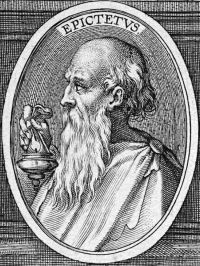 Epictetus,
 the Discourses as reported by Arrian…
(1928)
Epictetus,
Epictetus, the Discourses as reported by Arrian…
(1928)
“ Turn your thoughts upon yourselves, find out the kind of preconceived ideas which you have. what sort of a thing do you imagine the good to be? Serenity, happiness, freedom from restraint. Come, do you not imagine it to be something naturally great? ”
George Edward Moore,
Principia Ethica — Chapter IV
(1903)
“ But it may be said further that willing and feeling are not only the origin of cognitions of goodness; but that to will a thing, or to have a certain feeling towards a thing, is the same thing as to think it good. ”
Olive Higgins Prouty, The Fifth Wheel (1916)
“ With what grace, intelligence, and appreciation of values would you move among the other monitors of great fortunes, admired by them, praised, and loved, I think. What a factor for good you could become! ”
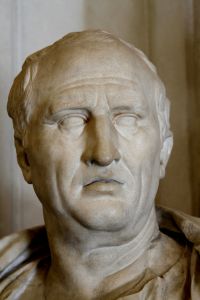 Marcus Tullius Cicero,
The Academic Questions, Treatise De Finibus…
(1891)
Marcus Tullius Cicero,
The Academic Questions, Treatise De Finibus…
(1891)
“ For when, by a comparison of the reason, the mind ascends from those things which are according to reason, then it arrives at a notion of good. And this good we are speaking of, we both feel to be and call good, not because of any addition made to it, nor from its growth, nor from comparing it with other things, but because of its own proper power. ”
George Edward Moore,
Principia Ethica — Chapter I
(1903)
“ To take, for instance, one of the more plausible, because one of the more complicated, of such proposed definitions, it may easily be thought, at first sight, that to be good may mean to be that which we desire to desire. ”
 F. H. Bradley,
Appearance and Reality — Chapter XXV
(1893)
F. H. Bradley,
Appearance and Reality — Chapter XXV
(1893)
“ When, however, we take goodness in its narrower meaning, this last feature is essential. The good, in short, will become the realized end or completed will. It is now an idea which not only has an answering content in fact, but, in addition also, has made, and has brought about, that correspondence. ”
 Gustave Flaubert,
The George Sand-Gustave Flaubert Letters
Gustave Flaubert,
The George Sand-Gustave Flaubert Letters
“ To see as far as possible the good, the bad, about, around, yonder, everywhere; to perceive the continual gravitation of all tangible and intangible things towards the necessity of the decent, the good, the true, the beautiful. ”
 Wilhelm Hauff,
The Little Glass Man, and Other Stories
Wilhelm Hauff,
The Little Glass Man, and Other Stories
“ Sense, I tell you, sense—common sense and judgment you ought to have wished for, but not a horse and chaise. Come, come, don’t be so sad, we will do all we can to make it turn out for the best, even as it is, for the second wish is on the whole not altogether foolish. ”
 Jonathan Edwards,
Selected Sermons of Jonathan Edwards
Jonathan Edwards,
Selected Sermons of Jonathan Edwards
“ But if we take reason strictly, not for the faculty of mental perception in general, but for ratiocination, or a power of inferring by arguments; I say, if we take reason thus, the perceiving of spiritual beauty and excellency no more belongs to reason than it belongs to the sense of feeling to perceive colors, or to the power of seeing to perceive the sweetness of food. ”
 Josiah Royce,
The World and the Individual, Second Series
(1901)
Josiah Royce,
The World and the Individual, Second Series
(1901)
“ What I say is that our present recognition of the concrete things in which we all believe is not a mere acceptance of any content of sense, but does include an intention to act, and does fulfil, as far as it goes, a purpose, and our own conscious purpose. ”
 Origen,
The writings of Origen, Vol. 1…
(1869)
Origen,
The writings of Origen, Vol. 1…
(1869)
“ Now we must ask these persons the following questions: Whether to desire what is good is virtuous or vicious; and whether the desire to run in order to reach the goal in the pursuit of what is good be worthy of praise or censure? ”
 Margaret Fuller,
Life Without and Life Within; or…
Margaret Fuller,
Life Without and Life Within; or…
“ Let us show you our view, compare it with yours, and let us see which is the better. If, as we think, the truth lie with us, what joy will it be for us to cast the clear light on the object of your aspirations! ”
 Auguste Forel,
The sexual question
Auguste Forel,
The sexual question
“ Good dispositions in the domains of will, sentiment, judgment, imagination, perseverance, duty, accuracy, self-control, the faculty of thinking logically and distinguishing the true from the false, the faculty of combining æsthetic thoughts and sensations, all constitute human values which are much superior to the faculty of rapid assimilation or receptivity, and a good memory for words and phrases. ”
Sir Cusack P. Roney, Rambles on Railways
“ His sentiments, if not indicative of deep thought, are so instinct with the practical common sense on which we pride ourselves, so genial, and, above all, so charmingly expressed, that they are continually recurring to the recollection of every educated mind, and re-appearing in our best authors. ”
F. H. Bradley,
Ethical Studies — Essay VII.
(1876)
“ And, presupposing an acquaintance with that process, as well as with the evolution of the unreflecting good will, we can content ourselves with saying very little.—The self, as we saw, objectifies its reactions in external things, and rises from satisfaction, as forefelt in this or that sensuous object, to the thought of ends, the ideas of permanent objects and pursuits, felt or known to be pleasant, and exciting desire by the ideal affirmation which they bring. ”
Oliver Prescott Hiller, God Manifest (1858)
“ The question might be asked,—how is it to be shown that all these things are the work of a single Being, and not of two or more?—thus satisfying the terms of the proposition, that "there is a Being All-powerful, Wise, and Good, by whom everything exists." ”
John Lord, A Modern History, From the Time of Luther to the Fall of Napoleon
“ Proceeding from this point, he asserted, further, that every faculty and emotion are derived from sensation; that all minds are originally equal; that pleasure is the only good, and self-interest the only ground of morality. ”
 Mary Wollstonecraft,
Posthumous Works of Mary Wollstonecraft
(1798)
Mary Wollstonecraft,
Posthumous Works of Mary Wollstonecraft
(1798)
“ I have done with insensible human wisdom,—"indifference cold in wisdom's guise,"—and turn to the source of perfection—who perhaps never disregarded an almost broken heart, especially when a respect, a practical respect, for virtue, sharpened the wounds of adversity. ”
 William G. T. Shedd,
Sermons to the Natural Man
William G. T. Shedd,
Sermons to the Natural Man
“ If the beauty of virtue, and the grandeur of truth, and the sublimity of invisible things, have been able to make such an impression upon your intellects, and your tastes,—upon that part of your constitution which is fixed and stationary, which responds organically to such objects, and which is not the seat of moral character,—then why is there not a corresponding influence and impression made by them upon your heart? ”
 Charles Dickens,
A Tale of Two Cities
(1859)
Charles Dickens,
A Tale of Two Cities
(1859)
“ Among these, accordingly, much discoursing with spirits went on—and it did a world of good which never became manifest. ”
George Herbert Palmer, The Nature of Goodness
“ Still, though the two forms of goodness are thus regularly united, we may fix our attention on the one or the other. According as we do so, we speak of an object as intrinsically or extrinsically good. ”
Thomas More, Utopia (1901) — Chapter 6: Of the Travelling of the Utopians (1901)
“ They reckon up several sorts of pleasures, which they call true ones; some belong to the body, and others to the mind. The pleasures of the mind lie in knowledge, and in that delight which the contemplation of truth carries with it; to which they add the joyful reflections on a well- spent life, and the assured hopes of a future happiness. ”
 Raghupathi Venkataratnam Naidu,
The Message and Ministrations of Dewan Bahadur R. Venkata Ratnam
(1923)
Raghupathi Venkataratnam Naidu,
The Message and Ministrations of Dewan Bahadur R. Venkata Ratnam
(1923)
“ Thou art the main-spring, the vital secret, the fountain-source, of our existence. What is life but a genial current of joy and grace that wells up incessantly from Thy centred self? Thou art the life, the inner vitality, of our senses. ”
Muhsin Fani, The Dabistán, or School of manners…
“ Whatever comes forth from the rational soul in the way of generality, of that the rational soul gives an account by means of images in the way of particularity, and brings it home to common sense by way of allegories. ”
Josiah Royce,
The World and the Individual, First Series
(1899)
“ And the real, although common sense thus often opposes it to the merely desirable, remains to the end that which, if present, would, as we say, satisfy reason, and thereby give us the greatest fulfilment possible to our type of consciousness. ”
 Matthew Arnold,
Discourses in America
Matthew Arnold,
Discourses in America
“ Following our instinct for intellect and knowledge, we acquire pieces of knowledge; and presently, in the generality of men, there arises the desire to relate these pieces of knowledge to our sense for conduct, to our sense for beauty,—and there is weariness and dissatisfaction if the desire is baulked. ”
 John Gregory,
A Father's Legacy to his Daughters…
(1808)
John Gregory,
A Father's Legacy to his Daughters…
(1808)
“ If you have any sensibility or imagination, this will establish such an intercourse between you and the Supreme Being, as will be of infinite consequence to you in life. It will communicate an habitual cheerfulness to your tempers, give a firmness and steadiness to your virtue, and enable you to go through all the vicissitudes of human life with propriety and dignity. ”
Alexander Pope,
An Essay on Man
(1751)
“ At best more watchful this, but that more strong. The action of the stronger to suspend, Reason still use, to reason still attend. Attention, habit and experience gains; Each strengthens reason, and self-love restrains. ”
F. H. Bradley,
Ethical Studies — Essay VII.
(1876)
“ The reasoning we have developed rests, in a word, on the confusion between a pleasant thought and the thought of a pleasure; between an idea of an objective act or event, contemplation of which is pleasant, and of which I desire the realization, and the idea of myself as the subject of a feeling of satisfaction which is to be. ”
F. H. Bradley,
Ethical Studies — Essay VII.
(1876)
“ The pleasant feeling which is to result from an act may be presented in imagination, and thought of as the end to be reached; or the thought of myself to be pleased as much as possible generally, and here by such means and in such a way, may be the end which I take as the principle and motive of my action. ”
 Mary Baker Eddy,
Science and Health with Key to the Scriptures
(1906)
Mary Baker Eddy,
Science and Health with Key to the Scriptures
(1906)
“ Hold thought steadfastly to the enduring, the good, and the true, and you will bring these into your experience proportionably to their occupancy of your thoughts. ”
 Victor Mapes,
Heart and Soul by Maveric Post
Victor Mapes,
Heart and Soul by Maveric Post
“ Down below them, is another question which is included in them all and which sooner or later must be faced by each and every one of us: "Why am I here on earth? Has my life any purpose in the great, everlasting scheme of things? What is that purpose?" ”
 Plato,
The Republic of Plato
(1901)
Plato,
The Republic of Plato
(1901)
“ Is any better than experience, and wisdom, and reason? There cannot be a better, he said. Then, I said, reflect. Of the three individuals, which has the greatest experience of all the pleasures which we enumerated? Has the lover of gain, in learning the nature of essential truth, greater experience of the pleasure of knowledge than the philosopher has of the pleasure of gain? ”
 Lady Caroline Lamb,
Glenarvon, Volume 1 (of 3)
Lady Caroline Lamb,
Glenarvon, Volume 1 (of 3)
“ Lovely indeed is that grace of manner, that perfect ease and refinement which 77 so many attempt to acquire, and for which it is to be feared so much too often is renounced—the native vigour of mind, the blush of indignant and offended integrity, the open candour of truth, and all the long list of modest unassuming virtues, known only to a new and unsullied heart. ”
J. G. H. Barry, Our Lady Saint Mary
“ How shall we attain it? By being men of good will, plainly. But what constitutes good will in a man? That which I have already discussed, perhaps abundantly, simplicity and childlike obedience of character. ”
William Dawson Le Sueur, Popular Science Monthly (1882)
“ When we are struck by the generosity or baseness of an action, or feel the influence of character, or experience the pleasure of harmonious or the pain of discordant relations, our consciousness is in no way concerned with matter. ”
Henry James, Views and Reviews
“ You must also be serious. You must forget yourself in your ideas. Your personal qualities—the vigour of your temperament, the manly independence of your nature, the tenderness of your heart—these facts are impertinent. ”
 William Shakespeare,
Cymbeline
(1623)
William Shakespeare,
Cymbeline
(1623)
“ I would we were all of one mind, and one mind good. ”
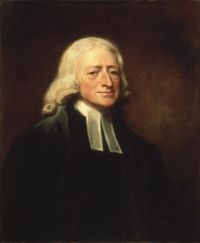 John Wesley,
The works of the Rev. John Wesley…
(1771)
John Wesley,
The works of the Rev. John Wesley…
(1771)
“ Their every day lessons and instructions were so many lectures upon the nature of man, his true end, and the right use of his faculties; upon the immortality of the soul, its relation to God, the beauty of virtue, and its agreeableness to the divine nature; upon the necessity of temperance, fortitude, and generosity, and the shame and folly of indulging our passions. ”
Related terms
Authors who wrote about “good sense”
Ralph Waldo EmersonVariousGeorge Edward MooreJosiah RoyceF. H. BradleyMary Baker EddyJonathan EdwardsAlexander PopeJean-Jacques RousseauSamuel SmilesHannah MoreTheodore P. WilsonOlive Higgins ProutyMarcus Tullius CiceroGustave FlaubertWilhelm HauffOrigenAuguste ForelSir Cusack P. Roney