High water mark

Definition and stakes

Henry Charles Adams,  The Sewerage of Sea Coast Towns

“ Wave motion is most felt where the float is in shallow water. A pier or quay wall will probably be most convenient, but in order to obtain records of the whole range of the tides it is of course necessary that the float should not be left dry at low water. In some instances the float is fixed in a well sunk above high water mark to such a depth that the bottom of it is below the lowest low water level, and a small pipe is then laid under the beach from the well to, and below, low water, so that the water stands continuously in the well at the same level as the sea. ”
Source: Gutenberg

Henry Charles Adams,  The Sewerage of Sea Coast Towns

“ A chart similar to Fig. 6 should be prepared from the diagrams, showing the rise and fall of the highest spring tides, the average spring tides, the average neap tides, and the lowest neap tides, which will be found extremely useful in considering the levels of, and the discharge from, the sea outfall pipe.
The levels adopted for tide work vary in different ports. Trinity high-water mark is the datum adopted for the Port of London by the Thames Conservancy
”
Source: Gutenberg

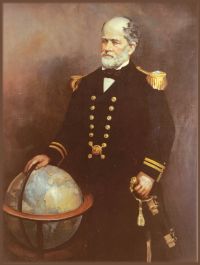
Portrait of James Clark Ross James Clark Ross,  A Voyage of Discovery and Research in the Southern and Antarctic Regions (1847)

“ The highest tide occurs at either the seventh or eighth high water; and the largest tide, varying from 6 feet to 7 feet 1 inch, at the eighth low water after the full and change.
From one hundred and forty observations of high and low water, the mean level of the sea was computed by Captain Crozier, and a corresponding mark cut upon the perpendicular face of the rock on the S.E. side, near the head of the cove, where we always found the best landing, and where the tide-gauge was fixed.
”
Source: Wikisource

Get perspective with Kwize: daily news enlightened by great literature