“ Iron may be connected by similar joints as for copper, or by screw joints as for gas pipes. No white lead to be used, it being a bad conductor.24. Iron flat bands may be connected by rivets or screws, working in slots, to provide for expansion, each surface in contact being at least six times the sectional area of band.25. Copper bands to be similarly connected. Joints between different metals may be soldered, screwed, or rivetted, the extent of surface in contact being regulated by the dimensions of the metal of the least conducting power. ”
Iron band
Definition and stakes
The theme of “iron band” has been addressed by authors such as by William Gilbert, Elizabeth Ida Samuel, la Verne W. Spring, Ettrick W. Creak, Francis H. Butler and Silvanus P. Thompson and Thomas W. Corbin. It is often associated with terms like steel, magnetism, magnet, lodestone and carbon.
Quotes about “iron band”
Harold P. Manly, Oxy-Acetylene Welding and Cutting
“ Pure iron is never obtained commercially, the metal always being mixed with various proportions of carbon, silicon, sulphur, phosphorus, and other elements, making it more or less suitable for different purposes. Iron is magnetic to the extent that it is attracted by magnets, but it does not retain magnetism itself, as does steel. Iron forms, with other elements, many important combinations, such as its alloys, oxides, and sulphates. ”
Elizabeth Ida Samuel, The story of iron (1914)
“ Billy looked at him questioningly.“That was rather technical, wasn’t it, Billy? You see, I was talking to a technical man. Just between you and me, meteoric iron comes down from the sky, from what we call shooting stars. Sometimes large pieces are found. I suppose that much of it falls into the sea. It is the purest iron that has ever been found.”“What about magnetic iron?” asked Dr. Crandon. “Where does that come from?”“At the present time,” answered Mr. Prescott, “most of it comes from Sweden and Norway. It makes the best kind of steel. ”
 Francis Bacon,
Novum Organum — Book II
(1620)
Francis Bacon,
Novum Organum — Book II
(1620)
“ For its nature is such that the magnet when armed does not attract iron more powerfully at any given distance than when unarmed; but if the iron be brought in contact with the armed magnet, the latter will sustain a much greater weight than the simple magnet, from the resemblance of substance in the two portions of iron, a quality altogether clandestine and hidden in the iron until, the magnet was introduced. It is manifest, therefore,,that the form of cohesion is something which is vivid and robust in the magnet, and hidden and weak in the iron. ”
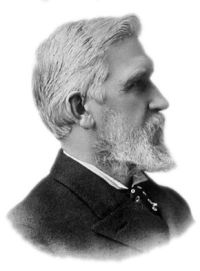 Elisha Gray,
Electricity and Magnetism
Elisha Gray,
Electricity and Magnetism
“ The soft iron is comparatively free from this coercive force, because its molecules are free to move on each other, so that when they are wrenched out of their natural position [Pg 29] they fly back by their own attractions as soon as the force holding them apart is taken away. The molecules of hardened steel are unable to fly back, although they tend to do it just as much as in the iron, and so it is called a permanent magnet. Its molecules also are under a strain, like a bent bow. ”
Robert Routledge, Discoveries and Inventions of the Nineteenth Century
“ But the difference in the magnetic behaviour of iron and steel is not so well understood, and it is a point of importance for our subject, and connected with a fundamental law which governs all magnetic manifestations. A piece of pure iron is very readily cut with a file, whereas a piece of steel may be so hard that the file 484makes no impression upon it whatever; and hence a piece of pure iron, or rather iron holding no carbon in combination, and possessed of no steely quality, is often spoken of as soft iron. ”
Robert Hunt, The Poetry of Science; or, Studies of the Physical Phenomena of Nature
“ It is curious that iron becomes magnetic in a superior degree to any other metal; that steel retains permanently any magnetism imparted to it; but that soft iron rapidly loses its magnetic power. This must be in virtue of some peculiar arrangement of the molecules, or some unknown physical condition of the atoms of the mass, by which a continued influence is retained by the steel, probably in a state of constant internal circulation. ”
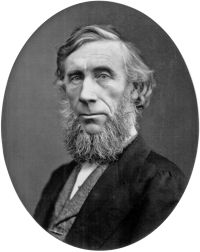 John Tyndall,
The Glaciers of the Alps
John Tyndall,
The Glaciers of the Alps
“ Iron, in fact, is a magnetic metal, which the others are not. It is to be particularly observed, that the bit of iron attracts both ends of the needle when it is presented to them in succession; and if a common steel sewing needle be substituted for the iron it will be seen that it also has the power of attracting both ends of the magnetic needle. ”
N. Hawkins, Hawkins Electrical Guide v. 01…
“ Well annealed, pure wrought iron, as a rule, possesses very little residual magnetism, while, on the other hand, wrought iron, which contains a large percentage of impurities, or which has been subjected to some hardening process, such as hammering, rolling, stamping, etc., and cast iron, possess a very large amount of residual magnetism. ”
by William Gilbert, On the Magnet — Book II. Chap. 4… (1900)
“ Again, iron which has been excited by a loadstone, * if that iron on account of obstacles should not be able to turn round immediately in accordance with its nature, as happens with a versorium, is laid hold of, when a loadstone approaches, on either side or at either end. Because, just as it can implant, so it can suddenly change the polarity and turn about the formal energies to any part whatever. So variously can iron be transformed when its form is adventitious and has not yet been long resident in the metal. ”
William Greener, Gunnery in 1858: Being a Treatise on Rifles…
“ The strength of iron is at its maximum in the smallest mechanical structures.2. The quality of the metal is improved as it is subjected to greater pressure and condensation.The extent to which this improvement may be carried has never yet been ascertained; every fresh manipulation improves its quality. The tenacity of wrought iron is best displayed in a wire, drawn out until it is not thicker than a human hair. Large masses of wrought iron are weak and spongy in geometrical progression with the mass, and the crystalline or molecular form increases with the mass. ”
On the magnet, magnetick bodies also…
“ And for this reason Aristotle in the fourth book of his Meteora seems not unfairly to separate iron from all the rest of the metals. Gold, he says, silver, copper, tin, lead, belong to water; but iron is of the earth. Galen, in the fourth chapter of De Facultatibus Simplicium Medicamentorum, says that iron is an earthy & dense body. Accordingly a strong loadstone is on our showing especially of the earth: the next place is occupied by iron ore or weaker loadstone ”
la Verne W. Spring, Non-technical chats on iron and steel and their application to modern industry (1917)
“ It is so highly 75refined that it can hardly be called steel at all but is often called “open-hearth iron” or “ingot iron.” It is probably the purest iron on the market in commercial quantities to-day. While in the chemical laboratory iron of considerably greater purity can be made, for a commercial product this is remarkably pure, seldom containing more than 1⁄4 per cent of elements other than the metal, iron. ”
Various, Scientific American Supplement…
“ The remarkable researches and experiments of Professor Hughes clearly show that magnetism is totally independent of iron, and that its molecules, particles, or polarities are capable of rotation in that metal. It would also appear that by reason of the friction between magnetism and iron, the molecules of the latter are only partially moved, such movement being the result of the tendency of iron to retard magnetic change. ”
On the magnet, magnetick bodies also…
“ Pieces of iron in the presence of a loadstone (even if they are not * touching the loadstone) run together, seek one another anxiously and embrace one another, and when joined are as if they were cemented. Iron * filings or the same reduced to powder inserted in paper tubes, placed upon a stone meridionally or merely brought rather close to it, coalesce into one body, and so many parts suddenly are concreted * and combine; and the whole company of corpuscles thus conspiring together affects another piece of iron and attracts it, as if it constituted one integral rod of iron ”
Various, Scientific American Supplement…
“ Perfectly soft iron we can easily free, by vibrations, from the slightest trace of previous magnetism, and study the neutrality produced under varying conditions.FIG. 1.If we take a flat bar of soft iron, of 30 or more centimeters in length, and hold it vertically (giving while thus held a few torsions, vibrations, or, better still, a few slight blows with a wooden mallet, in order to allow its molecules to rotate with perfect freedom) , we find its lower end to be of strong north polarity, and its upper end south. ”
Ettrick W. Creak, Francis H. Butler and Silvanus P. Thompson, 1911 Encyclopædia Britannica, Volume 6… (1911)
“ Soft iron is iron which becomes instantly magnetized by induction when exposed to any magnetic force, but has no power of retaining its magnetism. Hard iron is less susceptible of being magnetized, but when once magnetized it retains its magnetism permanently. ”
On the magnet, magnetick bodies also…
“ For the iron is not taken possession of and allured by material effluvia, after the manner of electricks, but only by the immaterial action of its form or an incorporeal progression, which in a piece of iron as its subject acts and is conceived, as it were, in a continuous homogeneous body, and does not need more open ways. ”
la Verne W. Spring, Non-technical chats on iron and steel and their application to modern industry (1917)
“ Again, while iron, the carbon steels, and even the magnetic oxide of iron which contains only about 72 per cent of the metal, are strongly magnetic, manganese steel which has 85 per cent of iron is so non-magnetic that it is sometimes used in place of brass or bronze where an entirely non-magnetic material is required. The nickel steels with 24 per cent or more of nickel are also non-magnetic though both constituent metals, alone, are strongly attracted by the magnet. ”
by William Gilbert, On the Magnet — Book III. Chap… (1900)
“ When this ignition has overcome the acquired polarity, and it has been now completely subdued and not awakened again, that iron is left unsettled and utterly incapable of direction. But we must further inquire how iron remains affected by verticity. It is manifest that it strongly affects and changes the nature of the iron, because the presence of a loadstone attracts the iron to itself with an altogether wonderful readiness. ”
On the magnet, magnetick bodies also…
“ But since iron is more like iron than loadstone, and the virtue in both pieces of iron is exalted by the proximity of the loadstone, so in the loadstone itself, in case of equal strength, likeness of substance prevails, and iron gives itself up rather to iron, and they are united by their very similar homogenic powers. Which thing happens not so much from a coition, as from a firmer unition; and a knob or snout of steel, fixed skilfully on the pole of the stone, raises greater weights of iron than the stone of itself could. ”
On the magnet, magnetick bodies also…
“ Iron is by all reckoned in the class of metals, and is a metal livid in colour, very hard, glows red-hot before it melts, being most difficult of fusion, is beaten out under the hammer, and is very resonant. ”
“ Iron is used to form the body of the armature since the magnetic lines of force flow easily through the iron. The iron by its permeability also concentrates and increases the magnetic flux. The best armatures are made of many thin sheets of soft iron. These are called laminated armatures. An armature made of a solid piece of iron becomes hot when revolving in a magnetic field. This is due to electric currents induced in the iron itself. This heating is largely reduced by laminating the armature. Why? Fig. 290.—Armature connected to slip rings producing an alternating current. ”
On the magnet, magnetick bodies also…
“ Manufactured irons differ very greatly amongst themselves. For one kind is tenacious in its nature, and this is the best; one is of medium quality: another is brittle, and this is the worst. Sometimes the iron, by reason of the excellency of the ore, is wrought into steel, as to-day in Noricum. From the finest iron, too, well wrought and purged from all dross, or by being plunged in water after heating, there issues what the Greeks call στόμωμα; the Latins acies; others aciarium, such as was at times called Syrian, Parthian, Noric, Comese, Spanish ”
Elizabeth Ida Samuel, The story of iron (1914)
“ Prescott. “Heat expands iron. If we didn’t keep it cool, the screw wouldn’t be the right size when it is done.“Cold naturally works the other way. Ever hear about the iron bridge where the parts wouldn’t quite come together, so they put ice on to do the job?” he asked, but he kept right on, without waiting for Billy to answer.Billy saw other machines boring holes and rounding corners. It seemed as if iron could cut iron into any shape that anybody wanted. ”
Selimo Romeo Bottone, Electric Bells and All About Them…
“ Iron is rendered hard by hammering, by being rapidly cooled, either in cold air or water, [Pg 66] and hard iron retains magnetism for a longer time than soft iron. As we wish to have a magnet that will only act as such when a current of electricity is passing around it, and shall return to the state of a simple piece of unmagnetised iron when the current is broken, we take the precaution of having it of soft iron. Many bells have failed to act properly, because this precaution has been neglected, the "residual" (or remaining) magnetism holding down the armature after contact has been broken. ”
 James Clerk Maxwell,
A Treatise on Electricity and Magnetism
(1873)
James Clerk Maxwell,
A Treatise on Electricity and Magnetism
(1873)
“ The magnetic as well as the mechanical differences between steel of hard and soft temper are much greater than those between hard and soft iron. Soft steel is almost as easily magnetized and demagnetized as iron, while the hardest steel is the best material for magnets which we wish to be permanent. Cast iron, though it contains more carbon than steel, is not so retentive of magnetization. ”
Francis Bacon,
Novum Organum — Book II
(1620)
“ Iron, at a red or white heat, when quenched in a direction parallel to the north and south, also acquires polarity without the touch of the magnet, as if the parts of iron being put in motion by ignition, and afterward recovering themselves, were, at the moment of being quenched, more Susceptible and sensitive of the power emanating from the earth, than at other times, and therefore as it were excited. ”
Thomas M. St. John, The Study of Elementary Electricity and Magnetism by Experiment
“ The molecules of steel do not move about or change their relative positions as readily as those of soft iron. When the molecules of hard steel are once arranged, by magnetizing them, for example, they strongly resist any outside influences which tend to mix them up again.A magnet does not attract a piece of red-hot iron. The particles of the hot iron are supposed to vibrate too rapidly to be brought into line; that is, the iron cannot become polarized by induction. ”
Thomas Wilhelm, A Military Dictionary and Gazetteer
“ Wrought iron is softer than cast iron, and, being pure iron, is more liable to be corroded by the action of the atmosphere and products of combustion of the powder; it possesses also considerable ductility. The tensile strength of wrought iron, which under the most favorable circumstances is double that of the best cast iron, depends on the character of the crystalline structure, and the manner of applying the tensile force, or in other words, wrought iron offers the greatest resistance to a force of extension when the structure is fibrous, and the force acts in the direction of the fibres. ”
Thomas W. Corbin, The Romance of War Inventions
“ So we believe that the little molecules lie just anyhow, wherefore they neutralize each other and the mass of iron is powerless. When another magnet comes near, however, they are more or less pulled into the right position and the iron becomes magnetized. When the magnet is removed the magnetism which it produced is largely lost, and if last of all we give the iron a smart blow with a hammer even the residual magnetism vanishes too. ”
George Iles, Inventors at Work, with Chapters on Discovery
“ We have long known that carbon has forms which vary as widely as coal, graphite and the diamond. Many other elements are detected in a similar masquerade. Iron, for instance, takes three forms, alpha, beta, and gamma. Alpha iron is soft, weak, ductile and strongly magnetic; beta iron is hard, brittle and feebly magnetic; gamma iron is also hard and feebly magnetic, yet ductile. Joule, the famous English experimenter, prepared an amalgam of iron with mercury ”
la Verne W. Spring, Non-technical chats on iron and steel and their application to modern industry (1917)
“ Open-hearth iron is practically pure iron, having no constituents or slag inclusions which materially affect its properties.2. Wrought iron, for all practical purposes, is pure iron 86except for its content of slag. It is the only one of the iron family which does normally contain slag.3. Neither open-hearth iron nor wrought iron contains carbon in appreciable quantities.4. The distinguishing and active element of the steel family is carbon. With increase of carbon the hardness of the alloy increases as does its tensile strength, but the ductility (elongation or stretch) decreases. ”
Related terms
Authors who wrote about “iron band”
by William GilbertElizabeth Ida Samuella Verne W. SpringEttrick W. Creak, Francis H. Butler and Silvanus P. ThompsonThomas W. Corbin Torbern BergmanThomas D. CopeHarold P. ManlyVariousJames Clerk MaxwellFrancis Bacon
 Robert Stawell Ball
 Nikola TeslaRobert RoutledgeThomas WilhelmJohn TyndallElisha Gray
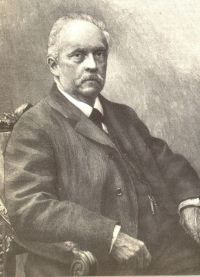 Hermann von HelmholtzThomas BainesDmitry Ivanovich Mendeleyev
Torbern BergmanThomas D. CopeHarold P. ManlyVariousJames Clerk MaxwellFrancis BaconRobert Stawell BallNikola TeslaRobert RoutledgeThomas WilhelmJohn TyndallElisha GrayHermann von HelmholtzThomas BainesDmitry Ivanovich Mendeleyev