Lacrimal gland

Definition and stakes

B. F. Kaupp The anatomy of the domestic fowl (1918)

The vena ophthalmica lies close to the point where the olfactory nerve passes out of the cranial cavity. The largest branch it receives is the recurrent ophthalmo-temporalis, which accompanies the lateral side of the optic nerve. It collects the blood from the base of the brain, from Harder’s gland, from the eye muscles, from the 237inner eye, the nose, the lacrimal gland, the skin of the frontal region, and the comb.
Source: Gutenberg

Albert M. Reese The alligator and its allies (1915)

The cartilage described in the nictitating membrane of Lacerta is wanting, according to Bronn, in the Crocodilia.
The glands of the eye are of three types: the lachrymal glands proper, the Harderian glands, and the conjunctival glands. The lachrymal gland is small in proportion to the size of the eye. It [145] is an elongated, almost band-like structure situated in the roof of the eye-socket, near its border; its long axis lies in an antero-posterior direction. It is so closely inclosed by and united with connective tissue that it is difficult to find.
Source: Gutenberg

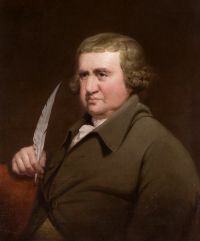
Portrait of Erasmus Darwin Erasmus Darwin Zoonomia, or, the Laws of Organic Life… (1796)

In this case there exists a chain of associated actions, the secretion of the lacrymal gland is increased by whatever stimulates the surface of the eye, at the same time the increased abundance of tears stimulates the puncta lacrymalia into greater action; and the fluid thus absorbed stimulates the lacrymal sac, and its nasal duct in the nose into greater action. In a contrary direction of this chain of association the present increase of action is induced. First, the nasal duct of the lacrymal sac is excited into increased action by some pleasurable or painful idea, as described in Sect.
Source: Wikisource

Get perspective with Kwize: daily news enlightened by great literature