“ This lava flow seems to have been poured out during the same eruption that gave birth to the cone, cutting the lake in two, flowing a little way into the woods and overwhelming the trees in its way, the ends of some of the charred trunks still being visible, projecting from beneath the advanced snout of the flow where it came to rest; while the floor of the forest for miles around is so thickly strewn with loose cinders that walking is very fatiguing. ”
Lava flow
Definition and stakes
The theme of “lava flow” has been addressed by authors such as Corwin Knapp Linson, Thomas Augustus Jaggar, John W. Judd, Frederick William Rudler and Sir Charles Lyell. It is often associated with terms like volcano, crust, mountain, steam and basalt.
Quotes about “lava flow”
Caroline Pridham, Twilight and Dawn; Or, Simple Talks on the Six Days of Creation
“ Such is the force of this steam that even the bed of the sea has been heaved up by it into a burning mountain, from which great stones are cast high into the air; while down its sides flow melted rocks and metals, forming the lava which, when seen at night, looks like a stream of liquid fire, but quickly cools into a river of mud. ”
W. D. Westervelt, Hawaiian Legends of Volcanoes…
“ He was the god of the insatiable appetite, the continual eater of trees, whose path through forests was covered with black smoke fragrant with burning wood, and sometimes burdened with the smell of human flesh charred into cinders in the lava flow. ”
 Algernon Blackwood,
The Centaur — Chapter XIV
(1911)
“ Most of the passengers were ashore, hurrying with guidebooks and field-glasses to see the statue of the dead Bellini or watch the lava flow. A blazing, suffocating heat lay over the oily sea, and the summit of the volcano, with its tiny, ever-changing puff of smoke, soared through blue haze. ”
Frank Coffee, Forty Years On The Pacific — Volcanoes (1920)
“ Five native villages have been covered by the flow, and even their former sites can only be conjectured, for the thickness of the lava is seldom under thirty or forty feet at any place. No lives have so far been lost, for, as a usual thing, the approach of a lava flow is slow. The sight is overpoweringly majestic, and once witnessed is never forgotten. ”
 Charles Henry Hitchcock,
Popular Science Monthly
(1874)
“ When a stream of lava flows down a slope, the surface and sides of the molten river are soon covered by a thick crust, the result of cooling. This will become so firm that men may walk upon it, as upon ice over lakes in the winter. During one of the eruptions from Vesuvius, when lava covered the town of Resina—the old Herculaneum—some of the inhabitants, driven to the tops of the houses, escaped by walking over the stiffened crust, before the flow had ceased. Whenever the lateral walls of the stream are broken, the lava will flow out and change its course. ”
 Frederick William Rudler,
1911 Encyclopædia Britannica
(1911)
“ Notwithstanding the high temperature of lava on emission, it cools so rapidly, and the consolidated lava conducts heat so slowly, that vegetable structures may be involved in a lava-flow without being entirely destroyed. A stream of lava on entering a wood, as in the sylvan region on Etna, may burn up the undergrowth but leave many of the larger trees with their trunks merely carbonized. On Vesuvius a lava-flow has been observed to surround trees while the foliage has been apparently uninjured. ”
 Thomas Augustus Jaggar,
My experiments with volcanoes
(1956)
“ Ordinarily these outlets are along cracks or rifts in the slope of the mountain, where they are seen to break out in gassy fountains 500 feet high, and often to flow along the crack to a cavity where they cascade downward when less foamy and heavier. A lava flow is always solving a problem of foaming and liquefying, just as does champagne or beer. ”
Anonymous, Wonders of Creation: A Descriptive Account of Volcanoes and Their Phenomena
“ Lava, not being so liquid as water, does not flow so rapidly: nevertheless, when it is careering down the sides of a mountain, or where the slope of the ground is considerable, it advances with great speed. Even when at its hottest, it is somewhat viscid, like treacle, and this viscidness increases as it cools. Hence on a level plain, and at some distance from its source, the lava-stream advances at a leisurely pace. ”
Charles Morris, The San Francisco Calamity by Earthquake and Fire
“ A lava stream at Vesuvius ran three miles in four minutes, but took three hours to flow the next three miles, while a stream from Mauna Loa ran eighteen miles in two hours. Glowing at first as a white-hot liquid, the lava soon cools at the surface to red and then to black; cinder-like scoriaceous masses form on its surface and in front of the slowly-advancing mass; clouds of steam and other vapor rise from it, and little cones are thrown up from its surface; but many years may elapse before the mass is cooled through. Thus, while the surface is glassy, the interior becomes crystalline. ”
Justin R. Loomis, The Elements of Geology; Adapted to the Use of Schools and Colleges
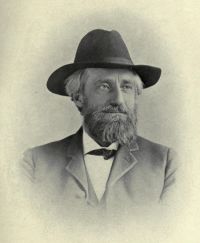
“ The force by which mountains are elevated being the elasticity of the vapor diffused through the subjacent lava, it may happen, if the lava have a high degree of fluidity, that this vapor will collect in large masses, and rise as far as the lava is in a fluid state. The irregular [142] flow of lava from craters during an eruption is undoubtedly due to the rapid ascent of such steam bubbles through the lava. Such an accumulation of vapor under a mountain mass, if it cannot escape, would support it as long as the temperature remained unchanged. ”
 Nathaniel Southgate Shaler,
Outlines of the Earth's History…
“ As the freezing goes deeper, a firm stone roof may be formed across the gorge, which, when the current of lava ceases to flow from the crater, permits the lower part of the stream to drain away, leaving a long cavern or scries of caves extending far up the cone. The nature of this action is exactly comparable to that which we may observe when on a frosty morning after rain we may find the empty channels which were occupied by rills of water roofed over with ice; the ice roofs are temporary, while those of lava may endure for ages. ”
 Mark Twain,
Roughing It — Chapter LXXIV
(1872)
“ Occasionally the molten lava flowing under the superincumbent crust broke through—split a dazzling streak, from five hundred to a thousand feet long, like a sudden flash of lightning, and then acre after acre of the cold lava parted into fragments, turned up edgewise like cakes of ice when a great river breaks up, plunged downward and were swallowed in the crimson cauldron. ”
 Charmian London,
Our Hawaii
(1917)
“ For all the beauty of its rose and velvet of distance, there reigns intense desolation, With something sinister in the dearth of plant or animal life. Passing an over-toppling crimson Niagara of dead lava frozen in its fall, we reinvested the silent bleakness with fire and flow and upheaval, until, suddenly whooping into a mad race up the flanks of a big blowhole that had earlier presented its dry throat to our downward scrutiny, we hesitated to look over into the soundless pit, half expecting we knew not what. ”
Anonymous, Wonders of Creation: A Descriptive Account of Volcanoes and Their Phenomena
“ Even where the current continues flowing rapidly, this crust may be formed on its surface; and a man, whose curiosity exceeds his prudence, may stand on the top of it, bore a hole through the crust, and see the lava flowing underneath his feet!Nothing can resist the progress of the lava-flood; trees, houses, everything yields to its massive assault, The trees take fire before its approach, and when it reaches them they emit a hissing noise almost amounting to a shriek, and then plunging into the molten flood are seen no more. ”
Grenville A. J. Cole, Rocks and Their Origins (1912)
“ The surface of ordinary lava-flows remains rough for centuries, and only slowly crumbles down before weathering to form a soil. While tuff-beds provide light and fertile lands, the lava-streams remain marked out among them, as sinuous bands of rock, given over to an irregular growth of woodland. ”
Various, The Strand Magazine (1892)
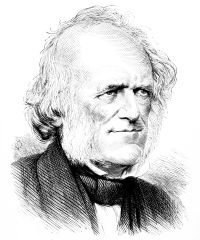
“ A lava stream flows down the slope of the mountain like a burning river, at first rapidly, but, as it cools, scoriæ gradually form, and at length the molten matter covers itself completely, both above and at the sides, with a solid crust, within which, as in a tunnel, it continues to flow slowly as long as it is supplied from the source, here and there breaking through the crust which, as continually, reforms in front. ”
 Sir Charles Lyell,
A Manual of Elementary Geology
“ A. Church and town of Castell Follit, overlooking precipices of basalt. B. Small island, on each side of which branches of the river Teronel flow to meet the Fluvia. c. Precipice of basaltic lava, chiefly columnar, about 130 feet in height. d. Ancient alluvium, underlying the lava-current. e. Inclined strata of secondary sandstone. I shall describe one more section to elucidate the phenomena of this district. A lava-stream, flowing from a ridge of hills on the east of Olot, descends a considerable slope, until it reaches the valley of the river Fluvia. ”
1911 Encyclopædia Britannica (1911)
“ The lava is emitted from the volcanic vent at a high temperature, but on exposure to the air it rapidly consolidates superficially, forming a crust which in many cases is soon broken up by the continued flow of the subjacent liquid lava, so that the surface becomes rugged with clinkers. ”
G. Hartwig, The Subterranean World
“ Further on, the lava flows down the mountain’s side according to the same laws which regulate the movements of any other stream, whether of water, mud, or ice: more rapidly down an abrupt declivity, slower where the slope is more gradual ”
Charles Morris, The San Francisco Calamity by Earthquake and Fire
“ After the eruption of ashes, lava frequently follows, sometimes rising to the top of the cone of cinders, at others disrupting it on the least resisting side. When the lava has reached the base of the cone it begins to flow down the mountain, and, being then in a very fluid state, it moves with great velocity. As it cools, the sides and surface begin to harden, its velocity decreases, and after several days it moves only a few yards an hour. ”
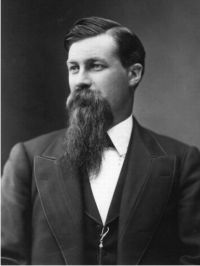
“ But far the greater part of the plateau is good sound desert, rocky, sandy, or fluffy with loose ashes and dust, dissected in some places into a labyrinth of stream-channel chasms like cracks in a dry clay-bed, or the narrow slit crevasses of glaciers—blackened with lava flows, dotted with volcanoes and beautiful buttes, and lined with long continuous escarpments—a vast bed of sediments of an ancient sea-bottom, still nearly as level as when first laid down after being heaved into the sky a mile or two high. ”
 Thomas C. Chamberlin,
Geology
(1906)
“ Lava streams are good types of viscous fluids flowing in masses comparable to those of glaciers and on similar slopes, and, in their last stages, at similar rates, but their special modes of flow and their effects on the sides and bottoms of their paths are radically different from those of glaciers. ”
William Harmon Norton, The Elements of Geology
“ The column of lava rises, breaks through the side of the mountain, and discharges in lava streams. There are no explosions, and usually no earthquakes, or very slight ones, accompany the eruptions. The lava in the calderas boils because of escaping steam, but the vapor emitted is comparatively little, and seldom hangs above the summits in heavy clouds. We see here in its simplest form the most impressive and important fact in all volcanic action, molten rock has been driven upward to the surface from some deep-lying source. Fig. 214. Pahoehoe Lava, HawaiiLava flows. ”
Orange Perry Barnes, Fly Fishing in Wonderland
“ These eruptions were accompanied by prodigious outpours of lava that altered the topography of the entire mountain section. Nowhere else in all creation has such an amount of matter been forced up from the interior of the earth to flow in red-hot rivers to the distant seas as in the western part of the United States. ”
Emory Adams Allen, The Prehistoric World; Or, Vanished Races
“ In explanation of that we arrive at some very important conclusions, and we can not fail to be impressed with the fact that countless ages have rolled away since that lava flood poured down the mountain side. “No one can deny that a stream of melted lava, running for forty miles down the slope of the Sierra, must have sought and found a depression or valley in which to flow ”
J. H. Kerry-Nicholls, The King Country; or, Explorations in New Zealand
“ Up this we had to crawl on our hands and knees, as the wind sweeping around the mountain from the right, fearfully cold, and with unabated force, made it impossible to stand. The scoria ridge and masses of rock and gigantic boulders that rose up around, were covered with festoons of ice, and the whole mountain shone and glittered with a dazzling splendour. Above the white snow, the dark ridges of lava rose like stupendous walls, rugged, bare, and desolate, but adamantine and colossal in structure, as if the Architect of nature had intended them to endure for all time. ”
“ Now woodland and crag, here again earth and soil are in the flood. The lava-river itself aids their supplies and adjusts the compliant material to its own course. But if perhaps in some deep valley it lags and stops, its rolling volume browses leisurely over the fields uneven as they are. Then it redoubles its billows and chides the laggard waves; as when a violent sea plunges headforemost with curving swell; and first it urges on its feeble waves, others beyond . . . advancing, it spreads far and wide, and choosing (what to envelop) . ”
W. H. Davenport Adams, Celebrated Women Travellers of the Nineteenth Century
“ With a clang, a clash, and a roar, like that of breakers on a rocky coast, waves of blood-red, fiery, liquid lava dashed against the opposing cliffs, and flung their spume high up in the air—waves which were never still, but rolled onwards incessantly to the charge, and as incessantly retired—hustling one another angrily, and hissing and boiling and bubbling, like a sea chafed by adverse wind and current. ”
Sir Charles Lyell,
A Manual of Elementary Geology
“ For, a multitude of causes tend, near the land, to reduce the bottom of the sea to a nearly uniform level,—the sediment of rivers,—materials transported by the waves and currents of the sea from wasting cliffs,—showers of sand and scoriæ ejected by volcanos, and scattered by the wind and waves. When, therefore, lava is poured out on such a surface, it will spread far and wide in every direction in a liquid sheet, which may afterwards, when raised up, form the tabular capping of the land. ”
Richard Lee, Once a Week (1863)
“ For miles around, the rocks were spouting steam, hissing and roaring, and filling the whole air with pent-up gases from the great laboratory beneath; while burning streams of red-hot lava came rolling onward in stern, irresistible waves, now plunging in majestic grandeur over a deep precipice, or sweeping away the vegetation of the earth and shrivelling up huge forest trees in its relentless, solemn fury. ”
A. H. Macklin, Shackleton's Last Voyage: The Story of the Quest
“ The plain is grass clothed, and the upper slopes are covered in moss, bracken and scrub trees. This 321 vegetation continues up to about 4,000 feet, above which point the rocks are bare. Geology The island consists of a great series of lava flows which have poured from the volcano, and are of the nature of scoriæ, cinder, trachyte and basalt in succeeding and alternating layers. As is so common on these volcanic islands, the lower lava is generally a hard, compact basalt showing rough columnar structure. ”
 Ida Pfeiffer,
A Visit to the Holy Land, Egypt…
“ It is difficult for one who has not seen it to picture to himself the scene that lay around us. Devastation every where; lava covering the whole region in heaps upon heaps, fantastically piled one on the other. Here a huge isolated mound rises, seemingly cut off on all sides from the lava around; there we see how a mighty stream once rushed down the mountain-side, and cooled gradually into stone. Immense chasms are filled with lava masses, which have lain here for many years cold and motionless, and will probably remain for as many more, for their fury has spent itself. ”
 Robert Sterling Yard,
The Book of the National Parks
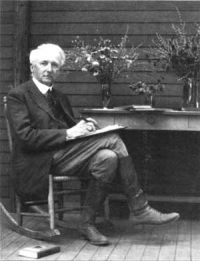
“ Precipices rise at times two thousand feet, sheer as a wall. Elsewhere gentle slopes of powdery lava, moss-tinted, connect rim and water with a ruler line. And between these two extremes are found every fashion and kind and degree of lava wall, many of them precipitous, most of them rugged, all of them contorted and carved in the most fantastic manner that imagination can picture. Caves open their dark doors at water's edge. Towered rocks emerge from submerged reefs. A mimic volcano rises from the water near one side. Perpetual snow fills sheltered crevices in the southern rim. ”
Related terms
Authors who wrote about “lava flow”
 Corwin Knapp LinsonThomas Augustus JaggarJohn W. JuddFrederick William RudlerSir Charles Lyell
 Edwin J. HoustonRobert I. TillingHenry James Johnston-LavisW. S. C. RussellRichard LeeJ. H. Kerry-NichollsWilliam EllisJustin R. LoomisW. D. WesterveltRobert Sterling YardPliny MilesLuigi PalmieriGrenville A. J. ColeCharmian London
 Grove Karl Gilbert
