Logarithmic spiral

Definition and stakes

Memorabilia Mathematica; or, the Philomath's Quotation-Book

“ Algebra, Part 2 (Edinburgh, 1879) , p. 209.
922. In the year 1692, James Bernoulli, discussing the logarithmic spiral [or equiangular spiral, ρ = αθ] ... shows that it reproduces itself in its evolute, its involute, and its caustics of both reflection and refraction, and then adds: "But since this marvellous spiral, by such a singular and wonderful peculiarity, pleases me so much that I can scarce be satisfied with thinking about it, I have thought that it might not be inelegantly used for a symbolic representation of various matters.
”
Source: Gutenberg

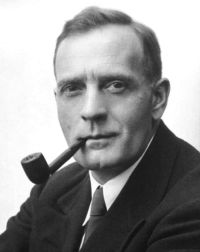
Portrait of D'Arcy Wentworth Thompson D'Arcy Wentworth Thompson,  On Growth and Form

“ It follows that the resultant of the forces F and T (as PQ) makes a constant angle with the radius vector. But the constancy of the angle between tangent and radius vector at any point is a fundamental property of the logarithmic spiral, and may be shewn to follow from our definition of the curve: it gives to the curve its alternative name of equiangular spiral. Hence in a structure growing under the above conditions the form of the boundary will be a logarithmic spiral. {506}
Fig.
”
Source: Gutenberg

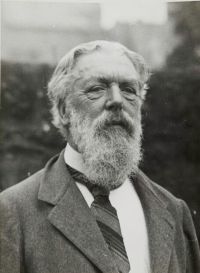
Portrait of Jean-Henri Fabre Jean-Henri Fabre,  Insect Adventures

“ There is more than this: these same angles, the obtuse as well as the acute, do not alter in value, from one sector to another, as far as the eye can judge. Taken as a whole, therefore, the spiral consists of a series of cross-bars intersecting the several radiating lines obliquely at angles of equal value.
By this characteristic we recognize what geometricians have named the “logarithmic spiral.” It is famous in science. The logarithmic spiral describes an endless number of circuits around its pole, to which it constantly draws nearer without ever being able to reach it.
”
Source: Gutenberg

Get perspective with Kwize: daily news enlightened by great literature