 Herbert Spencer,
The Data of Ethics
Herbert Spencer,
The Data of Ethics
“ For unquestionably the essential trait in the moral consciousness is the control of some feeling or feelings by some other feeling or feelings. ”
Herbert Spencer,
The Data of Ethics
“ For unquestionably the essential trait in the moral consciousness is the control of some feeling or feelings by some other feeling or feelings. ”
W. R. Sorley, Recent Tendencies in Ethics
“ All the facts of our moral consciousness, therefore,—the knowledge of right and wrong, the judgments of conscience, the recognition of duty and responsibility, the feelings of reverence, remorse, and moral indignation,—all these could be traced, they thought, to an origin in experience, to an origin which in the last resort was sensuous, that is, due to the perceptions of the senses and the feelings of pleasure and pain which accompany or follow them. ”
M. Valentine, Theoretical Ethics
“ The great fact of moral distinctions, found to be universal in human thought and life, must be traced back to the particular power of the mind which discerns and feels these distinctions. Back of the phenomenon must be recognized the psychical capacity and action out of which the discriminations arise. The moral faculty answers to and in part accounts for the moral fact. In modern general literature it is usually called the conscience. Ethical science properly accepts the designation. It is sometimes called the moral consciousness, or the moral sense. ”
Boyd Henry Bode, Creative Intelligence: Essays in the Pragmatic Attitude
“ But just as little as the process of the moral consciousness is satisfied by an emotional theory of the judgment does it sanction any conception of objectivity which requires that values are here or there once for all; that they are fixed entities or "a nature of things" upon which the moral consciousness may look for its information but upon which it exercises no influence. The process of attempting to give—or discover—moral values is a process of mutual determination of object and agent. We have to do in morals not with a nature of things but with natures of persons. ”
Cora May Williams, A Review of the Systems of Ethics Founded on the Theory of Evolution
“ For now let us observe that the ethical sentiment and idea, properly so-called, are independent of the ideas and sentiments above described as derived from external authorities, and coercions, and approbations—religious, political, or social. The true moral consciousness which we name conscience does not refer to those extrinsic results of conduct which take the shape of praise or blame, reward or punishment, externally awarded ”
 Ralph Barton Perry,
The Moral Economy
Ralph Barton Perry,
The Moral Economy
“ VI Let me add a word concerning the part played by the imagination in enforcing the logic of morality. An enlightened conscience, or a rational conviction of duty, will consist essentially in the viewing of life with a certain remove from its local incidents. In conduct, as in all matters where validity or truth is concerned, the critical consciousness must disengage itself and view the course of things in its due proportions, allowing one's dearest interests to lie where they lie among the rest. ”
M. Valentine, Theoretical Ethics
“ The conscience discerns and affirms this reality of good and evil-desert.Here is reached the psychological source of the great fact of responsibility in the world. It emerges into consciousness and into actual force in human life from this point in the disclosures and affirmations of the moral sense. Hence arises the unspeakably varied but ever persistent human necessity under which men are compelled to regard themselves and others as justly amenable to the law of moral consequences. Its application is seen in every sphere of life, personal, domestic, social, and national. ”
 F. H. Bradley,
Ethical Studies — Essay VI.
(1876)
F. H. Bradley,
Ethical Studies — Essay VI.
(1876)
“ It would not repay us to investigate these difficulties in detail; they arise from doctrines which are not false in themselves, but each of which is false if taken as the expression of the whole truth, and their solution will come readily from the answer to the question, Who for the moral consciousness is the most moral man? ”
M. Valentine, Theoretical Ethics
“ Sense and consciousness can give us only what is, not what ethically ought to be. The memory can but renew to mental view what was before known. The sense of logical necessity is clearly different from the perception of moral rightness and obligation. But the action of these antecedent powers or faculties supplies the conditions for the existence and action of the conscience—gives knowledge of the personal self and the relations of life, in the midst of which moral right and wrong and obligation and duty are developed and are seen to arise. ”
W. R. Sorley, Recent Tendencies in Ethics
“ It seems to have been assumed that moral principles can be reached by the application of scientific generalisations or of the results of a metaphysical analysis which has started by overlooking the facts of the moral consciousness. ”
 James Frederick Ferrier,
An Introduction to the Philosophy of Consciousness
(1883)
James Frederick Ferrier,
An Introduction to the Philosophy of Consciousness
(1883)
“ We are aware of the attempts which have been made to invest our emotions with the stamp and attribute of morality; but, in addition to the testimony of our own experience, we have the highest authority for holding that none of the natural feelings or modifications of the human heart partake in any degree of a moral character. ”
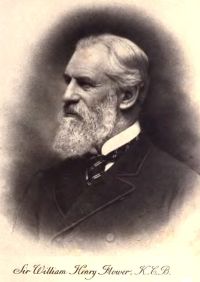 William Henry Flower,
1911 Encyclopædia Britannica
(1911)
William Henry Flower,
1911 Encyclopædia Britannica
(1911)
“ These form, naturally and necessarily, the objective expression of moral ideas, and it is in some civic or social whole that the moral ideal must finally take concrete shape. To ask “What is man?” is to ask “What is experience?” for experience means that of which I am conscious. The facts of consciousness are the only facts which, to begin with, we are justified in asserting to exist. ”
Various, The Monist, Vol. 1, 1890-1891
“ In just the same proportion as we recognise the law of causality, we shall also recognise the moral law. Reason itself is compelled to arouse in us conscience,—theoretical consciousness awakens ethical consciousness. ”
Joseph Warschauer, Problems of Immanence: studies critical and constructive
“ All moral judgments imply this; and in practice we know that the experience of moral struggle and moral conquest is intensely real, not to be argued away any more than we can be argued out of any other primary fact of consciousness, which is its own sufficient evidence. ”
M. Valentine, Theoretical Ethics
“ It is through these feelings that the conscience becomes a motive power for moral life. The perception of duty alone, as purely intellectual, would be, as said, "like a mirror accurately reflecting the ethical reality passing before it, but as indifferent as the mirror." But upon the perception the emotional nature springs into action. Knowledge, if at all, always goes into effect mediately through the sensibilities in which the soul is stirred by affections and desires. ”
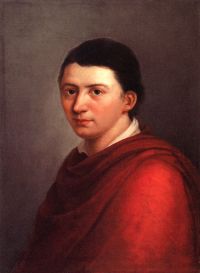 Friedrich von Schlegel,
The philosophy of life, and philosophy of language…
Friedrich von Schlegel,
The philosophy of life, and philosophy of language…
“ In the same way no one will wish to deny that the moral feeling, as the natural expression of the inner voice of conscience, constitutes in social life the fundamental condition and the surest foundation for all lofty and noble sentiments. ”
M. Valentine, Theoretical Ethics
“ Both the intellectual and emotional action of the soul are, therefore, included in what is named the conscience—the perceptive action, here as everywhere else, being primary and conditional for the emotional. If there were no ethical distinction perceived, none would be felt. The conscience, taken in its totality, thus includes both sides of the human psychology, the intellect and the sensibility, and it addresses its behests of duty to the will in its own peculiar way of moral law for conduct. ”
M. Valentine, Theoretical Ethics
“ Starting from the universal phenomenon of moral distinctions in life, it determines the conscience psychologically, as a rationally intuitive power discerning the moral distinction and the reality and authority of moral law. ”
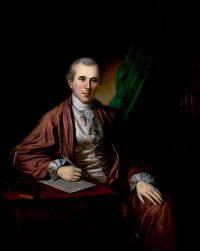 Benjamin Rush,
Medical Inquiries and Observations…
Benjamin Rush,
Medical Inquiries and Observations…
“ The moral faculty is to the conscience, what taste is to the judgment, and sensation to perception. It is quick in its operations, and, like the sensitive plant, acts without reflection, while conscience follows with deliberate steps, and measures all her actions, by the unerring square of right and wrong. The moral faculty exercises itself upon the actions of others. ”
 Josiah Royce,
The Religious Aspect of Philosophy
(1885)
Josiah Royce,
The Religious Aspect of Philosophy
(1885)
“ Shall ethics be founded on feeling, which to-day is and tomorrow is cast into the oven? The traditional answer of the advocates of conscience, when these facts are urged against them, is well known. They say, various less dignified mental tendencies may at times be mistaken for conscience; but the moral sense is real and trustworthy notwithstanding all these mistakes. Shame, or love of praise, or sense of propriety may pass themselves off as conscience; but the genuine conscience, when you find it, is infallible. ”
M. Valentine, Theoretical Ethics
“ But if seen under strong light and with their supreme import, the intuition impresses with greater force. So, too, the state of the whole moral75 nature is a reason of higher or lower moral sensibility. The more unblighted is the condition of personal life, the more is it responsive to the ethical discernment. Habitual refusal of duty, easy and indifferent familiarity with wrong-doing, or any continued enslavement of the higher nature to the lower, necessarily blunts the delicateness of the sensibilities and lowers the strength of the moral feelings. ”
Thomas More, Utopia (1901) — Chapter 6: Of the Travelling of the Utopians (1901)
“ As to moral philosophy, they have the same disputes among them as we have here. They examine what are properly good, both for the body and the mind; and whether any outward thing can be called truly good, or if that term belong only to the endowments of the soul. ”
Cora May Williams, A Review of the Systems of Ethics Founded on the Theory of Evolution
“ But the question, 'Why should I be moral?' means, most naturally and usually, What inducements are there to me to do right?" The answer is that motives differ for different individuals. With some, outer social inducements, with others, the approbation and disapprobation of conscience are stronger. ”
Durant Drake, Problems of Conduct: An Introductory Survey of Ethics
“ But the important truth to observe is not the particular details of their haphazard origin but the causes of their survival. Overlaying the countless originating causes of moral ideals are two main preservation—causes, two constant factors which retain certain of the innumerable impulses for one reason or other momentarily dominant. These are of extreme significance for a comprehension of the function of morality in life. ”
Cora May Williams, A Review of the Systems of Ethics Founded on the Theory of Evolution
“ When I attempt to convince any one that certain conduct which he considers right is wrong, by showing him that it is opposed to the general welfare, my final appeal is to his conscience. And in the same manner, when I correct some of my own moral conceptions, it is my conscience which determines me to the proof of them, and my conscience which is the standard that determines my decision. Conscience is the principle underlying my moral convictions. ”
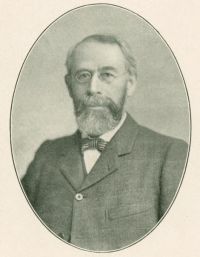 Josephus Nelson Larned,
Popular Science Monthly
(1877)
Josephus Nelson Larned,
Popular Science Monthly
(1877)
“ The dispute of the moralists has reference, not to any characteristic of the qualities in conduct which we cognize as moral, but to the mode in which they are cognized. Our conception of such qualities involves the conception of absoluteness in them, and it is only by that notion of absoluteness that they are distinguished from the other qualities which appear in human conduct, such as wisdom, prudence, ingenuity, and the like. ”
George Henry Lane Fox Pitt-Rivers, Conscience & Fanaticism: An Essay on Moral Values
“ We believe that a correct appreciation of psychology makes it abundantly clear that although there are many impulsive, instinctive and emotional factors totally unconnected with any rational or intellectual process which do, indeed, affect our moral judgments and give rise to ethical conventions, these factors can give no validity to moral codes ”
Thomas Welbank Fowle, Popular Science Monthly (1878)
“ The history of the process by which, under the influence of social life, its wants, obligations, utilities, arrangements, and sanctions, the sense of a right due to ourselves was elaborated into the voice of conscience prescribing what is due to others, would be a valuable and interesting contribution to moral science. But though quite beyond our present limits it is, I think, possible to sketch in mere outline the stages through which conscience passed till it reached its full growth. ”
 Karl Rosenkranz,
Pedagogics as a System
Karl Rosenkranz,
Pedagogics as a System
“ We pass from the consideration of the culture of character to that of conscience. This is the relation which the moral agent makes between himself as manifestation and himself as idea. It compares itself, in its past or future, with its nature, and judges itself accordingly as good or bad. This independence of the ethical judgment is the soul proper of Religious Culture.86 all morality, the negation of all self-deception and of all deception through another. ”
Cora May Williams, A Review of the Systems of Ethics Founded on the Theory of Evolution
“ The word "conscience," as it is more generally used, seems to emphasize the element of reflection in a greater degree than "moral sense." The explanation of the apparent independence of conscience is merely that, in the good man, the moral order is realized, and action from moral principle takes place spontaneously. ”
Giovanni Gentile, The Reform of Education
“ This consideration, important as it is, cannot however be considered as sufficient. For this moral conscience, this certitude with which the moral conscience affirms the existence of an unavoidable duty, might also be an illusion determined in us by natural causes. ”
M. Valentine, Theoretical Ethics
“ A third thing to be marked in this psychological analysis of the action of conscience, and revealing its nature, is the affirmation of right or wrong to particular acts or principles of conduct. In this the function of conscience passes from its fundamental idea into the form of an applicatory judgment. The ideas of right and obligation are applied to the actual affairs and activities of life. The quality of right or wrong is connected with particular actions, feelings or purposes, and these are affirmed to be right or wrong according as they have or have not such moral quality. ”
George Henry Lane Fox Pitt-Rivers, Conscience & Fanaticism: An Essay on Moral Values
“ It is, moreover, equally absurd to look upon moral values as ultimate and irreducible categories of good and evil, irrevocably codified by an omniscient Deity for the conduct of humanity for all time, and supposedly accessible to the intelligence of all who consult their conscience. ”
 Washington Allston,
Lectures on Art
Washington Allston,
Lectures on Art
“ But to illustrate by example: we could not, for instance, have the ideas of good and evil without their objective realities, nor of right and wrong, in any intelligible form, without the moral law to which they refer,--which law we call the Conscience; nor could we have the idea of a moral law without a moral lawgiver, and, if moral, then intelligent, and, if intelligent, then personal; in a word, we could not now have, as we know we have, the idea of conscience, without an objective, personal God. ”
Various, The Continental Monthly, Vol. 6…
“ Yet this very tone of society, and all these standards of honor and uprightness, when traced to their origin, are found to arise from the precepts of revelation. We are all, physically and intellectually, the creatures of circumstance. Experience moulds and develops the intellect. Our moral natures are not innate, but solely and entirely the result of the influences by which we are surrounded. ”
M. Valentine, Theoretical Ethics
“ They concerned the powers and possibilities of man in the crowning endowments of his nature, and in the highest ascent of their evident intention and adaptation. They touched the great problems of personal and social welfare in the most vital relations and decisive interests. So the old sages became moralists and their great themes were the themes of virtue and duty. Not very deeply, however, did they, for centuries, succeed in penetrating the rational principles of the moral life and the authority of the moral judgments. ”
 Charles Darwin,
The Descent of Man
(1875)
Charles Darwin,
The Descent of Man
(1875)
“ Ultimately our moral sense or conscience becomes a highly complex sentiment—originating in the social instincts, largely guided by the approbation of our fellow-men, ruled by reason, self-interest, and in later times by deep religious feelings, and confirmed by instruction and habit. ”
Josiah Royce,
The Religious Aspect of Philosophy
(1885)
“ If the moral insight be concerned with conflicting general aims, such as could express themselves in systems of conduct, then the moral insight involves the will to act, so far as may be, as if one included in one’s own being the life of all those whose conflicting aims one realizes. ”
Josiah RoyceBoyd Henry BodeJames Frederick Ferrier Friedrich NietzscheWilliam Dawson Le SueurGeorge Henry Lane Fox Pitt-RiversJosephus Nelson LarnedW. R. SorleyDurant Drake
 Theodore Parker
 Arthur SchopenhauerFriedrich von Schlegel
 George SantayanaGiovanni GentileHerbert Spencer
 Thomas Hill GreenJoseph Warschauer
 James Mill