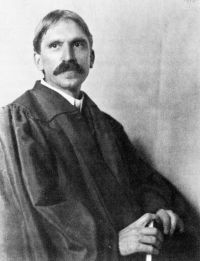
W. R. Sorley

Biographical details

W. R. Sorley,  On the Ethics of Naturalism

“ It is a mistake to think that the will to live which pulses through all existence can be annihilated by the phenomenal individual. The individual's duty is not to seek for himself the painlessness of annihilation or passionless Nirwâna, but to join in the ceaseless painful striving of nature, and, by contributing to the development of life, to hasten its arrival once more at the goal of unconsciousness. The self-destruction, not of the individual will, but of the cosmic or universal will, is the final end of action. ”

Source: Gutenberg

W. R. Sorley,  Recent Tendencies in Ethics

“ Thus, "for example, if I would perform an act of charity pure and simple, and wish to justify this act rationally, I must imagine an eternal Charity at the ground of things and of myself, I must objectify the sentiment which leads to my action; and here the moral agent plays the same rôle as the artist.... In every human action there is an element of error, of illusion": and it is conjectured that this element increases as the action rises above the commonplace: "the most loving hearts are the most often deceived, in the highest geniuses the greatest incoherences are often found." ”
Source: Gutenberg

W. R. Sorley,  On the Ethics of Naturalism

“ If greatest apparent pleasure—or greatest present pleasure—is by an inexorable law of human nature always sought, how can it be shown that we ought to sacrifice the apparent to the real—the present pleasure that is small to the greater future pleasure? If the individual necessarily pursues his own pleasure, how can we show that he ought to subordinate it to the pleasures of the "greatest number"? ”
Source: Gutenberg

Get perspective with Kwize: daily news enlightened by great literature