
“ The name then is perfectly general; for, no matter what the something is that good is held to mean, the theory is still Naturalism. Whether good be defined as yellow or green or blue, as loud or soft, as round or square, as sweet or bitter, as productive of life or productive of pleasure, as willed or desired or felt: whichever of these or of any other object in the world, good may be held to mean, the theory, which holds it to mean them, will be a naturalistic theory. ”
Naturalism
Definition and stakes
Naturalism is the philosophical stance that asserts only natural laws, entities, and forces exist, dismissing supernatural explanations. This idea has been examined by thinkers such as Rudolf Otto, who associated naturalism with scientific investigation, and G. E. Moore, who viewed ethical naturalism as defining "good" through natural occurrences.
Thomas Huxley emphasized its contrast with supernaturalism, while Albert Parker Fitch traced its origins in humanism and materialism. Modern naturalism, shaped by scientific progress, focuses on explaining reality through empirical approaches, as illustrated by the causal completeness of the physical world. This combination of classical philosophical foundations and contemporary scientific frameworks highlights naturalism’s lasting influence on our understanding of existence.
Quotes about “naturalism”
 Albert Parker Fitch,
Preaching and Paganism
Albert Parker Fitch,
Preaching and Paganism
“ How deeply sunk in the modern world are the roots of this naturalism is shown by its long course in history, paralleling humanism. It has seeped down through the Protestant centuries in two streams. One is a sort of scientific naturalism. It exalts material phenomena and the external order, issues in a glorification of elemental impulses, an attempted return to childlike spontaneous living, the identifying of man's values with those of primitive nature. ”
 Rudolf Otto,
Naturalism and Religion
Rudolf Otto,
Naturalism and Religion
“ The fundamental convictions of naturalism, its general tendencies, and the points of view which determine its outlook, are primarily related to that order of facts which forms the subject of the natural sciences, to “Nature.” ”
Abel J. Jones, Rudolph Eucken : a philosophy of life
“ He first treats of Naturalism, that solution of the problem that makes the sense experience of surrounding nature the basis of life, subordinating even the life of the soul to the level of the natural, material world.Nature in the early ages had been superficially explained, often in the light of religious doctrine. Man gave to nature a variety of explanations and of colouring, depending largely upon his ideas of the place of nature in relation to himself and to the invisible world. ”
 Thomas Henry Huxley,
Lectures and Essays
Thomas Henry Huxley,
Lectures and Essays
“ Whether this difference of the fortunes of Naturalism and of Supernaturalism is an indication of the progress, or of the regress, of humanity; of a fall from, or an advance towards, the higher life; is a matter of opinion. ”
Rudolf Otto,
Naturalism and Religion
“ The aggressive naturalism which we have discussed has from very early times exercised itself on this point, and has instinctively and rightly felt that herein lies the kernel of the whole problem under dispute. ”
Rudolf Otto,
Naturalism and Religion
“ The True Naturalism. But naturalism becomes fundamentally different when it ceases to remain at the level of naïve or fancifully conceived ideas of “nature” and “natural occurrences,” when, instead of poetry or religious sentiments, it incorporates something else, namely, exact natural science and the idea of a mathematical-mechanical calculability in the whole system of nature. “Nature” and “happening naturally”, as used by the naïve intelligence, are half animistic ideas and modes of expression, which import into nature, or leave in it, life and soul, impulse, and a kind of will. ”
 Ralph Barton Perry,
The Approach to Philosophy
Ralph Barton Perry,
The Approach to Philosophy
“ Preliminary Note.—By naturalism is meant that system of philosophy which defines the universe in the terms of natural science. In its dogmatic phase, wherein it maintains that being is corporeal, it is called materialism. ”
 William Ralph Inge,
Outspoken Essays
William Ralph Inge,
Outspoken Essays
“ But the difference between naturalism and idealism may, I think, be better stated otherwise than by emphasising the contrast between existence and value, which it is impossible for either side to maintain. Naturalism seeks to interpret the world by investigation of origins ”
Rudolf Otto,
Naturalism and Religion
“ But even the domain of the natural itself, as we know it, is by no means simple and capable of a unified interpretation. Nature, especially in the realm of organic life, the animal and plant world, appears to be filled with marvels of purposefulness, with riddles of development and differentiation, in short with all the mysteries of life. ”
W. R. Sorley, On the Ethics of Naturalism
“ Now these strongest tendencies, in the harmonious play of which natural good or perfection is said to consist, are themselves the result of the courses of conduct which have been most vigorous and successful in ancestral organisms, and they may therefore, perhaps, be taken as a survival and index of the antecedent state of human nature. ”
Rudolf Otto,
Naturalism and Religion
“ With these it deals and through them it works. Even in the most elementary naturalistic idea, that “everything happens of itself,” there lurks that aversion to purpose which characterises all naturalistic systems. ”
Rudolf Otto,
Naturalism and Religion
“ The strength of these evidences was greatly overestimated, and Nature was too much studied with reference to her harmony, her marvellous wealth and purposeful wisdom, her significant arrangements and endless adaptations ”
 F. Max Müller,
The Silesian Horseherd - Questions of the Hour
F. Max Müller,
The Silesian Horseherd - Questions of the Hour
“ That is [pg 059] the thought, the idea, the logos of dog. Can there be a thought without a thinker? Did the ideas in nature, the millions of objects which make up our knowledge, fall from the clouds? Did they make themselves or did nature make them? Who, then, is nature? Is it a masculine, feminine, or neuter? If nature can choose, then it can also think and produce. But can it? No, nature is a word, very useful for certain purposes; but empty, intangible, and incomprehensible. Nature is an abstraction, as much as dog or tree, but far more inclusive. ”
 Josiah Royce,
The World and the Individual, Second Series
(1901)
Josiah Royce,
The World and the Individual, Second Series
(1901)
“ Whatever the deeper reality behind Nature may turn out to be, — our Nature, the realm of matter and of laws with which our science and our popular opinions have to do, is a realm which we conceive as known or as knowable to various men, in precisely the same general sense in which we regard it as known or as knowable to our private selves. Take away the social factor in our present view of Nature, and you would alter the most essential of the characters possessed, for us, by that physical realm in which we all believe. ”
 Sir Francis Edward Younghusband,
The Heart of Nature; or, The Quest for Natural Beauty
Sir Francis Edward Younghusband,
The Heart of Nature; or, The Quest for Natural Beauty
“ For it is in ourselves that the dominating spirit of Nature is most clearly manifested to us. And being ourselves the instruments and agents of Nature, and informed through and through with her spirit, we ought to be able to understand how she works if only we look carefully enough into the working of our own inner selves.What we find is that under the inspiration of the genius of Nature we are perpetually projecting in front of us a pattern or standard of what we think we ought to be, or should like to be, and of what we think our country and the world ought to be. We set up an ideal. ”
 Charles Kingsley,
The Water of Life, and Other Sermons
Charles Kingsley,
The Water of Life, and Other Sermons
“ For this innumerable multitude of things, of which we now-a-days talk as if it were one thing, and had an organic unity of its own, or even as if it were one person, and had a will of its own, and call it Nature—a word which will one day be forgotten by philosophers, with the ‘four elements,’ and the ‘animal spirits;’—this multitude of things, I say, which we miscall Nature, has its dark and ugly, as well as its bright and fair side. ”
Fred S. Lincoln, An Indiana Girl — Chapter 16 (1901)
“ Tell me—where would one derive naturalness but from nature? You grant that?" he asked, as she poised her lips in good-humored stubbornness. "Well, then, we people see nature so little that it affects us not at all, and we are far from natural, which makes that virtue unusual among us. ”
“ Its test is, that it will explain all phenomena. Now many are thought not only unexplained but inexplicable; as language, sleep, madness, dreams, beasts, sex.Philosophically considered, the universe is composed of Nature and the Soul. Strictly speaking, therefore, all that is separate from us, all which Philosophy distinguishes as the NOT ME, that is, both nature and art, all other men and my own body, must be ranked under this name, NATURE. In enumerating the values of nature and casting up their sum, I shall use the word in both senses;—in its common and in its philosophical import. ”
 F. H. Bradley,
Appearance and Reality — Chapter XXVI
(1893)
F. H. Bradley,
Appearance and Reality — Chapter XXVI
(1893)
“ Or, as you reflect on Nature, your object identifies itself gradually with the universe or Absolute. And the question arises at what point, when we begin to add psychical life or to attribute spiritual attributes to Nature, we have ceased to deal with Nature in any proper sense of that term. Where do we pass from Nature, as an outlying province in the kingdom of things, to Nature as a suppressed element in a higher unity? These enquiries are demanded by philosophy, and their result would lead to clearer conclusions about the qualities of Nature. ”
Sir Francis Edward Younghusband,
The Heart of Nature; or, The Quest for Natural Beauty
“ So as we take a comprehensive view of Nature both in her outward bodily form and her inner spiritual reality, and find her to be an interconnected whole in which all the parts are interrelated with one another, one body and one mind, self-contained and self-conscious, and driven by a self-organising, self-governing, self-directing Activity—we should regard her as nothing less than a Personal Being. In ordinary language we speak of Nature as a Person, and when we so speak we should not regard ourselves as speaking figuratively: we should mean quite literally and as a fact that she is a Person. ”
 James Hutchins Baker,
Education and life
(1900)
James Hutchins Baker,
Education and life
(1900)
“ The natural world, plants, animals, the human race, institutions, science, art, religion, all animate individual beings, man as an individual, have their history of development, which suggests its lesson.Nature is aspiration. From chaos to the world of this geologic age, from protoplasm to man, from savagery to civilization, from ignorance to culture, from symbolism to developed art, from egoism to altruism, from germ to fruit, from infancy to maturity, from realization to higher realization, has been the process. ”
 James Frederick Ferrier,
Scottish Philosophy: The Old and the New
(1856)
James Frederick Ferrier,
Scottish Philosophy: The Old and the New
(1856)
“ What would be thought of a naturalist, were he, in composing a treatise on fishes, first of all, to set about proving to himself and others that there were such creatures? Would he not be thought rather a natural than a naturalist? Such very reasonably might I have been thought, if I had ever dreamt of proving to the world, either that Knowledge was, or that Being was. ”
 Friedrich Schiller,
Aesthetical and philosophical essays
(1899)
Friedrich Schiller,
Aesthetical and philosophical essays
(1899)
“ Nature, in being capricious and defying logic, in pulling down great and little, in crushing the noblest works of man, taking centuries to form—nature, by deviating from intellectual laws, proves that you cannot explain nature by nature’s laws themselves, and this sight drives the mind to the world of ideas, to the absolute. ”
Charles Morris, Popular Science Monthly (1881)
“ But is the human form the true culmination of the development of matter? Has Nature really reached in man her acme in this direction? A deductive philosopher would perhaps answer this question in the affirmative, on the theory that Nature would not stop short of the most completely developed physical form, as the starting-point of mental evolution. He might claim that a perfect soul could only arise in a perfect body, and that, as Nature is striving toward perfection, she must lay all her foundations at the highest possible point. ”
 George MacDonald,
A Dish of Orts : Chiefly Papers on the Imagination…
(1893)
George MacDonald,
A Dish of Orts : Chiefly Papers on the Imagination…
(1893)
“ We have already said that the forms of Nature (by which word forms we mean any of those conditions of Nature which affect the senses of man) are so many approximate representations of the mental conditions of humanity. The outward, commonly called the material, is informed by, or has form in virtue of, the inward or immaterial—in a word, the thought. The forms of Nature are the representations of human thought in virtue of their being the embodiment of God’s thought. ”
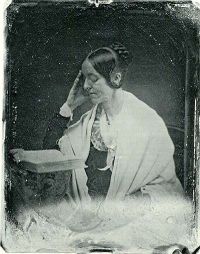 Sarah Margaret Fuller,
Papers on Literature and Art
(1846)
Sarah Margaret Fuller,
Papers on Literature and Art
(1846)
“ Those who observe in this spirit will often experience, from some humble offering to the Muses, the delight felt by the naturalist in the grasses and lichens of some otherwise barren spot. These are the earliest and humblest efforts of nature, but to a discerning eye they indicate the entire range of her energies. ”
Duchess of Margaret Cavendish Newcastle, Philosophical Letters: or, modest Reflections upon some Opinions in Natural Philosophy
“ But pardon, Madam, for I think it a Crime to compare the Creating, Generating and producing Corporeal Life and Wisdom of Nature unto any particular Creature, although every particular Creature hath their share, being a part of Nature. ”
Emory Adams Allen, The Golden Gems of Life; Or, Gathered Jewels for the Home Circle
“ With still greater force might it be said that he who attentively studies nature and fails to see in her ways the workings of Providence must, indeed, be blind. Who the guide of nature, but only the God of nature? In him we live, move, and have our being. Those things which nature is said to do are by divine art performed, using nature as an instrument. ”
 Theodore Parker,
The Collected Works of Theodore Parker
(1879)
Theodore Parker,
The Collected Works of Theodore Parker
(1879)
“ Naturalists carry mind into matter, and seek the eternal truth of God in the perishing forms of the fossil plant, or the evanescent tides of the sea; she carries love into the lanes and kennels of society, to give bread to the needy, eyes to the blind, mind to the ignorant, and a soul to men floating and weltering in this sad pit of society. ”
W. H. Sparks, The Memories of Fifty Years
“ He should disabuse his own mind of prejudices and superstitions at variance with nature, and study natural organization to learn the intention of the Creator; learn the nature of plants, the organization of the earth, its components how formed, and of what—all animal creation—the mechanism of the universe, its motions—the exact perfection of every creation for the design of that creation ”
Sir Francis Edward Younghusband,
The Heart of Nature; or, The Quest for Natural Beauty
“ And these experiences of ours in the formulation and working out of our ideal give us the clue to the manner in which Nature on her part works out her ideal. We are the representations and representatives of the whole, and we may assume that the whole works in much the same way as we ourselves work. ”
Josiah Royce,
The World and the Individual, Second Series
(1901)
“ Neither by our empirical science nor by our art do we then directly discover anything but this: Namely, that our human Internal Meanings do indeed possess some reference to a vast finite realm beyond ourselves, within which we men find our place. Out of this realm we ourselves have proceeded through the processes of evolution. Into this realm, at death, we seem to return. This realm is called Nature. ”
Sir Francis Edward Younghusband,
The Heart of Nature; or, The Quest for Natural Beauty
“ If we have petty, meagre souls we shall find little in common with the great soul of Nature, and consequently see only shallow Beauty. If we have great souls we shall have more in common and see more Beauty. But to arrive at a full understanding of the real Nature we must observe her from every point of view and see her in all her aspects. Only so shall we be able to understand her real self and see her full Beauty. ”
W. Y. Sellar, The Roman Poets of the Republic…
“ Thus under the name, and with some of the attributes of the Goddess of Mythology, the genial force of Nature,—'Natura Naturans' as distinct from the 'rerum summa,' or 'Natura Naturata,'—is apprehended as a living, all-pervading energy, the cause of all life, joy, beauty, and order in the world, the cause too of all grace and accomplishment in man. ”
Friedrich Schiller,
Aesthetical and philosophical essays
(1899)
“ And how does one succeed in representing something that is above nature without having recourse to supernatural means? What can this phenomenon be which is accomplished by natural forces—otherwise it would not be a phenomenon—and yet which cannot be derived from physical causes without a contradiction? ”
 Ralph Waldo Emerson,
The Method of Nature
(1841)
Ralph Waldo Emerson,
The Method of Nature
(1841)
“ Therefore man must be on his guard against this cup of enchantments, and must look at nature with a supernatural eye. By piety alone, by conversing with the cause of nature, is he safe and commands it. And because all knowledge is assimilation to the object of knowledge, as the power or genius of nature is ecstatic, so must its science or the description of it be. ”
Popular Science Monthly (1872)
“ I could trust a fact, and always cross-examined an assertion." He was, indeed, a true disciple of that philosophy which says: "Man, who is the servant and interpreter of Nature, can act and understand no further than he has, either in operation or contemplation, observed of the method and order of Nature." And, verily, Nature admitted her servant into her secret chambers, and showed him marvels to interpret to his fellow-men more wonderful and beautiful than the phantasmagoria of Eastern romance. ”
 Amos Bronson Alcott,
Concord Days
Amos Bronson Alcott,
Concord Days
“ Inspired by his example of dealing thus reverently and lovingly with nature, the great naturalists of our time are reading secrets hitherto hidden from less careful and pious observers. If the results thus far have not satisfied the idealist, it becomes him to consider that his methods are the reverse of theirs, and that when they shall have tracked Life in its manifold shapes and modes of working in nature up to Spirit, their office is fulfilled, their work complete, and their discoveries are passed over to him for a higher generalization and genesis. ”
