“ Those of the Aoudad are very large, and would be well adapted for the same purpose, but they would not furnish such instruments as the horns of the Mouflon, which are so large that they seem almost unwieldy for an animal of twice the Mouflon's size, and give visible proofs of the strength and agility of an animal which can carry them so lightly and leap about under their weight so easily as does the Mouflon. ”
Mouflon
Definition and stakes
The theme of “mouflon” has been addressed by authors such as J. G. Wood, Cleveland Rockwell, Augustus Henry Keane and Frank Richardson Cana and Theodore Wood. It is often associated with terms like sheep, Dick, horn, Sardinia and whale.
Quotes about “mouflon”
Cleveland Rockwell, The Pacific Monthly
“ The mouflon or big-horned sheep and the great mountain goat frequent the most inaccessible rocky peaks of the highest mountains, above the limits of perpetual snow. The fur-bearing animals, whose winter coats are sought after by man to make his winter coats, embrace numerous species, as the fur seal, sea and land otter, beaver, fisher mink, the silver, cross and red fox, muskrat and weasel or ermine. ”
Augustus Henry Keane and Frank Richardson Cana, 1911 Encyclopædia Britannica (1911)
“ The mouflon, gazelle, hares, rabbits and marmots are among the commoner animals. Reptiles include the horned viper and the gecko. The characteristic animal is the camel, found only in the domesticated state. ”
Theodore Wood, The Animal World, A Book of Natural History
“ A smaller variety exists in Cyprus, where it has been preserved since the British occupation. The mouflon is a typical wild sheep. In Sardinia and Corsica are dense scrubby forests of tall heather, some five feet high, practically impenetrable to hunters. ”
comte de Georges Louis Leclerc Buffon, Buffon's Natural History. Volume 08…
“ From what we have since observed we are the more convinced in our former opinion, that the muflon is the original stock of all other sheep, and that he has a constitution sufficiently strong to live either in cold, temperate, or warm climates. M. Steller says, that the rams of Kamtschatka have the manner of the goat, and the hair of the rein-deer; that some of their horns weigh more than thirty pounds; that they are as active as roe-bucks, and live upon the edges of mountains, that their flesh is good, but they are principally hunted for their skins. ”
comte de Georges Louis Leclerc Buffon, Buffon's Natural History. Volume 09…
“ What a difference from our sheep, who scarcely have any power to subsist in flocks, and who cannot defend themselves even by numbers; who are unable to withstand the rigors of our winters without shelter, and who would all perish if it were not for the care and protection of man? In the hottest climates of Africa and Asia, the muflon, who is the common father of all the races of sheep, seems to have suffered less degeneration than in any other country; for, though reduced to a domestic state, he has preserved his stature and his hair, and has only suffered a loss in the size of his weapons. ”
Ernest Young, Peeps at Many Lands: Corsica
“ Then there is a wild sheep which79 is found nowhere else in Europe, except in the neighbouring island of Sardinia. It is known as the moufflon, and it resembles that almost extinct animal, the ibex of the Alps. It lives in the highest parts of the mountains amongst the bare rocks. Few people would, perhaps, recognize it as a sheep even if they saw one, for the moufflon has no fleece like its domesticated relatives; instead, it has a short brown hairy coat. The body is light; the legs are slender; the tail is short. The moufflon is agile in its movements; the ordinary sheep is clumsy. ”
comte de Georges Louis Leclerc Buffon, Buffon's Natural History. Volume 08…
“ In the mountains of Greece, in the islands of Cyprus, Sardinia, and Corsica, and in the desarts of Tartary, the animal, which we call the muflon (fig. 139.) , is still to be found, and which in my opinion is the primitive stock of all the varieties of sheep; he lives in a state of nature, and subsists and multiplies without the help of man; he resembles the several kinds of domestic sheep more than any other wild animal; he is more lively, stronger, and swifter, than any of them; his head, forehead, eyes, and face, are like the ram’s ”
 Frederick Courteney Selous,
African Nature Notes and Reminiscences
Frederick Courteney Selous,
African Nature Notes and Reminiscences
“ The male moufflon of Sardinia, which lives in a temperate climate where the colours of its surroundings are much brighter and more diversified than is the case in the habitat of the Barbary sheep, is a much more conspicuously coloured animal than the latter, or than the females of its own kind. As the females and young of the Sardinian moufflon, which are of a uniform brown colour, are more difficult to see than the males in their somewhat conspicuous autumn and winter coats, the latter cannot be said to be protectively coloured. ”
Walter Harris, Tafilet (1895)
“ Otherwise the mountains are free to the muflon—the Barbary wild sheep—which wander in large flocks over the steeps, safe from molestation alike of sportsmen and wild beasts—for, with the exception of a very occasional leopard, there are none of the latter large enough to attack them. The reason that the lion is not found here is no doubt the fact that scarcely any covert exists. However, were the region one that could be reached by sportsmen, unlimited bags of muflon, antelope, and gazelle could be obtained, as the natives seldom if ever hunt. ”
 William J. Long,
Ways of Wood Folk
William J. Long,
Ways of Wood Folk
“ When hungry, Mooween has as many devices as a fox for getting a meal. He tries flipping frogs from among the lily pads in the same way that he catches salmon. That failing, he takes to creeping through the water-grass, like a mink, and striking his game dead with a blow of his paw. ”
comte de Georges Louis Leclerc Buffon, Buffon's Natural History. Volume 09…
“ The degeneration of the original species is still greater in our climates. Of all the qualities belonging to the muflon, our ewes and rams retain nothing but a small portion of vivacity, and even that yields to the voice of the shepherd. ”
Ernest Young, Peeps at Many Lands: Corsica
“ This animal is not often seen upon the high mountains where it makes its home. Tracking the moufflon is a difficult task, for the hunter must make his way over rocks and boulders, and often risk his life on the edge of a steep precipice. The beast is keen of smell and sight, and runs away from the hunter before he has even seen it. It is hunted for its skin, which can be sold in the markets of Paris for about thirty shillings. Travellers to the island will often pay as much as three or four pounds for one. ”
William J. Long,
Wood Folk at School
“ The rattle and dash of the falling fruit are such music to Mooween’s ears that he will not hear the rustle of your approach, nor the twig that snaps under your careless foot.If you cry aloud now to your friends, under the hilarious impression that you have Mooween sure at last, there is another surprise awaiting you. And that suggests a bit of advice, which is most pertinent: don’t stand under the bear when you cry out. If he is a little fellow, he will shoot up the tree, faster than ever a jumping jack went up his stick, and hide in a cluster of leaves, as near the top as he can get. ”
David Starr Jordan, A Guide to the Study of Fishes…
“ Family Mobulidæ.—The sea-devils, Mobulidæ, are the mightiest of all the rays, characterized by the development of the anterior lobe of the pectorals as a pair of cephalic fins. These stand up like horns or cars on the upper part of the head. The teeth are small and flat, tubercular, and the whip-like tail is with or without spine. The species are few, little known, and inordinately large, reaching a width of more than twenty feet and a weight, according to Risso, of 1250 pounds. When harpooned it is said that they will drag a large boat with great swiftness. ”
William J. Long,
Ways of Wood Folk
“ He will play twenty pranks under your very eyes. But if you would see Mooween, you must camp many summers, and tramp many a weary mile through the big forests before catching a glimpse of him, or seeing any trace save the deep tracks, like a barefoot boy's, left in some soft bit of earth in his hurried flight.Mooween's ears are quick, and his nose very keen. The slightest warning from either will generally send him off to the densest cover or the roughest hillside in the neighborhood. Silently as a black shadow he glides away, if he has detected your approach from a [Pg 189] distance. ”
 Robert Henry Codrington,
The Melanesians: Studies in their Anthropology and Folklore
(1891)
Robert Henry Codrington,
The Melanesians: Studies in their Anthropology and Folklore
(1891)
“ And what is the name of that fellow over there? and he said, Molwor. And she said, Aia! true enough! your name is Molgon, Go-catch, and you have come here and have caught on to the pigs which belong to you and me, and the house, and the gamal, and the food, and the money; but he, his name is Molwor, Go-clear, and he has come here to be clear of all the goods of you and me. And he cried and cried. Then the woman said, Get up, let us go and see him; and they went over and found him dead, lying in the canoe, for the sun had smitten him dead with its rays. ”
Clarence E. Mulford, Jerry Brown (1909)
“ As Hopalong reached his side a piece of driftwood ducked under the water and an angry humming sound died away down stream. “He's some shaky,” Hopalong remarked, looking back. “I must a hit him harder than I thought in Harlan's.” “I was trying to rope that rock over there,” Red replied, coiling the rope. “If I could anchor to that th' current would push me over. But it's too far.” “We can't do nothing here 'cept get plugged,” Hopalong replied. And then, suddenly, “Say! Remember that meadow back a piece? We can make it there.” “That's what we got to do. He's sending 'em nearer every shot. ”
 Thomas Bulfinch,
Bulfinch's Mythology
Thomas Bulfinch,
Bulfinch's Mythology
“ I require thee to get me for my huntsman Mabon, the son of Modron. He was taken from his mother when three nights old, and it is not known where he now is, nor whether he is living or dead.”“It will be easy for me to compass this, although thou mayest think it will not be easy.”“Though thou get this, there is yet that which thou wilt not get—the two cubs of the wolf Gast Rhymhi; no leash in the world will hold them, but a leash made from the beard of Dillus Varwawc, the robber. And the leash will be of no avail unless it be plucked from his beard while he is alive. ”
James Edward Preston Muddock, The Sunless City — Chapter XXIII (1905)
“ Flonatin pitied her for her ignorance, but he did not like to be rude, and so he explained that horses were four- legged animals, and were extremely useful in the upper world."I never heard of such beings," the Princess replied. "The only animal we use as a draught animal, and then only for heavy loads, is the anoplotherium.""Bless my life, is it possible?" cried Flin in amazement. "Why, we have always looked upon the anoplotherium as an extinct animal. ”
 Henry Rowe Schoolcraft,
The Indian in his Wigwam; Or, Characteristics of the Red Race of America
Henry Rowe Schoolcraft,
The Indian in his Wigwam; Or, Characteristics of the Red Race of America
“ Moowis had been long out of sight, when the sun arose, and commenced upon his snow-formed body the work of dissolution. He began to melt away, and fall to pieces. As she followed him, piece after piece of his clothing were found in the path. She first found his mittens, then his moccasins, then his leggins, then his coat, and other parts of his garments. As the heat unbound them, they had all returned also to their debased and filthy condition. The way led over rocks, through wind falls, across marshes. ”
James Edward Preston Muddock, The Sunless City — Chapter I (1905)
“ In personal appearance Flin Flon was as singular as his name. When Nature constructed him she must have suddenly run short of materials, because she commenced a head that would have done credit to a giant in stature as well as intellect. ”
comte de Georges Louis Leclerc Buffon, Buffon's Natural History. Volume 08…
“ This dant of America is the tapir, or the maipouri; and in order that it may not be confounded with the dant of Africa, which is our zebu, we shall give the history of it in this volume. THE MUFLON, AND OTHER SHEEP.The weakest species of useful animals were rendered domestic the earliest of any. The sheep and goat were subjugated before the horse, the ox, or the camel. They were also [60] transported from one climate to another with greater ease; hence the great variety which are to be met with in these species, and the difficulty of recognizing the original breed of each. ”
A. H. Cooke, The Cambridge natural history, Vol… (1895)
“ Fischer and Bouvier have made some interesting observations on the breathing of a species of Ampullaria (insularum Orb.) . The species has, in common with all Ampullaria, two siphons, but while the right siphon is but slightly developed, the left is very long, almost twice as long as the shell (see Fig. 65) . The animal, when under the water, lengthens its siphon, brings the orifice to the surface, and by alternately raising and depressing its head produces in the pulmonary sac movements of ex- and inspiration ”
 D. H. Lawrence,
Studies in Classic American Literature…
(1923)
D. H. Lawrence,
Studies in Classic American Literature…
(1923)
“ Almost forgetting for the moment all thoughts of Moby Dick, we now gazed at the most wondrous phenomenon which the secret seas have hitherto revealed to mankind. A vast pulpy mass, furlongs in length and breadth, of a glancing cream-colour, lay floating on the water, innumerable long arms radiating from its centre, and curling and twisting like a nest of anacondas, as if blindly to clutch at any hapless object within reach. ”
William J. Long,
A Little Brother to the Bear, and other Animal Studies
“ Another habit in which he has improved upon Mooween is his fishing. He knows how to flip fish out of water with his paw, as all bears do; but he has also learned how to attract them when they are not to be found on the shallows. Many times in the twilight I have found Mooweesuk sitting very still on a rock or gray log beside the pond or river, his soft colors and his stillness making him seem like part of the shore. ”
Various, The Strand Magazine (1892)
“ The worst of it was, Moozeby's fox-terrier would spend his whole time in walking round and round Moozeby on the tips of his paws, and with his legs rigid like those of an automaton, and growling; and the possibility of his deciding on a bite was increased by Mownde's intense aversion to dogs, which caused Moozeby's right hand (in the intervals of taking out the watch) to seize all sorts of objects with the purpose of flinging them at the dog. ”
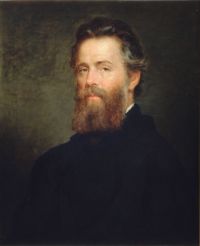 Herman Melville,
Moby-Dick
(1851)
Herman Melville,
Moby-Dick
(1851)
“ In general, the same remark, only within a less wide limit, applies to the solitaries and hermits among the matured, aged sperm whales. So that though Moby Dick had in a former year been seen, for example, on what is called the Seychelle ground in the Indian ocean, or Volcano Bay on the Japanese Coast; yet it did not follow that were the Pequod to visit either of those spots at any subsequent corresponding season, she would infallibly encounter him there. So, too, with some other feeding-grounds, where he had at times revealed himself. ”
Frank Fowler, The Wreck of the "Royal Charter"
“ It would be useless to delay this Narrative for any further particulars from Molfra. One knows so well what the nature of those particulars will be—fresh bodies, more tattered rags, more copper bolts and bars twisted like wire, more iron plates and beams gnawed by the sea as dogs gnaw bones, more recognitions by disconsolate friends of those whom, long ere this, they had hoped to welcome at an English fireside! ”
Herman Melville,
Moby-Dick
(1851)
“ In the distance, a great white mass lazily rose, and rising higher and higher, and disentangling itself from the azure, at last gleamed before our prow like a snow-slide, new slid from the hills. Thus glistening for a moment, as slowly it subsided, and sank. Then once more arose, and silently gleamed. It seemed not a whale; and yet is this Moby Dick? thought Daggoo. ”
 Rudyard Kipling,
The Second Jungle Book
Rudyard Kipling,
The Second Jungle Book
“ There is no meat in this hunting.""Hear the Outlier!" said Mowgli with a laugh. "Free People, we must go north and dig lizards and rats from the bank, lest by any chance we meet the dhole. He must kill out our hunting-grounds, while we lie hid in the north till it please him to give us our own again. He is a dog—and the pup of a dog—red, yellow-bellied, lairless, and haired between every toe! He counts his cubs six and eight at the litter, as though he were Chikai, the little leaping rat. ”
William J. Long,
A Little Brother to the Bear, and other Animal Studies
“ I have found one or two strange winter dens of Mooween, and have followed his trail uncounted miles through the snow when he had been driven out of one hibernaculum and was seeking another in the remote fastnesses, making an unending trail with the evident intention of tiring out any hunter who should attempt to follow him. I have found his bathing pools repeatedly, and watched him in midsummer when he sought out cool retreats—a muddy eddy in a trout brook under the alders, a mossy hollow under the north side of a great sheer [176] ledge—to escape the flies and heat. ”
