Pachyderm

Definition and stakes

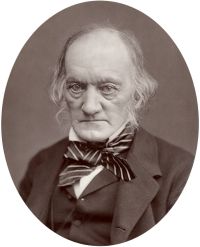
Portrait of Richard Owen Richard Owen,  The zoology of the voyage of H.M.S. Beagle… (1839)

“ If animals so characterized are of small size and seek their food in trees, or if they burrow for roots or for shelter, the vegetable type of dentition must co-exist with unguiculate extremities, as in the Edentata and Rodentia generally: but the largest genus (Hydrochærus) of the Rodent Order, whose affinity to the Pachydermata is manifested in its heavy shapeless trunk, thinly scattered bristly hair, and many other particulars, has each of its toes inclosed in a miniature hoof. ”
Source: Gutenberg

Various,  The Atlantic Monthly, Volume 12…

“ There is, however, one animal now in existence, forming one of those singular links before alluded to between the present and the past, of which I will say a few words here, though its relation is rather with a later group of Tertiary Pachyderms than with those described by Cuvier. On the coast of Florida there is an animal of very massive, clumsy build, long considered to be a Cetacean, but now recognized, by some naturalists at least, as belonging to the order of Pachyderms. ”
Source: Gutenberg

Portrait of Richard Owen Richard Owen,  The zoology of the voyage of H.M.S. Beagle… (1839)

“ The Macrauchenia, however, surpasses these aberrant Ruminants, and equals the Pachyderms in the elevation and extent of its scapular spine: but this process commences about half an inch behind the glenoid cavity, and rises at once to the height of three inches above the plane of the scapula; in which structure we may trace the same tendency to the Ruminant type, as is manifested in the scapula of the Hippopotamus and Anoplotherium; for in most other Pachyderms the spine increases gradually from its extremities to the middle part. ”
Source: Gutenberg

Get perspective with Kwize: daily news enlightened by great literature